
VETHY / CU2700 / PRODUCT AND APPLICATION GUIDE
CU2700 Twin-Rotary Cooling: Connect Compressor Architecture to Cab Comfort
CU2700 combines a twin-rotary compressor with DC inverter operation, brushless fans and independently directed indoor outlets. Recommend the complete package for a cab that can accommodate its rooftop arrangement. Evaluate smoothness and comfort in the occupied vehicle, where mounting, trim and airflow also shape the driver's experience.
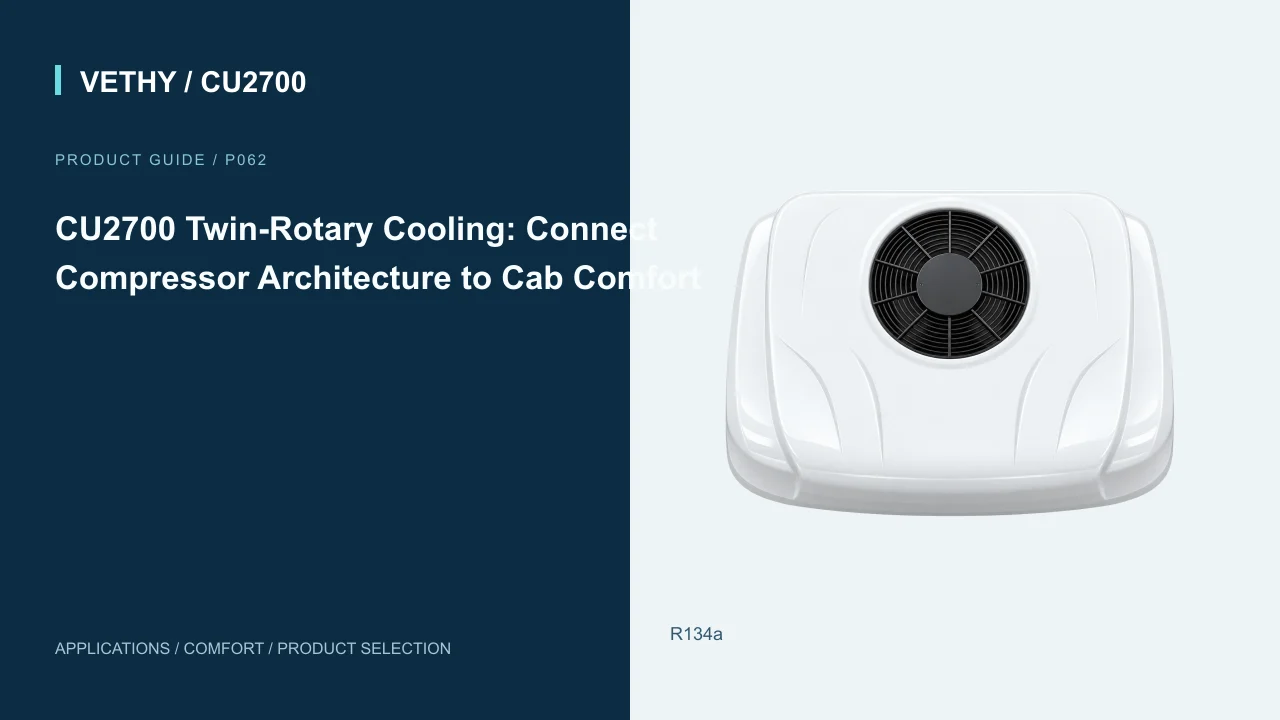
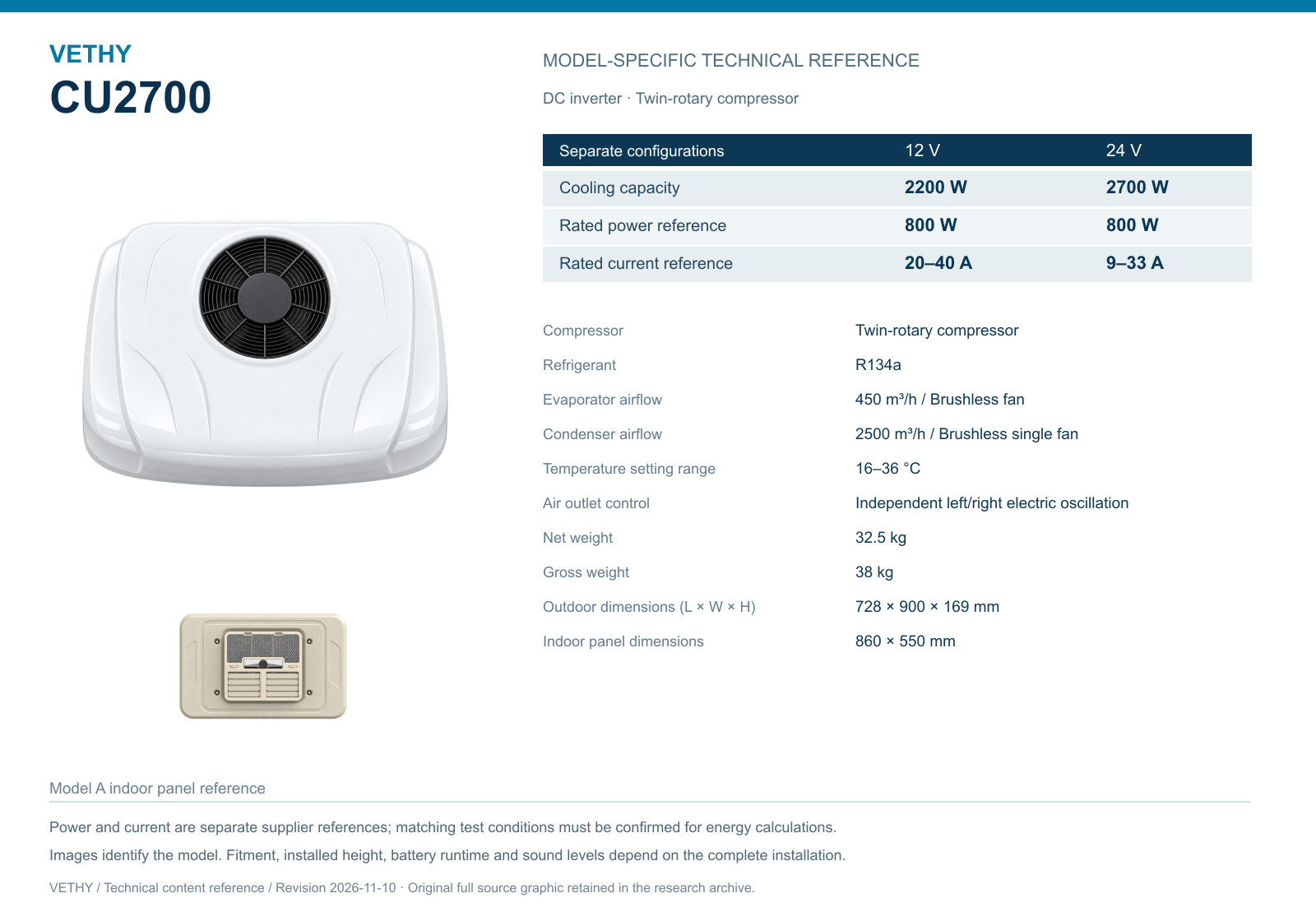
A compressor description becomes useful when it helps a customer understand the cooling product they are buying. CU2700 provides that starting point: its confirmed architecture is DC inverter with a twin-rotary compressor, using R134a. The complete unit pairs that circuit with brushless air-moving components and an indoor panel whose left and right outlets can be directed independently.
For a comfort-oriented truck project, recommend this combination as an organized cooling package. The compressor is central, but the experience at the seat or bunk comes from the whole installation. Understanding that relationship makes it possible to talk positively about smooth operation, changing demand and practical air delivery while keeping the recommendation tied to the actual CU2700 configuration.
Look at three connected layers of the cooling experience
The first layer is the refrigeration equipment. The compressor circulates refrigerant through a circuit that removes heat from cabin air and releases that heat outdoors. The evaporator, condenser, piping and associated controls all belong to the same task. CU2700 identifies the compressor architecture and refrigerant, giving an engineer or distributor a clearer basis for discussion than an unnamed cooling mechanism.
The second layer is regulation and air movement. Cooling demand changes as the cab conditions change, and the indoor and outdoor fans perform different jobs. The inverter description is relevant to the way output can be controlled, while brushless fans and the distribution panel help connect the refrigeration equipment to its surroundings. These are related functions, rather than interchangeable descriptions of one component.
The third layer is the occupied vehicle. Roof structure, interior trim, the position of bedding and the direction of the outlets influence how the driver experiences the equipment. A good recommendation follows all three layers. It begins with the documented architecture and finishes with a person using a particular cab, rather than ending at a compressor label in a brochure.
Understand what twin-rotary identifies
Twin-rotary is an architecture description involving two rotary compression cylinders. It gives the buyer a meaningful distinction from a product described only as a generic rotary unit. The exact compressor model, internal dimensions and control details still belong to the supplied configuration documentation; they should not be guessed from the family name.
For CU2700, twin-rotary is most useful as part of the smooth-operation story. A designer considers the compressor together with its mounting and the assembly around it. The intended result is a cooling package that can work near an occupied space in an acceptable manner. The source identifies the architecture, while the actual vehicle determines what the driver hears and feels.
An importer can use this distinction to improve a product explanation. Name the compressor architecture accurately, show the matching CU2700 outdoor assembly and explain the complete route from refrigeration to cabin comfort. This offers a more substantial recommendation than attaching the same quiet sticker to every product, because the explanation gives the customer identifiable components and a practical application to consider.
Give inverter regulation its own place in the discussion
The terms inverter and twin-rotary describe different aspects of the package. Twin-rotary identifies compressor construction. Inverter describes the electrical drive and its relationship to controllable operation. A useful sales presentation explains both terms without treating either one as a complete measurement of the finished unit's energy demand.
A parked truck can move from a demanding arrival period into a more settled evening. Sunlight diminishes, surfaces cool and the driver may use a smaller occupied area behind a curtain. CU2700's inverter architecture is relevant to a project that needs to respond to that changing thermal situation. The final operating behavior also depends on the ordered controls and the conditions around the unit.
Ask VETHY to identify the control arrangement included in the proposed product rather than borrowing modes from a different air conditioner. The available source does not define a particular minimum speed, firmware strategy or power-saving percentage. The useful product benefit is the opportunity to specify controlled cooling for a changing cab, with the actual configuration clearly documented before an order is finalized.
Translate the component package into customer value
A buyer does not need to become a compressor designer to make a well-informed choice. The important question is how each documented feature helps the proposed installation deliver a useful service. CU2700 provides several connected features that can be explained through ordinary vehicle situations.
| Documented feature | Useful customer discussion | Installation consequence |
|---|---|---|
| Twin-rotary compressor | A clearly identified compression architecture for a smooth-operation product package | Evaluate the complete mounted assembly in the cab |
| DC inverter technology | Cooling demand can change during a parking period | Confirm the requested control configuration and supply conditions |
| Brushless evaporator fan | Air movement through the occupied interior | Preserve the return path and demonstrate useful outlet direction |
| Single brushless condenser fan | A defined outdoor heat-rejection arrangement | Keep intake and discharge paths appropriately accessible |
| Independent electric oscillation | Different air direction on the two sides of the panel | Plan around actual seat and bunk positions |
| Copper evaporator, condenser and piping | Identifiable materials in the refrigerant system | Keep the quoted and supplied configuration consistent |
The table is a way to organize the purchase conversation. It does not assign a separate performance improvement to each component. A customer's benefit emerges when the features work together in a vehicle that has been surveyed and configured for the intended use.
Separate compressor sound from air sound
The driver may describe every unwanted sound as air-conditioner noise, but the installation team benefits from a more specific account. A sound can be associated with the refrigeration assembly, a fan, air passing through an outlet or an interior part responding to vibration. Those possibilities lead to different questions during an inspection or demonstration.
A concentrated stream near the pillow can make moving air prominent even when the refrigeration equipment is operating acceptably. A loose cabinet item can create a rattle that appears only with the vehicle parked in a particular orientation. A roof or trim connection may make an operating change more noticeable. Recognizing these differences helps preserve the value of the product recommendation when a customer describes an unsatisfactory detail.
CU2700's quiet positioning should therefore be supported by attention to the complete cab. The twin-rotary compressor and brushless fans are useful elements of the package, while outlet direction, secure interior fittings and a suitable installation determine how those elements are experienced. A calm resting environment is the target; no single component description establishes a universal sound level at every sleeping position.
Use the panel to avoid unnecessary comfort compromises
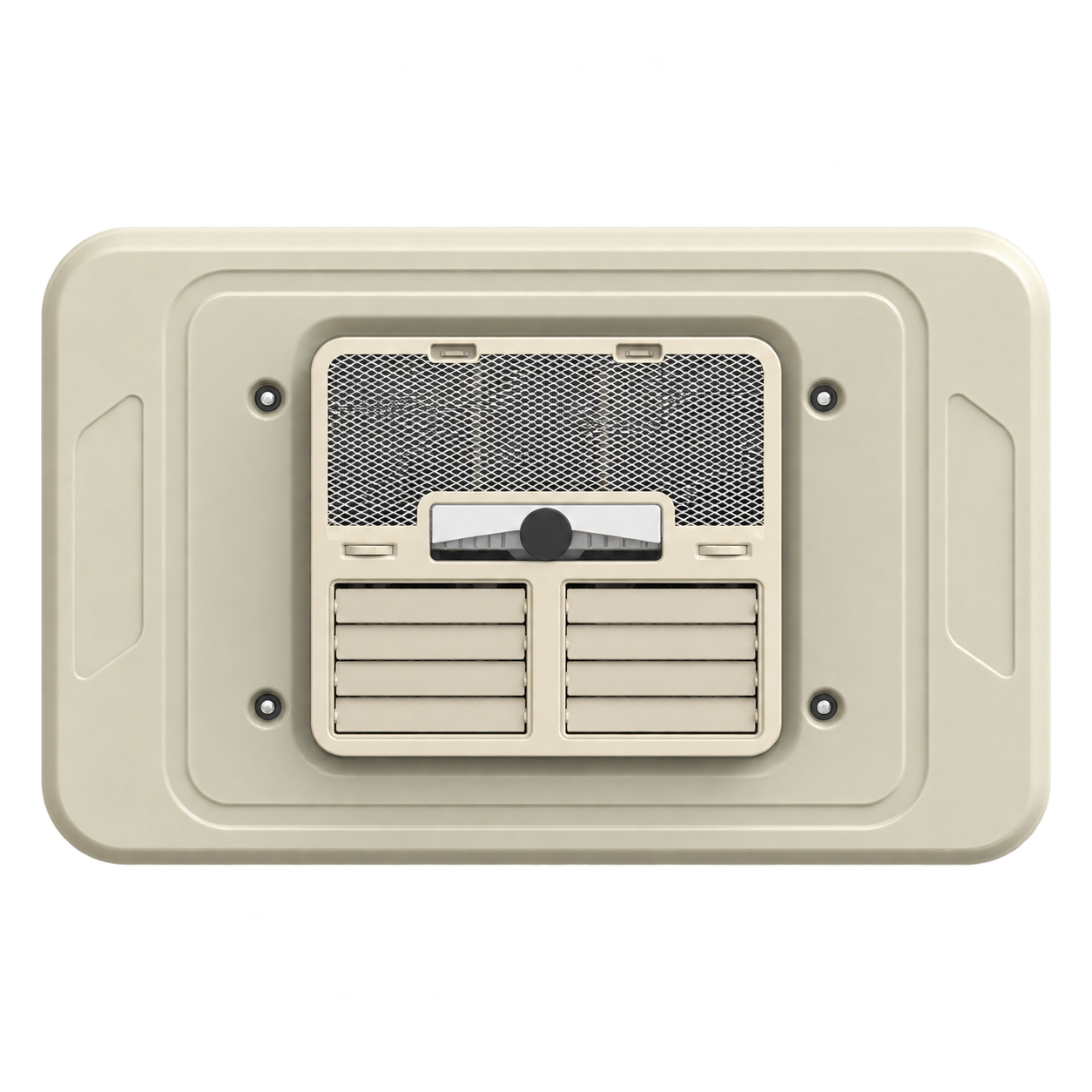
CU2700's Model A panel offers independent left and right electric oscillation. This can help an installation accommodate different preferences without assuming that both sides of the occupied space need the same directed stream. A driver near the bunk might want moving air across the room, while someone seated on the opposite side prefers a more immediate circulation path.
Consider a demonstration with the normal bedding and curtain in place. Show how the two outlets relate to the occupied positions, then ask the customer where the air feels useful and where it feels intrusive. That conversation connects a tangible product function with the person's preferences. It can also identify whether a proposed panel position would place the available adjustment in a sensible range.
The evaporator airflow reference is 450 m³/h, but useful circulation depends on more than that volume. The air needs a path around the interior and back to the unit. A bag placed close to the return or a curtain pulled across the supply path can change the experience. The product's distribution feature is most convincing when it is demonstrated in a layout that resembles the customer's ordinary use.
Keep the roof connection in the comfort story
CU2700 is an overhead installation, so its relationship with the cab structure deserves early attention. The published outdoor envelope is 728 × 900 × 169 mm. Those dimensions allow an initial packaging review, while the roof interface, supporting structure and sealing details require information specific to the vehicle and installation.
The installer should consider how the assembly will be supported and how interior trim will meet the panel. This is not an invitation to improvise mounting details from a general article. It is a reason to treat the roof connection as part of the comfort package being offered. Good mechanical planning gives the named compressor architecture an appropriate environment in which to operate.
For a fleet, retain the approved arrangement so it can be compared with later vehicles. A truck with different roof trim or nearby accessories may require a fresh review even if the cab name appears similar. A repeatable product program comes from understanding those differences, not from assuming that an identical model label removes all installation variables.
Protect the condenser's access to outside air
The outdoor fan moves air through the heat-rejection side of the system. CU2700 lists a 2500 m³/h condenser airflow reference. That reference describes a different air path from the 450 m³/h cabin airflow, and the two should not be combined or shown as a single ventilation figure in sales material.
On a working truck, the outdoor surroundings may change after the AC is installed. A rack, communication device or other accessory can be added close to the assembly. The owner may also use the roof differently from the original demonstration vehicle. These changes deserve consideration because the unit's outside air access is part of its cooling task.
A useful handover identifies the relevant air paths and the need to keep them in the intended condition. It also records how to obtain the correct maintenance information. This supports the product's everyday usefulness without requiring the customer to infer service clearances from photographs. The compressor, fan and heat exchanger are being recommended as a functioning package with an appropriate place on the vehicle.
Keep electrical capacity and useful cooling distinct
The CU2700 reference cooling capacities are 2200 W for the 12V version and 2700 W for the 24V version. Those figures describe the cooling side of the specification. They are different from the electrical energy drawn from a battery during a particular parking period. Keeping that distinction clear is essential when inverter technology becomes part of the buying conversation.
The data also contain a named 800 W rated-power reference and separate current ranges. These references do not establish a common condition for every listed endpoint. A proposal should not divide whichever numbers look most favorable and present the result as measured efficiency. Nor should it use the lowest current entry to promise a full night's operation.
The productive next question concerns the complete assignment: how long the driver is parked, what conditions the cab experiences, what other loads share the supply and what usable reserve is available. A suitable power plan allows the cooling package to serve that assignment. This is the way to make energy-conscious operation a meaningful part of the recommendation rather than a calculation detached from the customer's vehicle.
Explain smooth operation through a realistic example
Imagine a sleeper truck that reaches a rest location in late afternoon. The driver's immediate goal is to make the cab comfortable enough to sit inside. Later, after the curtain is closed, the resting position becomes the main occupied area. The useful recommendation connects CU2700 to those two experiences and the transition between them.
At the first stage, cabin surfaces and sunlight may keep demand comparatively high. At the later stage, the driver may prefer gentler air movement near the bunk and a setting appropriate for rest. The inverter architecture and adjustable distribution are relevant to that changing use, while the exact behavior should be established for the supplied controls and installation.
During a demonstration, let the customer experience those positions and observe the difference between initial arrival and settled use. Record the vehicle configuration if the observations will inform a purchase. The result is practical evidence for that customer, without claiming that an illustrative scene proves a particular noise reduction or fixed energy saving for every CU2700 installation.
Give the service conversation a useful starting point
An accurate product record helps if the owner later reports that the unit feels or sounds different. It should identify CU2700, its voltage version and the installed arrangement. The service team can then connect the customer's observation to the actual equipment rather than starting with a generic description of a rooftop cooler.
Ask where the change is noticed and whether it relates to the occupied position, air direction or surrounding conditions. A sound heard near the outdoor assembly and a sound heard only at the pillow may lead to different inspections. Likewise, weak circulation behind a curtain and a general loss of cooling are different observations, even if the owner initially calls both a comfort problem.
The owner should obtain service guidance through the appropriate support route rather than opening the refrigerant circuit or changing components based on a general product article. The value of this explanation is better communication: a defined model, a clear description of the experience and a technician who can review the relevant installation details.
Use the product images as a consistent reference
The CU2700 outdoor photograph shows the single condenser fan arrangement associated with this model. The indoor panel image identifies the Model A air-distribution reference. Keeping those images together with the correct specification sheet makes the recommendation easier to follow, particularly when a distributor presents several similar rooftop products.
Images are useful for explaining layout, panel location and the relationship between the two assemblies. They do not establish internal compressor dimensions or prove that every visually similar housing contains the same configuration. The quotation and product identification still determine what is supplied. A clear photo is most valuable when it supports, rather than replaces, that identification.
For a repeat order, use the same model-specific image and technical reference in the customer's record. If a configuration changes, show the change explicitly. This avoids a situation in which the customer remembers the right product name but an unrelated photograph or voltage rating has been carried into the order. Consistent product identity strengthens both recommendation and after-sales communication.
Distinguish the fan motors from the compressor description
The CU2700 source names brushless evaporator and condenser fans separately from the inverter twin-rotary compressor. Those descriptions should remain distinct in a professional presentation. A brushless fan moves air; the compressor performs the refrigerant compression task. Calling every component a brushless compressor can obscure what the customer is actually choosing.
This distinction is helpful when a buyer asks about quieter operation. A change in the sound of moving air may relate to the fan or outlet arrangement, while a different operating character from the refrigeration assembly raises another set of questions. Recognizing the two functions helps a salesperson explain the product without pretending that one label resolves every acoustic concern.
It also helps the owner describe a later observation. The person can explain whether the sound changes with the direction or character of the air stream, whether it is heard outside or inside, and whether the surrounding cab has changed. The support team still performs the appropriate diagnosis, but it receives a more useful account than a general statement that the compressor is loud.
Assess the transition as well as the settled condition
A demonstration that shows only one settled moment can leave out the experience the customer cares about most. The driver may notice the period immediately after requesting cooling, the change after closing the curtain or the transition from a seated position to the bunk. Those moments belong in a product discussion about controlled, comfortable operation.
Choose a few ordinary actions from the customer's routine and observe the response of the complete installed unit. Keep the actions appropriate to the supplied operating instructions. The purpose is to understand the experience, not to force the equipment into an improvised laboratory sequence. Identify which parts are driver observations and which are instrumented measurements if both are recorded.
For example, a customer might find the initial air direction comfortable while seated but prefer a different distribution when lying down. The independent outlets offer a tangible way to discuss that preference. Another customer might be more sensitive to a change in operating character after the cab has settled. In each case, the relevant evidence concerns the actual installation and the person's routine, allowing the recommendation to become more specific.
One useful output from this assessment is a short comfort description in the customer's own terms. It might identify the preferred occupied position, the curtain arrangement and the air direction that felt appropriate during the demonstration. Keep that record descriptive and associated with the demonstrated vehicle. It can guide the final panel discussion and the owner's handover without being presented as a product-wide test result. This turns a discussion of compressor architecture into a recommendation that remains connected to the person using the cab.
Questions about the CU2700 compressor package
Does twin-rotary mean the unit contains two separate air conditioners?
No. It describes the compressor architecture within the CU2700 cooling system. The customer is selecting one rooftop cooling package with an indoor distribution assembly, rather than two independent units. Use the model-specific technical information to identify the supplied configuration.
Can a twin-rotary label tell me the sound at my bunk?
It identifies a relevant component architecture, but the bunk experience also includes airflow, mounting and the interior environment. A useful assessment takes place in the intended cab and resting position. Keep any measured or observed result associated with the vehicle and operating condition in which it was obtained.
Is the indoor fan count the same as the outdoor fan description?
The single-fan label identifies CU2700's condenser arrangement. The source separately describes a brushless evaporator fan and a Model A indoor panel. Explain the outside heat-rejection path and the inside air-delivery path separately so the buyer understands the complete package.
What should I send for a recommendation?
Provide the vehicle, available supply voltage, roof photographs, interior layout and typical parking pattern. Explain the occupied positions and any concerns about direct airflow or sound. Those details help VETHY connect CU2700's documented components with the installation the customer actually needs.
Recommend the complete architecture for the right cab
CU2700 is worth considering when inverter twin-rotary cooling, a single brushless condenser fan and independently directed cabin outlets fit the project. The product's value comes from joining those documented features to a suitable roof arrangement, useful circulation and an adequate supply plan. Explore the CU2700 guide collection or send a vehicle-specific enquiry to develop that recommendation around the actual truck.
Product sources
- VETHY CU2700 model-specific technical specifications — VETHY.
- CU2700 technical reference sheet — VETHY.
VETHY product recommendation and application analysis. Specification references identify the selected model and voltage. Installation examples are planning examples; measured project results are identified explicitly when available.
Discuss your CU2700 application
Send your vehicle, supply voltage, occupied space, parking schedule and installation photographs for a model-specific recommendation.
Prepare your vehicle brief ↗