
VETHY / CU2700 / PRODUCT AND APPLICATION GUIDE
CU2700 or a Dual-Fan Rooftop Unit? Choose Around the Installation
Choose between CU2700 and a dual-fan rooftop unit by comparing complete named configurations. CU2700 is an R134a inverter twin-rotary single-fan package; the selected CUDU2700 R410A variant has different cooling and airflow references. Fan count alone does not prove noise, energy consumption or vehicle suitability. Match the selected voltage and installation to the required service.
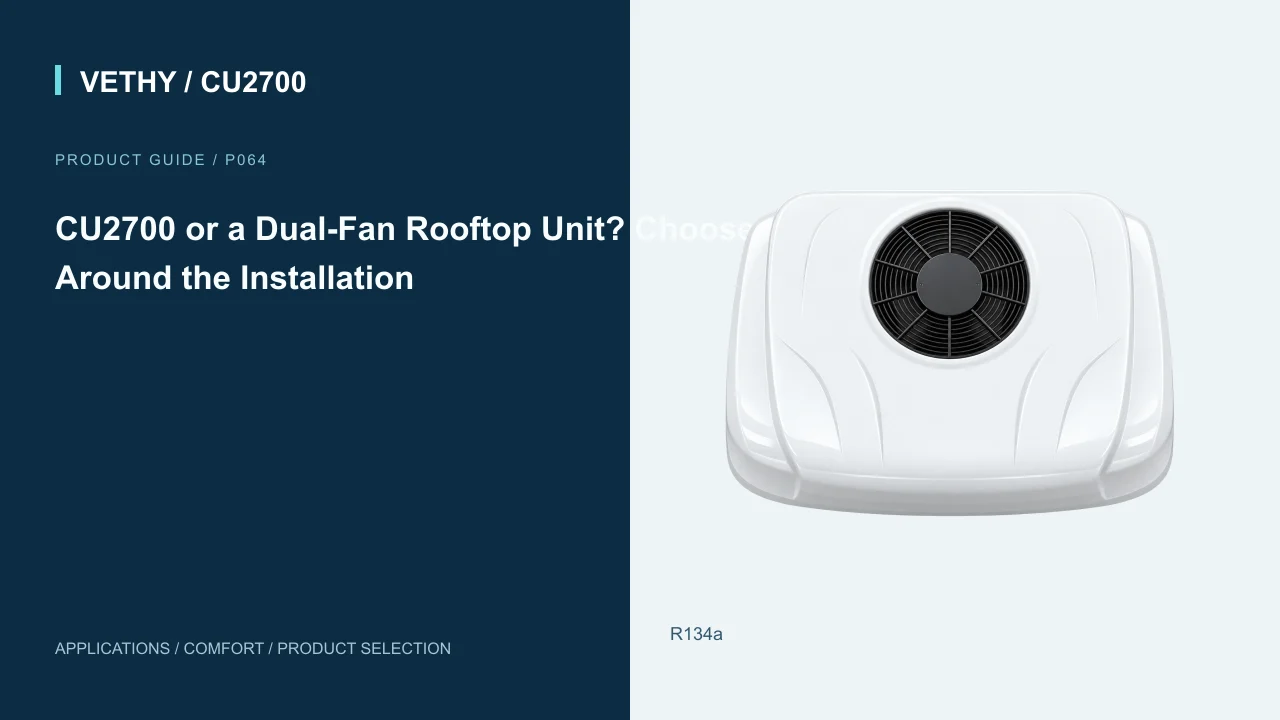
CU2700 is a credible single-fan rooftop choice when its cooling version, indoor distribution and installation requirements fit the truck. A dual-fan model can also be a sensible candidate, but the comparison should identify the actual alternative. Two products with different refrigerants, capacity references and air-moving arrangements cannot be ranked fairly by counting the visible fans in their photographs.
This guide compares CU2700 with the specifically identified CUDU2700 R410A twin-rotary variant. It explains when a buyer might recommend either package and which questions belong to the vehicle rather than the fan count. It does not treat every CUDU2700 version or every dual-fan product as one interchangeable specification.
Choose the comparison boundary before choosing a favorite
The first decision is what the customer needs the cooling installation to do. A driver with a small occupied sleeping zone, a fleet reviewing several roof layouts and an importer building a product range can arrive at different shortlists. Their decisions are not necessarily inconsistent; they reflect different vehicle and commercial requirements.
Describe the occupied space, supply voltage, usual parking pattern and relevant roof equipment. Those inputs establish the service to compare. They also prevent a discussion from drifting between the cooling capacity of one voltage version and the electrical reference of another. A meaningful comparison stays connected to a real configuration throughout.
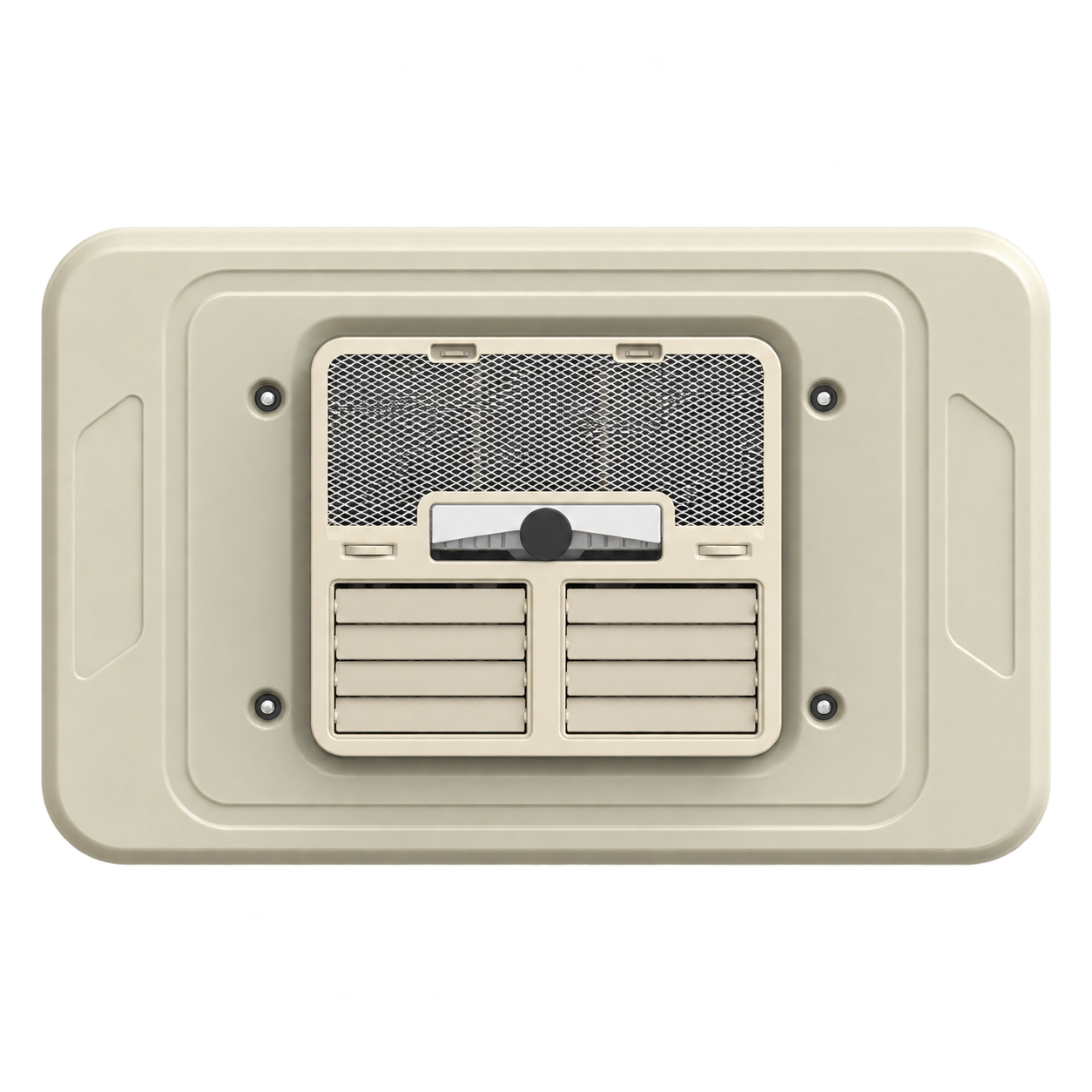
CU2700 should be recommended for the combination it offers: an R134a DC inverter twin-rotary system, one brushless condenser fan, copper heat exchangers and a Model A panel with independent air direction. The selected CUDU2700 R410A alternative brings its own documented package. The buyer can then evaluate which combination is more appropriate for the assignment rather than assuming the larger-looking feature list must win.
Keep the two named configurations distinct
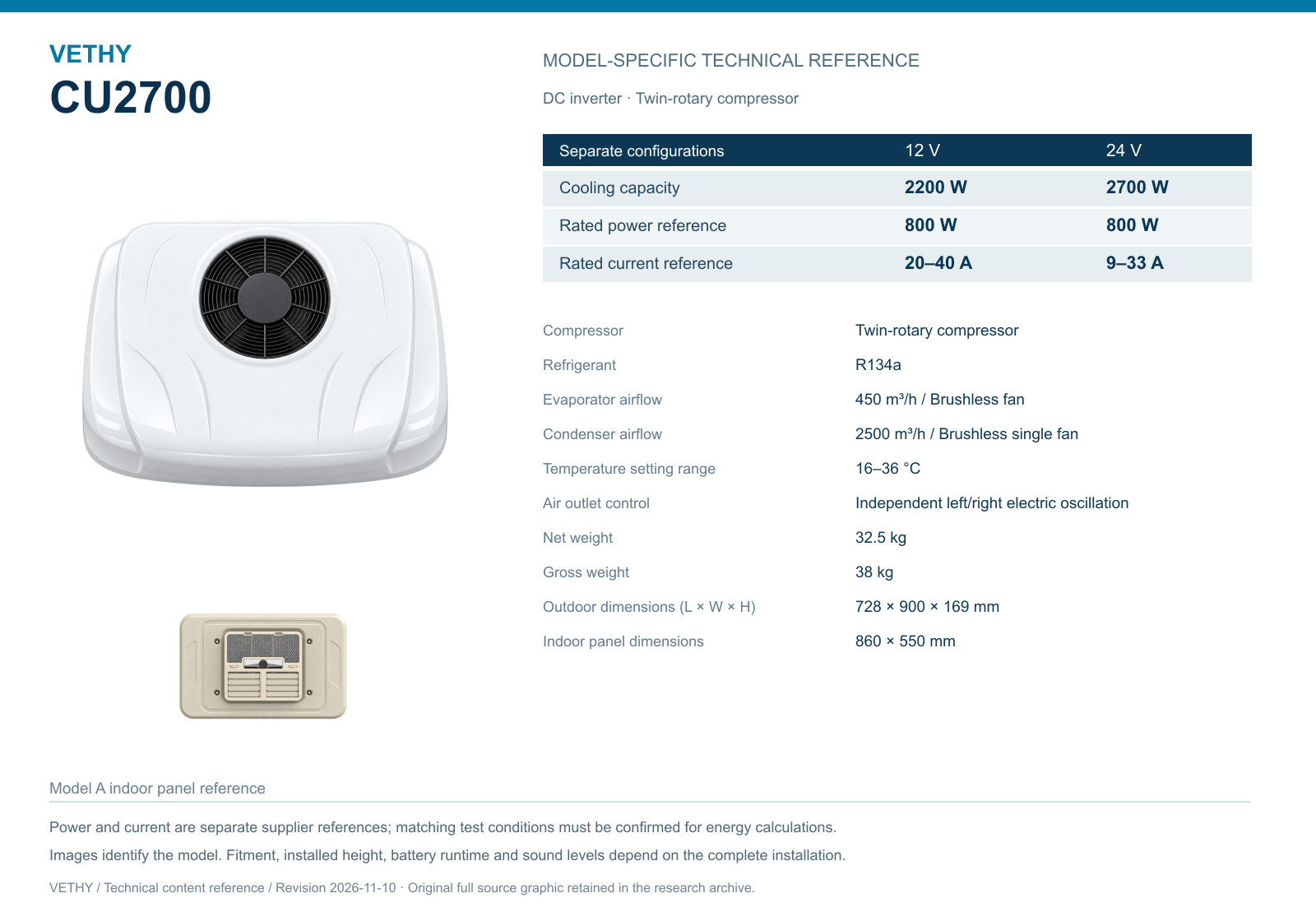
The manufacturer has more than one CUDU2700 configuration in its records. The R410A variant used here lists 2500 W cooling at 12V and 2900 W at 24V. Older R134a CUDU2700 references are different. A quotation should state the selected refrigerant and voltage so the customer knows which product is being compared with CU2700.
CU2700's references remain 2200 W at 12V and 2700 W at 24V, with R134a. A buyer should not replace those values with the R410A variant's figures because the products share family characteristics or a similar physical envelope. Clear naming is part of a credible recommendation and makes later ordering easier.
| Selection item | CU2700 | Selected CUDU2700 R410A variant |
|---|---|---|
| Refrigerant | R134a | R410A |
| Compressor technology | DC inverter, twin-rotary | DC inverter, twin-rotary |
| 12V cooling reference | 2200 W | 2500 W |
| 24V cooling reference | 2700 W | 2900 W |
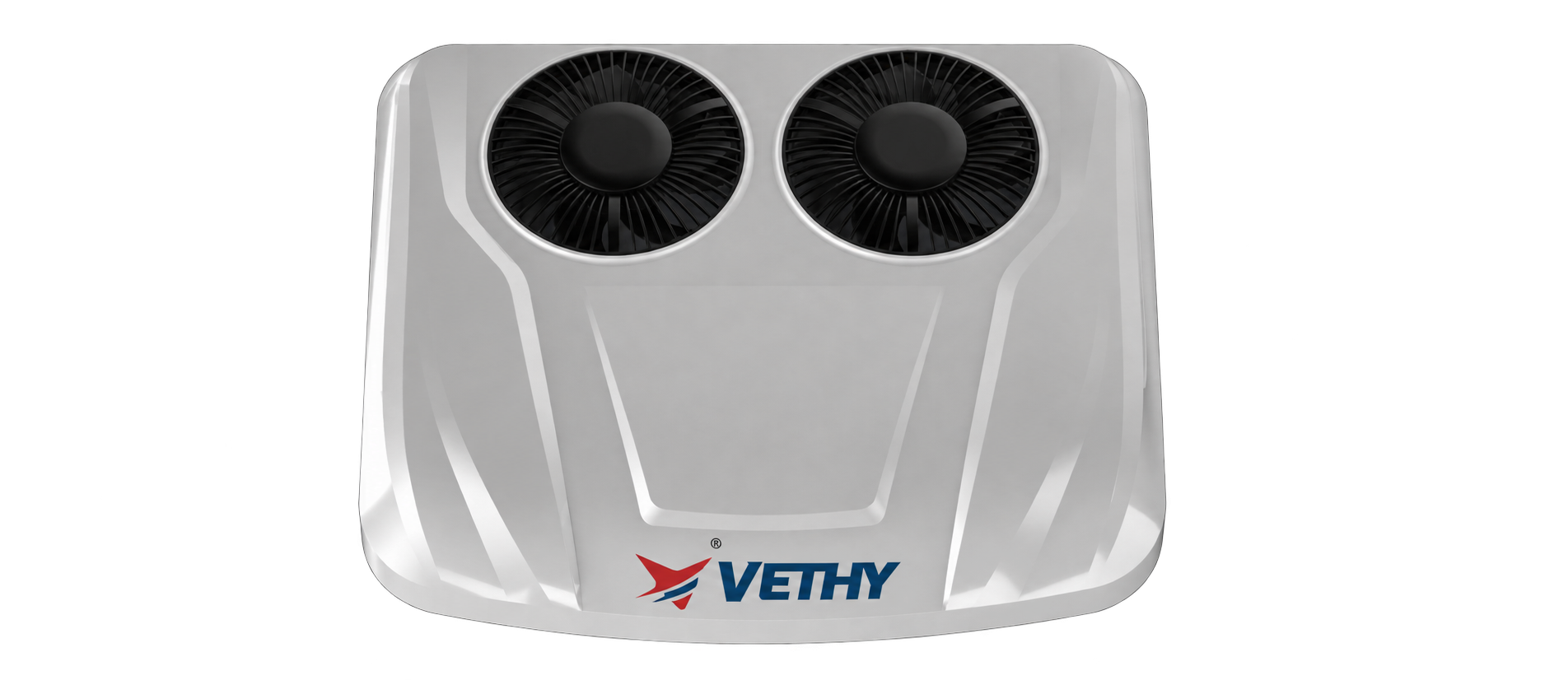
| Condenser fan arrangement | Single brushless fan | Dual brushless fans |
| Condenser airflow reference | 2500 m³/h | 4000 m³/h |
| Evaporator airflow reference | 450 m³/h | 480 m³/h |
| Air distribution | Model A, independent left/right electric oscillation | Model A, independent left/right electric oscillation |
| Outdoor envelope | 728×900×169 mm | 728×900×169 mm |
These are reference facts for the stated products, not a direct comparative test under a common operating condition. They help a buyer identify the candidates and the questions that remain for the particular vehicle.
Recognize the strengths the products share
Both configurations offer a documented inverter twin-rotary architecture. Both describe copper evaporator and condenser components with copper refrigerant piping. Their source records also identify brushless air-moving components and independently directed outlets. These shared features mean the single-fan option should not be presented as if it lacks the family's entire comfort approach.
For a material-focused customer, the named copper components may matter more than the number of outside fans. For another buyer, the indoor panel's ability to direct air toward two different occupied positions may be the feature that makes the installation useful. Recognizing the common ground helps the salesperson focus on the differences that actually influence the purchase.
It also improves comparison material. Use the matching product photographs and the appropriate voltage table for each model. Do not make one candidate appear more complete by showing its full specification while describing the other only by fan count. A fair presentation can be persuasive because it helps the customer understand why the recommended configuration fits their requirements.
Use cooling capacity as a selection reference
The selected CUDU2700 R410A variant has higher listed cooling references than CU2700 at the same nominal voltage. That difference is relevant when evaluating the required cooling task. It should be considered alongside the cabin load, the supply arrangement and the conditions under which the offered unit is expected to operate.
A larger capacity reference is not a complete statement about comfort in a particular cab. Air distribution, starting condition and roof integration still matter. Likewise, selecting the lower reference does not automatically establish that the unit will consume less energy over the customer's assignment. The products and their controls must serve a defined load before a useful operating comparison can be made.
For a buyer whose requirements align with CU2700, its single-fan package remains a reasonable shortlist candidate. If the brief points toward the selected R410A alternative, the higher reference can be part of that recommendation. The useful outcome is an appropriately specified cooling installation, with the choice explained in terms of the vehicle rather than a general preference for the biggest number.
Compare indoor and outdoor airflow separately
The condenser moves outside air through the heat-rejection side of the assembly. The evaporator moves cabin air through the indoor cooling path. These are different functions. The 4000 m³/h and 2500 m³/h condenser references should not be described as fresh-air ventilation delivered to the driver.
Similarly, the 480 m³/h and 450 m³/h evaporator references do not establish how evenly air reaches a particular bunk. They provide useful product information, while the panel location, outlet direction, curtain position and return route shape the occupied experience. A modest-looking difference in a table should not be converted into an unsupported claim that one vehicle will feel a stated amount cooler.
Use the airflow discussion to plan the installation. Show where the outside unit needs access to air and where the cabin stream should travel. Ask whether nearby equipment or normal personal belongings could obstruct either route. This turns the numerical comparison into a practical layout decision, allowing the buyer to understand the real conditions the recommended package needs.
Review the roof even when the envelopes match
Both source records list an outdoor envelope of 728×900×169 mm. Matching enclosure dimensions are convenient for an early packaging comparison, but they do not prove that every mounting, connection or service detail is interchangeable. Obtain the correct installation information for the actual model and order configuration.
The same published envelope also prevents a simplistic claim that the single-fan version necessarily saves roof area. The vehicle still has to accommodate the assembly and its required surroundings. Air intake, discharge and maintenance access extend the layout discussion beyond the basic rectangle shown on a plan.
For a roof with racks, antennas or another accessory, evaluate the complete arrangement for each candidate. An accessory can affect the air path or the technician's approach even if the air conditioner fits between two measured points. The recommendation should therefore identify an installation that remains usable and serviceable after the truck receives the equipment it normally carries.
Avoid assuming that one fan establishes the quieter choice
The sound experienced by a resting driver comes from the complete unit and its connection to the cab. Compressor operation, fan behavior, air direction, roof response and interior fittings can all contribute. The number of visible condenser fans is not enough to establish which installed product produces the preferred sound at the bunk.
CU2700's qualitative quiet positioning gives a distributor a reason to offer a calm-comfort demonstration. The selected CUDU2700 package has its own positioning and components to discuss. Neither should be given an invented decibel advantage simply to make a comparison chart look decisive. A useful assessment records the configuration and lets the customer experience the occupied vehicle.
If the buyer is especially concerned about rest, include the normal curtain and bedding arrangement. Ask what kinds of sound or air movement are intrusive to that person. This can reveal that outlet placement or a trim detail matters more to the decision than the feature initially discussed. The product recommendation then becomes more specific and more useful without depending on an unsupported acoustic ranking.
Compare energy through the same operating service
Both records include a named 800 W rated-power reference and separate current ranges. Their endpoints are not established as a complete set of paired operating measurements. The common presence of 800 W in a table does not prove identical session energy, and the different fan counts do not establish a universal consumption order.
Define the cooling service first: the initial cab condition, occupied zone, time period and relevant surroundings. Then ask for suitable information or a representative assessment of the actual configurations. Include the rest of the electrical arrangement if it affects the proposed service. This provides a sound basis for an energy-conscious recommendation without inventing a percentage difference.
For fleets, separate a one-off demonstration from a repeatable route pattern. The supply must support the normal assignment, including other loads and the planned replenishment between stops. CU2700 may fit that plan well, but the reason should be visible in the complete proposal. The selected product is part of an operating system, not an isolated current value chosen from a chart.
Think about service through the actual supplied assembly
A single-fan unit has a different condenser fan arrangement from a dual-fan unit. That is a useful identification detail for service planning. It does not, by itself, establish repair frequency, component life or the total cost of support. Those outcomes require information beyond the simple count.
A distributor should keep the model, voltage and refrigerant with the customer's installation record. The matching source data and photographs help identify which assembly is present when a service question arises. If several variants are offered, keep their ordering and support references separate so a familiar housing does not lead to the wrong part or procedure.
For an owner, the practical benefit is understandable support. The supplied documents should identify the unit and explain the appropriate contact route. Maintenance access and ordinary air-path care should be part of the installation conversation. A well-defined service arrangement can make either product more convincing than a hardware-only offer whose ownership responsibilities are unclear.
Recommend CU2700 for a deliberately focused package
CU2700 is a useful candidate when its published cooling version aligns with the cab task and the single-fan rooftop arrangement suits the installation. It still brings inverter twin-rotary technology, documented copper components and independently directed cabin air. Those features create a substantial product offer rather than merely an alternative with one fewer visible fan.
Imagine an owner replacing an unspecified rooftop cooler and wanting a clearly identified product, an improved panel arrangement and a supportable installation. The first step is to survey the actual roof and electrical system, not to assume the replacement is interchangeable. If CU2700 fits the resulting brief, the recommendation can explain how its components and air delivery address the owner's priorities.
This is a positive case for the product, but it remains tied to an identifiable vehicle. It does not require a claim that every single-fan configuration is superior or that a dual-fan product would be unnecessary for another customer. A focused package can be the right choice when its documented characteristics match the service being purchased.
Recommend the defined dual-fan alternative when its combination matters
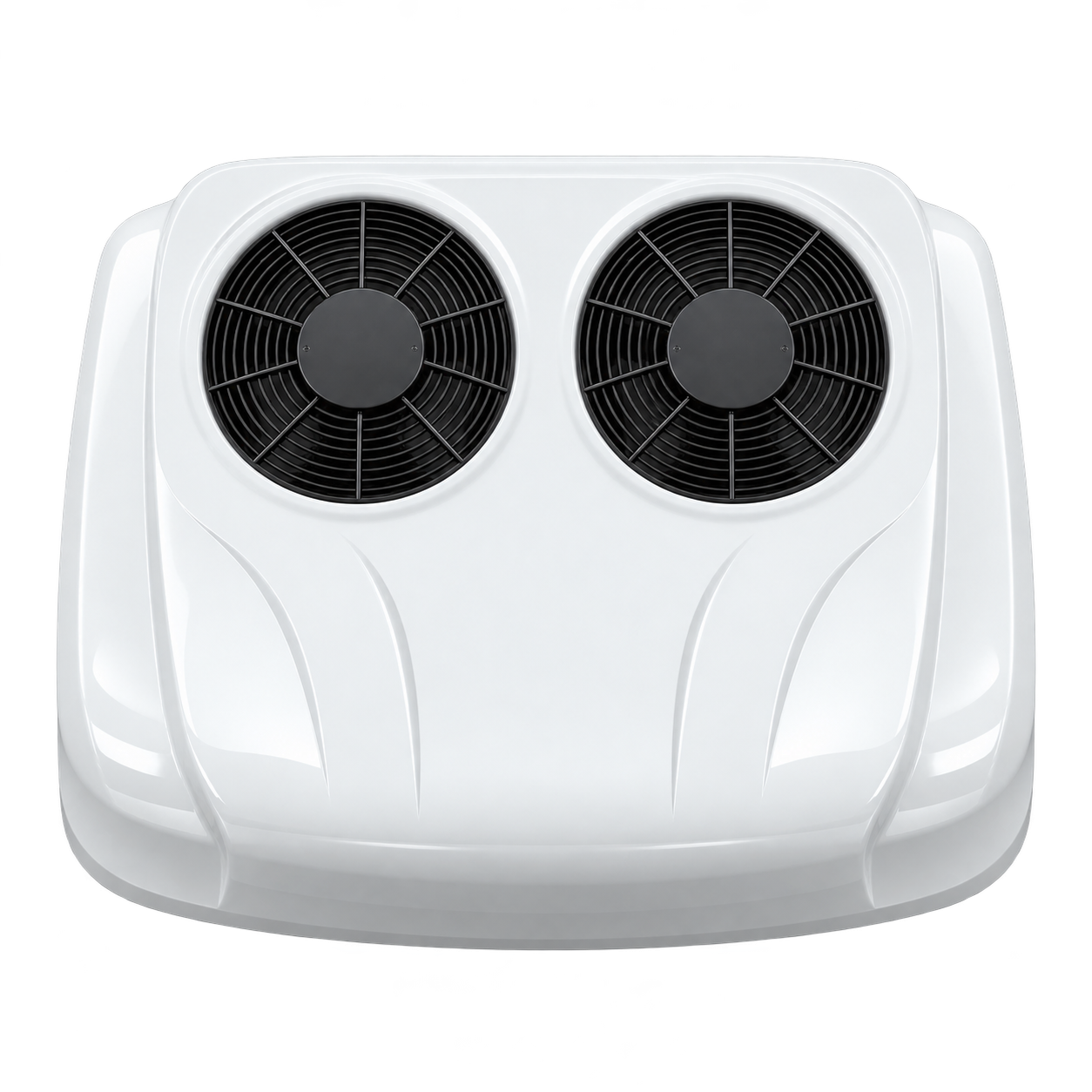
The selected CUDU2700 R410A variant is relevant to a buyer who specifically wants that refrigerant and its listed capacity and airflow package. A recommendation can point to those documented differences while retaining the shared emphasis on inverter architecture, copper components and controlled cabin distribution.
For example, an importer building an R410A product offering should not choose an R134a unit merely because the housings occupy a similar roof envelope. The refrigerant configuration belongs in the commercial and service description. The buyer may also have a particular capacity requirement to discuss with the supplier at the chosen voltage.
The next action is a configuration-specific review, not a conclusion that two fans solve every difficult installation. The CUDU2700 R410A guide collection develops that package in greater detail. Keep the selected variant visible throughout the enquiry so the quoted product matches the one the customer has been considering.
Give both candidates the same quality of demonstration
A comparison is useful only if it allows the customer to assess the question they are actually trying to answer. If one unit is shown in a sun-heated cab and another in a settled indoor display, the observations should not be presented as a direct test of their relative performance. Describe the conditions and identify the limitation.
For a layout decision, matching drawings and vehicle photographs may be the most useful first evidence. For a comfort decision, an occupied installation provides a different kind of information. For an energy discussion, an appropriate measured boundary and operating profile matter. Choose the method that answers the purchasing question rather than collecting impressive-looking figures without a clear purpose.
Customer preferences should remain part of the result. One person may value the material package, another the air direction near a bunk and another a particular installation arrangement. A professional recommendation explains how the preferred candidate addresses those priorities, with the complete model and voltage identified. That is more helpful than a comparison that simply awards points to visible features.
Keep the commercial offers comparable
Ask what each quotation includes. A loose air-conditioning assembly and an installed package with supporting equipment are different offers. List the hardware, agreed installation work and any required vehicle changes according to the actual proposal. This makes price discussions more useful without assuming costs that have not been quoted.
If a detail depends on the vehicle survey, keep it visible as an open item. The supplier should know what information is needed and how the final configuration will be agreed. A photograph of the roof, the supply voltage and a description of the occupied cab can move that review forward much more effectively than a request for the cheapest fan arrangement.
Once the buyer chooses, retain the same model identity throughout the order. The vehicle enquiry guide helps organize the necessary inputs. Accurate product naming and a clear offer make the recommendation easier to review, easier to purchase and easier to support after the equipment reaches the customer.
Include X79 when the buyer wants a dual-fan R134a option
A customer may like the idea of a dual-fan arrangement while wanting to remain with an R134a product. That request should lead to another clearly identified candidate rather than quietly changing the refrigerant stated for the CUDU2700 variant. The X79 reference identifies R134a, DC inverter twin-rotary technology and brushless condenser dual fans, with 2300 W cooling at 12V and 2800 W at 24V.
This does not turn the selection into a contest between three isolated capacity numbers. It gives the customer a more accurate set of configurations to discuss. CU2700 remains the single-fan R134a package, X79 provides a documented dual-fan R134a alternative, and the CUDU2700 configuration used in this article is specifically R410A. The X79 guide library explains that model's own application details.
Keeping this distinction visible is useful for distributors carrying several related products. The customer can choose around a refrigerant requirement, a desired installation and the appropriate cooling reference without receiving a mixture of data from different units. It also makes the eventual order easier to audit: the model name, photograph, voltage and technical record should all describe the same candidate.
Retain the comparison that actually supported the choice
The final customer record should identify what was compared and why one configuration was selected. Keep the model-specific photographs and technical references alongside the vehicle brief. If a layout drawing or installed demonstration influenced the decision, identify that evidence rather than replacing it with a broad claim that one fan arrangement is always preferable.
This record is useful if the customer later adds a different truck or changes the parking assignment. The team can review the original reasoning and see which parts remain applicable. A recommendation that was sound for one cab is then a useful starting point for the next vehicle, with the relevant differences visible. That continuity gives the product comparison lasting value beyond the original purchase conversation.
Questions about single-fan and dual-fan selection
Is CU2700 automatically more economical because it has one fan?
That cannot be established from fan count. Compare the complete configurations serving the same cooling task, with an appropriate electrical measurement boundary. CU2700's inverter package is relevant to energy-conscious planning, but the installation and operating conditions determine the actual session result.
Are CU2700 and CUDU2700 the same refrigerant in this comparison?
No. CU2700 is R134a. The alternative discussed here is the specifically selected CUDU2700 R410A variant, whose capacity references differ from older R134a CUDU2700 records. Name the refrigerant and voltage in the offer so the comparison remains unambiguous.
Does matching outdoor size prove the units use identical installation parts?
The common envelope supports an initial packaging discussion, but it does not approve an interchangeable mounting arrangement. Obtain the installation information for the chosen model and vehicle. Connections, roof interface, air access and maintenance provisions should be reviewed for the actual order.
What is the best reason to recommend CU2700?
Recommend it when its single-fan arrangement, cooling version and complete component package meet the vehicle brief. Its inverter twin-rotary architecture, copper heat exchangers and independent air distribution are meaningful features to consider together. Explain their relevance to the customer's use instead of relying on a general fan-count ranking.
Before accepting an order, ask the customer to name the selected candidate once more using the complete model, voltage and refrigerant description. This is a small step with practical value when several similar-looking units have been discussed. It ensures the final offer reflects the customer's decision rather than an earlier comparison image or a remembered capacity from another configuration.
Make the final choice around the vehicle
The right comparison ends with an identified cooling service and a corresponding product configuration. CU2700 offers a defined single-fan inverter package; the selected CUDU2700 R410A alternative offers a different documented combination. Use the six-model guide library to explore the relevant questions, then share the vehicle details with VETHY so the recommendation can become a complete, reviewable offer.
Product sources
- VETHY CU2700 model-specific technical specifications — VETHY.
- CU2700 technical reference sheet — VETHY.
- VETHY CUDU2700 R410A model-specific specification reference — VETHY.
- VETHY X79 model-specific specification reference — VETHY.
VETHY product recommendation and application analysis. Specification references identify the selected model and voltage. Installation examples are planning examples; measured project results are identified explicitly when available.
Discuss your CU2700 application
Send your vehicle, supply voltage, occupied space, parking schedule and installation photographs for a model-specific recommendation.
Prepare your vehicle brief ↗