
VETHY / CU2700 / PRODUCT AND APPLICATION GUIDE
CU2700: A Single-Fan Inverter Rooftop AC for a Focused Vehicle Brief
Recommend CU2700 when a single-fan rooftop layout, R134a DC inverter twin-rotary cooling and independently directed cabin airflow fit the vehicle. Its documented copper heat exchangers and brushless fans provide a clear product package. Select the 12V or 24V version around the actual cab, roof and auxiliary power arrangement.
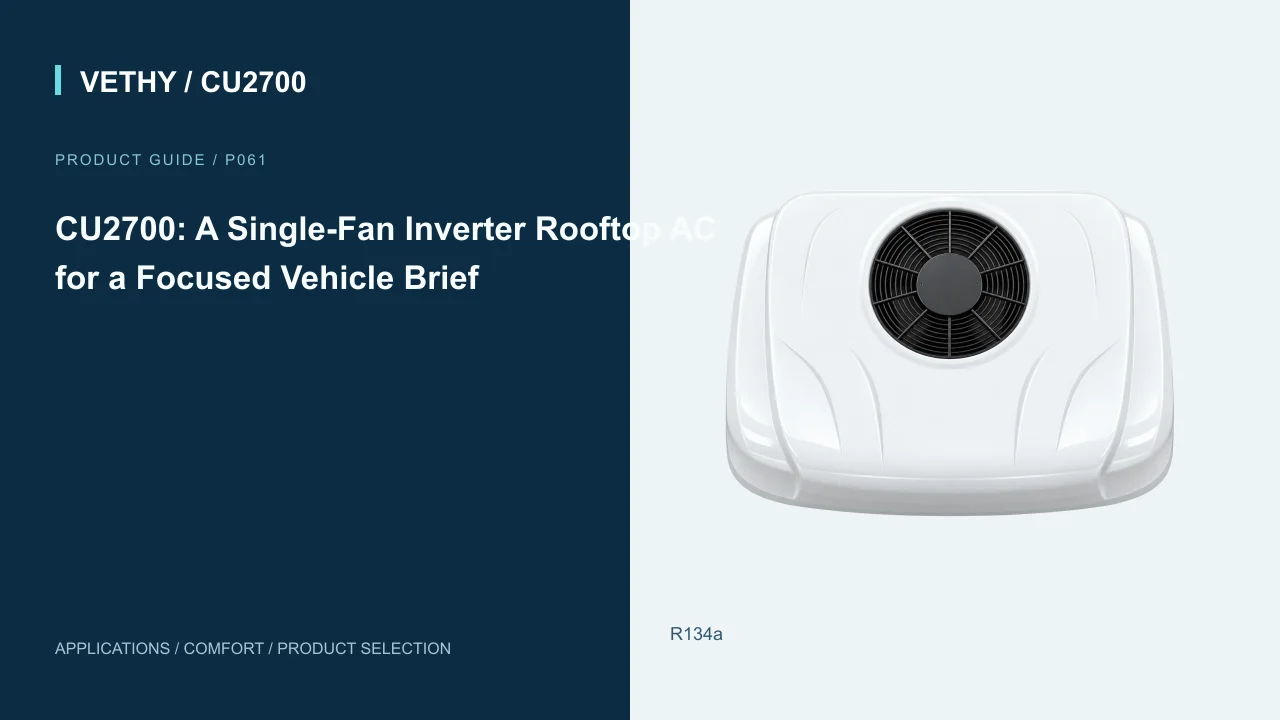
CU2700 is a useful starting point for a buyer who wants an identifiable rooftop parking air conditioner rather than a collection of attractive claims. It combines a single brushless condenser fan with an R134a DC inverter twin-rotary compressor system, copper heat exchangers and a Model A indoor panel. The recommendation is strongest when that package suits the vehicle's roof and the way its driver uses the parked cab.
The single-fan description identifies the outdoor arrangement. It does not reduce the product to a budget category or decide the quality of comfort on its own. CU2700 deserves consideration on the combined merits of its cooling references, controllable air distribution, physical envelope and documented components. Those characteristics give an installer and customer something concrete to plan together.
Begin with the cooling job the vehicle actually needs
A driver waiting between assignments may occupy a different part of the cab from someone sleeping after a long route. The first person might need air movement around the seat and a comfortable working area. The second may close a curtain and spend several hours in the bunk. A suitable recommendation begins by describing that occupied space, the likely parking period and the conditions around the truck.
CU2700 is relevant to projects that can accommodate a rooftop outdoor assembly and an indoor distribution panel. Its physical arrangement keeps the cooling package concentrated around the roof connection. That can be useful when other exterior locations are needed for vehicle equipment or when an installer prefers a defined overhead cooling position.
The useful question is whether that location serves the person inside. A roof area that looks convenient from outside may place the panel behind a curtain or above tall storage. Conversely, a position chosen with the bunk, seat and return-air path in mind can make the package easy to understand. The truck application overview provides a starting point for defining those vehicle and occupancy details.
Identify the voltage version before comparing capacities
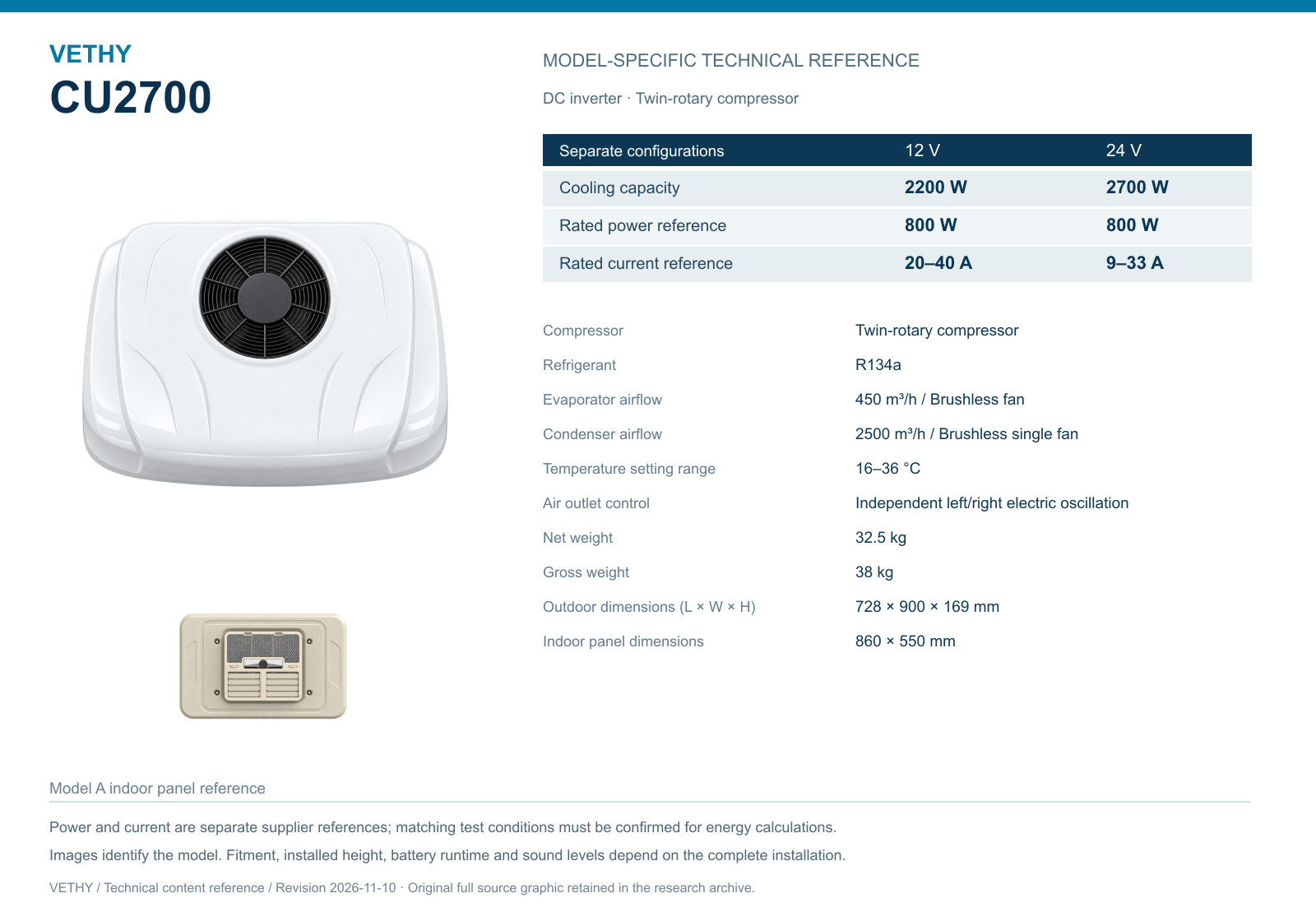
CU2700 has separate 12V and 24V references. The 12V version lists 2200 W cooling capacity, while the 24V version lists 2700 W. A proposal should identify which version is being discussed before it draws conclusions about the electrical arrangement or the cooling task. The model family name alone is not a complete order description.
The following table brings together a few selection facts from the VETHY specification record. These are manufacturer reference values, and their practical use depends on the named configuration.
| Selection question | CU2700 reference | How it helps the buyer |
|---|---|---|
| Which cooling version? | 12V:2200 W;24V:2700 W | Keep the vehicle supply and cooling reference aligned |
| Which compressor architecture? | DC inverter, twin-rotary | Discuss changing demand and the complete control arrangement |
| Which refrigerant? | R134a | Identify the correct supplied circuit and service documentation |
| Which outdoor fan layout? | One brushless condenser fan | Plan intake, discharge and maintenance access around this assembly |
| Which cabin airflow? | 450 m³/h evaporator reference | Review the occupied zone and return-air route |
| Which outlet control? | Independent left/right electric oscillation | Adjust delivery for different occupied positions |
| Which outdoor envelope? | 728×900×169 mm | Screen the roof layout before detailed installation approval |
For an initial conversation, this is enough to connect the product to a real vehicle. Detailed mounting and electrical requirements then belong in the configuration-specific installation information. This progression lets the buyer make an informed shortlist without confusing a specification table with a complete installation drawing.
Understand what the single condenser fan contributes
CU2700's condenser airflow reference is 2500 m³/h. The outdoor unit needs access to surrounding air so that its heat-rejection function can operate as intended. The fan count and airflow reference belong together: the customer is evaluating a single-fan outdoor assembly with a stated air-moving arrangement, rather than assuming any one-fan product behaves like every other.
A single-fan layout can offer a straightforward outdoor configuration to inspect and explain. The installer can show where air enters, where it leaves and how nearby accessories affect the available space. This is a useful commercial benefit because the roof installation becomes tangible during the survey rather than remaining an abstract photograph in a quotation.
Fan count alone does not establish that CU2700 is quieter, more economical or better suited than a particular dual-fan unit. Those questions involve the complete product and installation. The practical recommendation is to choose the arrangement whose capacity, air access and support requirements match the vehicle. A more extensive comparison can use the CU2700 product guide library without turning one visual feature into an unsupported ranking.
Connect inverter operation to the changing parking period
The CU2700 technology description explicitly identifies DC inverter cooling. That matters because a parked cab does not experience a single unchanging thermal demand. Hot interior surfaces, sunlight, occupancy, door openings and the evening transition all affect the cooling service needed over time. An output-control architecture that can respond to changing demand is relevant to that pattern.
For the buyer, the desirable outcome is useful comfort as the conditions settle. The conversation should include how the ordered configuration regulates operation, how the driver requests a comfortable setting and what happens when the vehicle supply reaches its operating limits. The inverter label is a starting point for that discussion, not a substitute for the actual controller specification.
CU2700 is positioned qualitatively around quiet, energy-efficient operation. A persuasive product offer connects that positioning to lower unnecessary cabin heat gain, sensible outlet direction and an adequate supply system. It does not require an invented percentage saving. The value of the inverter architecture is best presented as part of a coherent comfort package that adapts to the work the vehicle is asking it to perform.
Give the twin-rotary compressor a meaningful role
Twin-rotary identifies the documented compressor architecture. It belongs in a discussion of the unit's operating character alongside its inverter control, brushless airflow and mechanical installation. For a distributor, the benefit is a clearly described product platform that can be presented consistently through sales, ordering and service documentation.
The customer still hears and feels the complete installation. The compressor, outdoor fan, indoor air movement, mounting connection and interior trim all contribute to that experience. A competent demonstration therefore includes the occupied cab. Standing beside a running outdoor unit cannot tell the whole story of sound at the bunk or air delivery around a seated driver.
This is where a well-specified product becomes easier to recommend. The salesperson can name the technology confidently, then show how the proposed installation supports the user's comfort. A clear demonstration connects the architecture to everyday use without claiming that every truck will produce the same acoustic result. It also gives the customer an opportunity to express personal preferences before the final panel position is agreed.
Use the copper component description accurately
The CU2700 source identifies a copper evaporator, copper condenser and copper refrigerant piping. Those are concrete material details for buyers comparing otherwise similar-looking rooftop products. They allow a distributor to describe the named heat-transfer components and circuit construction rather than relying entirely on the exterior housing.
The word copper should stay attached to the components the source actually names. It does not mean that the complete housing, every fin, all fasteners or every internal item is copper. Keeping the description precise strengthens the product presentation because it lets the buyer understand what the material specification covers.
A material-focused purchaser can ask for this configuration to remain consistent in the quotation, supplied unit and technical record. That continuity is useful for repeat orders and support discussions. It should not be converted into an unsupported service-life promise or a numerical efficiency advantage over a different construction. The selling point is the documented component package and the ability to discuss it clearly within the complete cooling system.
Make the indoor panel serve the occupied space
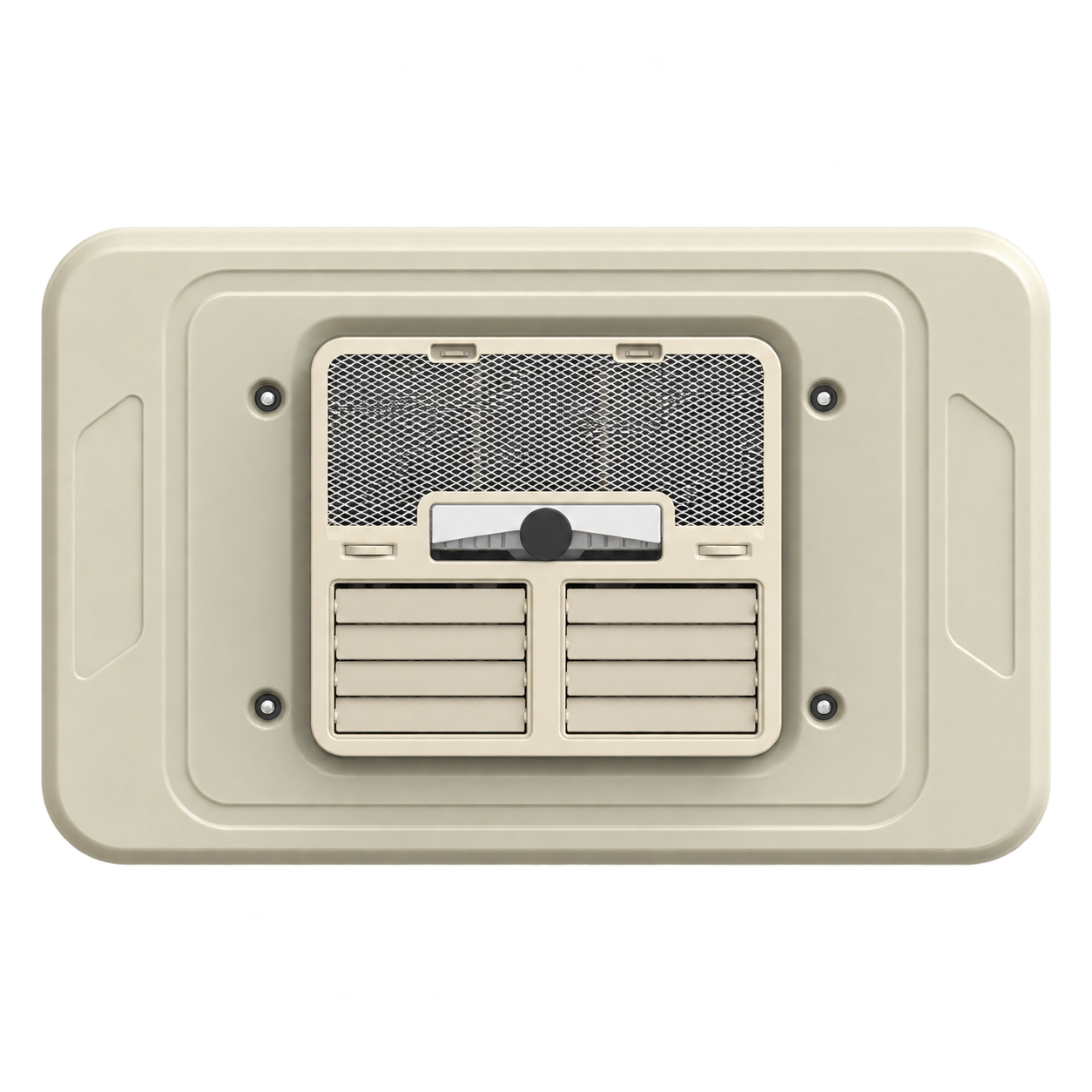
CU2700 uses the Model A distribution panel with independent left and right electric oscillation. The panel reference is 860×550 mm, while evaporator airflow is listed at 450 m³/h. Together, these details provide a practical basis for planning air delivery around a driver's ordinary resting and seated positions.
Independent outlet adjustment is particularly useful when the desired air direction differs across the cab. A person reclining at the bunk may prefer a stream that passes through the occupied space without striking the face. Someone seated nearby may want air movement closer to the upper body. The panel gives the installation team a specific distribution feature to demonstrate rather than promising that one fixed stream will satisfy everyone.
The surrounding layout remains important. Curtains, bedding, jackets and shelves should be considered with their normal positions represented. A clear circulation route allows the delivered air to reach the occupied space and return to the unit. This is a direct way of translating a product feature into everyday usefulness: the customer sees how the panel serves the actual room rather than an empty demonstration cab.
Put the 169 mm profile in the complete roof plan
The outdoor envelope is 728×900×169 mm. A169 mm assembly height is relevant when checking roof accessories and total vehicle height, but it is only one part of the finished installation. Mounting provisions and the vehicle's existing geometry still affect the completed result. The product dimension should therefore appear beside the vehicle survey rather than replace it.
The source also lists a 380×490 mm minimum installation opening reference. That value is useful context, while the actual roof interface requires the installation drawing and a review of the particular vehicle. Panel dimensions, outdoor dimensions and opening dimensions describe different parts of the package and should not be interchanged.
Access should be considered at this early stage. A roof layout that fits the assembly but makes later inspection difficult creates an avoidable ownership problem. Plan how a technician approaches the unit, which accessories share its surroundings and whether ordinary maintenance can be carried out appropriately. A good product recommendation includes this practical relationship between compact packaging and ongoing service access.
Build an energy plan around usable service
CU2700 lists 800 W as a rated-power reference, with current references of 20–40A at 12V and 9–33A at 24V. The current entries carry a 35°C ambient notation. These fields do not provide a common matched operating point from which to calculate a universal efficiency figure or overnight duration.
A useful energy plan starts with the requested parking service and the usable electrical energy made available to it. Other onboard loads and the reserve needed by the vehicle must be included. The expected cooling period then needs a realistic demand profile, including the warmer arrival phase and any later lower-load operation. This gives the installer a meaningful basis for discussing the supply arrangement.
There are practical ways to support an energy-conscious installation without inventing product test results. Keep avoidable sunlight out of the occupied area, use the intended curtain arrangement and avoid unnecessary open-door periods. Direct the air where the person needs it. These choices reduce avoidable work at the vehicle level and help the CU2700 package deliver useful comfort from the energy actually available.
Consider three buyers who can benefit from this package
An owner-driver may find CU2700 attractive when the roof layout suits a single-fan unit and the goal is a clear, self-contained parking-cooling package. The purchase conversation should emphasize the occupied bunk, selected voltage, complete installation scope and an understandable handover. The owner is choosing a daily comfort service with a documented product at its center.
A small fleet may value a repeatable arrangement across a group of similar trucks. CU2700 can be evaluated on a representative vehicle, with the panel position, roof surroundings and electrical configuration recorded. Differences between trucks still need attention, but the successful layout becomes a useful reference rather than relying on memory or appearance alone.
A distributor may want a clearly identified single-fan offering beside other rooftop models. Here the value lies in a precise product explanation: R134a, inverter twin-rotary, copper components, brushless airflow and independently directed outlets. Accurate photographs and the correct voltage table help that explanation remain consistent when an enquiry becomes an order and eventually a service request.
Turn the first demonstration into a usable recommendation
Begin the demonstration with a short description of the vehicle and the customer's intended routine. Show the actual outdoor assembly and Model A panel, then explain where they would sit on the truck. If an installed demonstration is available, let the customer experience the seat and bunk positions rather than observing only from the doorway.
Pay attention to preferences that can influence the layout. The customer may want less direct airflow near the pillow, easier access to a control or a different storage arrangement around the panel. These observations are useful product-selection inputs. They do not require the salesperson to promise a laboratory sound level or a universal duration from a particular battery.
Finish by naming the remaining project decisions. Confirm the voltage version, roof arrangement, included hardware, supply responsibilities and support contact. The vehicle brief guide helps collect the details needed for that next step. A good demonstration should make the proposed purchase clearer, with the customer's comfort expectations linked to the product configuration being quoted.
Decide how the driver will move between occupied positions
The cabin is a small room, but it still has more than one useful position. An owner might sit upright to complete paperwork, lie down to rest and later move back toward the driving area. Each movement changes the relationship between the person and the indoor panel. A cooling package becomes easier to live with when the air-delivery plan acknowledges these ordinary transitions.
During the layout discussion, mark the normal head and upper-body positions on a simple cab sketch. Show the intended curtain position and the places where bags tend to accumulate. The installer can then discuss whether the independent outlets have a useful path toward those areas. This is a practical use of CU2700's distribution features, rather than an attempt to describe comfort through airflow volume alone.
The eventual handover can follow the same sequence. Let the owner see the effect of changing outlet direction while keeping the overall cabin arrangement realistic. A driver who understands how to direct the available air is better placed to explain a later comfort question. The resulting conversation is specific: which occupied position is uncomfortable, what is obstructing circulation, and which layout detail might need attention?
Keep the supply and installation offer understandable
A customer buying CU2700 should be able to identify the air-conditioning equipment separately from the work and supporting equipment needed to install it. The proposal should name the voltage version, outdoor assembly, indoor panel and any agreed installation items. Auxiliary batteries, vehicle electrical changes and roof work belong in the offer according to the actual commercial scope, rather than being assumed from the product photograph.
This clarity is especially valuable when the customer receives several quotations. A comparison between a loose unit and a complete installed package can produce the wrong conclusion if the difference in scope is hidden. A useful offer makes the supplied equipment and responsibilities visible without requiring the buyer to become an HVAC specialist. The product remains the center of the recommendation, and the supporting work explains how that product becomes usable in the truck.
Record any project detail that remains provisional. A roof survey or an electrical review may determine the final arrangement. Stating the open item and the information needed to resolve it is more useful than leaving a general promise in the quotation. It also allows a distributor to move a serious enquiry forward with a defined next action and a clear contact for the customer.
Retain an installation record that helps the next owner
A well-presented CU2700 package should remain identifiable after the original purchasing conversation has been forgotten. Keep the model and voltage with the truck's service information, together with the installation layout and relevant supplied documentation. Photographs showing the completed roof surroundings and indoor panel location can be useful references when the vehicle later receives storage, communications equipment or other accessories.
The purpose is continuity of useful service. A future technician can see which unit is present and how it was incorporated into the vehicle. A fleet can compare a reported problem with the approved arrangement. An owner selling the truck can explain the cooling installation accurately. These are practical ownership benefits of buying a defined product package with supporting records, even though they do not imply a particular service life or warranty term.
Questions about choosing CU2700
Is a single condenser fan enough for my vehicle?
Fan count by itself cannot answer the vehicle-fit question. Review the selected version's cooling reference, the cab load and the complete outdoor air path. CU2700 lists 2500 m³/h condenser airflow with its single brushless fan. A vehicle-specific review establishes whether the configured package meets the required cooling service.
Can I order 12V and 24V as if they have identical output?
The published capacity references differ:2200 W for 12V and 2700 W for 24V. Keep the chosen version explicit through the quotation and installation record. Electrical supply planning should use the appropriate product information rather than transferring a convenient number from the other voltage column.
What makes CU2700 worth recommending for comfort?
Its documented combination includes inverter twin-rotary cooling, brushless fans and independent left and right air direction. These are useful features to build around an occupied cab. The strongest recommendation also includes panel placement, clear circulation, suitable mounting and a supply arrangement designed for the intended parking period.
Does quiet positioning establish a particular decibel rating?
No verified sound number is supplied in this specification set. The qualitative positioning supports a comfort-focused product discussion, while the installed sound should be evaluated in the relevant cab. If measured results are provided for a project, retain the configuration, operating condition and observation position with those results.
Choose CU2700 as a complete, identifiable installation
Recommend CU2700 when its single-fan rooftop arrangement, R134a inverter twin-rotary architecture and independently directed air delivery match the vehicle brief. Its documented copper components, brushless airflow and low outdoor profile provide specific reasons to consider the package. The next step is to connect those strengths to the customer's roof, supply system and occupied space so the quotation describes a product the customer can understand and use.
Product sources
- VETHY CU2700 model-specific technical specifications — VETHY.
- CU2700 technical reference sheet — VETHY.
VETHY product recommendation and application analysis. Specification references identify the selected model and voltage. Installation examples are planning examples; measured project results are identified explicitly when available.
Discuss your CU2700 application
Send your vehicle, supply voltage, occupied space, parking schedule and installation photographs for a model-specific recommendation.
Prepare your vehicle brief ↗