
VETHY / CU2700 / PRODUCT AND APPLICATION GUIDE
CU2700 and Changing Cooling Demand: Plan for the Whole Parking Period
CU2700's DC inverter twin-rotary package is relevant when cooling demand changes during a stop. Build the plan around arrival conditions, occupied space, door openings and later rest. Pair its independently directed airflow with a suitable auxiliary supply, then assess the complete session rather than treating one current reference as average consumption.
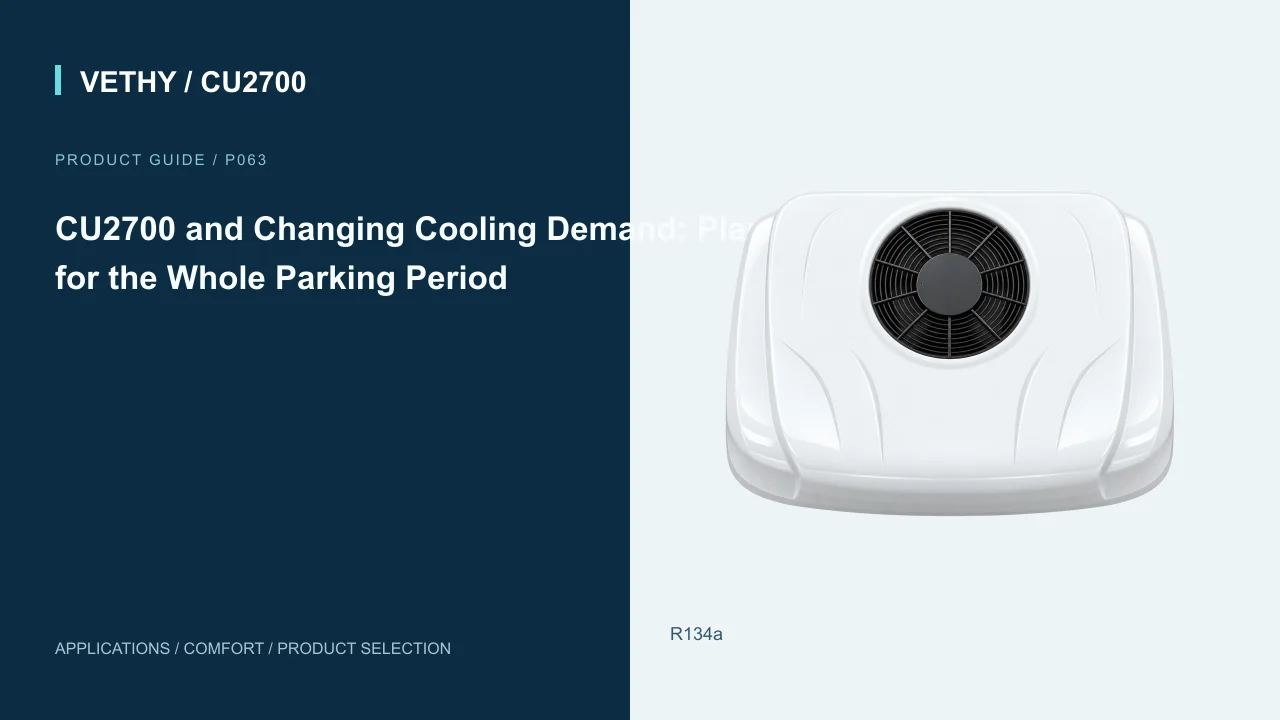
CU2700 is worth recommending to a driver or fleet that wants to plan parking comfort as a sequence of real situations. The cab may begin warm from sunlight and driving, become more comfortable during a meal break and then serve as a smaller sleeping space behind a curtain. Those stages ask different things of the air conditioner. A useful energy conversation follows the sequence instead of giving the whole stop one assumed electrical demand.
The CU2700 product package offers DC inverter twin-rotary cooling, a brushless indoor fan and independent left and right outlet direction. These features give the installation team a defined system to place within that changing routine. Their value becomes clearer when the recommendation describes what happens from arrival through departure, with the selected voltage version and the available supply kept explicit.
Describe the whole stop before selecting an operating assumption
A parking period is not necessarily a continuous sleep period. A driver may first unload belongings, leave the door open briefly, eat inside and complete paperwork before preparing the bunk. Another person may arrive after sunset and move directly into a curtain-enclosed resting area. Although both customers request parking air conditioning, their cooling demand can develop differently.
Ask the customer to describe a normal stop in ordinary language. Where is the truck parked? Which parts of the cab are used? When are doors opened? Does the person move between the front seats and bunk? These details reveal the service the equipment is expected to provide, without requiring the customer to estimate an engineering load at the first enquiry.
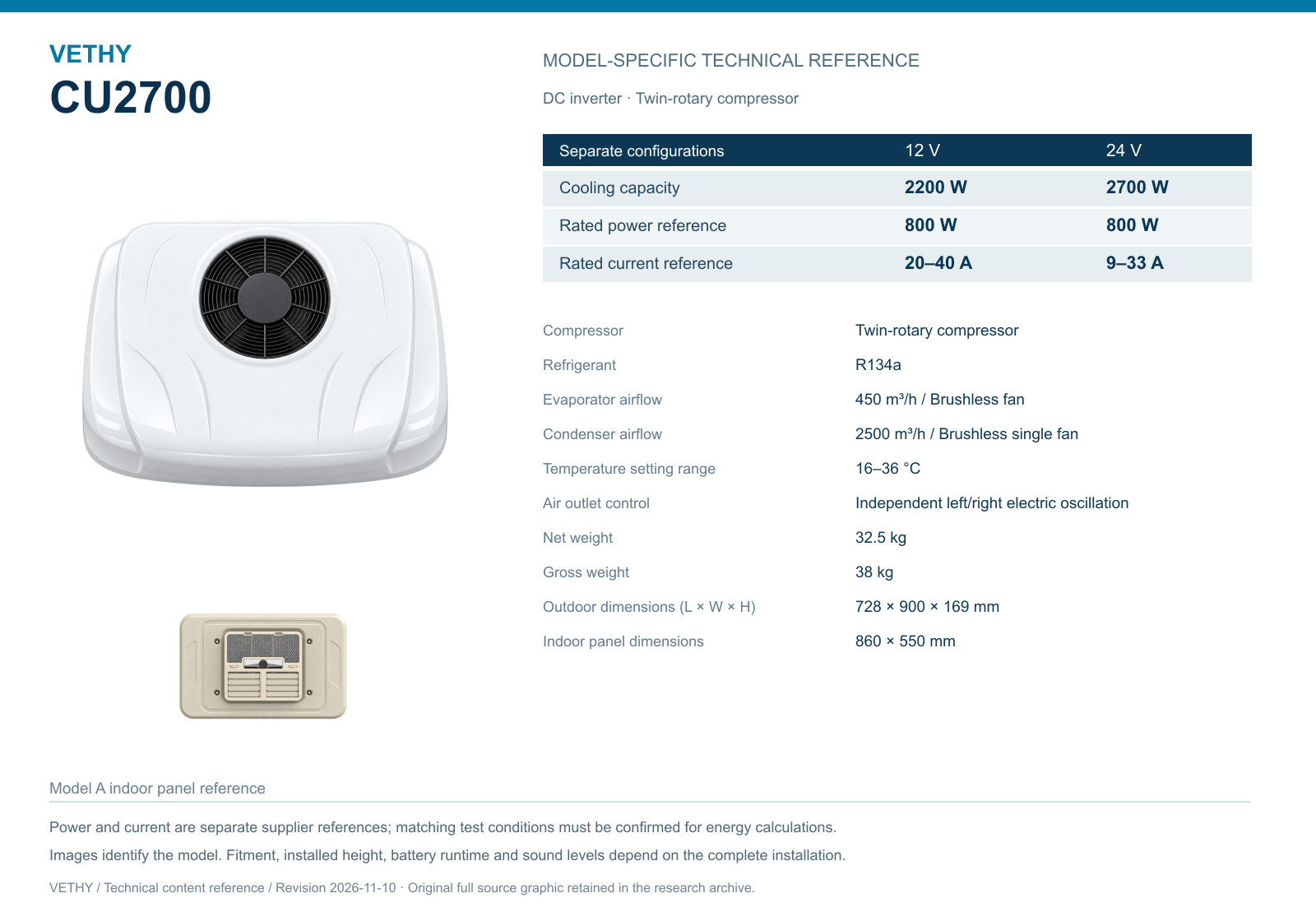
CU2700 can then be considered as a particular package serving that routine. The 12V reference capacity is 2200 W, while the 24V reference is 2700 W. Neither capacity predicts the entire energy history of a parking stop. They identify the cooling versions available for a project whose changing conditions still need to be understood.
Recognize the difference between warm air and stored cabin heat
After strong sun exposure, the cab contains more than warm air. Seats, trim, bedding and other interior surfaces can also be warm. The driver may feel a cool air stream before the whole occupied area becomes comfortable, because those surroundings remain part of the experience. This helps explain why a product demonstration should describe the starting condition rather than relying only on an outlet impression.
For the arrival phase, focus on delivering useful cooling while managing avoidable heat entry. Follow the supplied operating instructions and keep the intended indoor circulation path open. Let the cabin arrangement resemble actual use so that bags and curtains are not absent from the demonstration but present in the customer's working truck.
The recommendation should avoid promising a particular pull-down time from the capacity figure alone. A clear explanation of the arrival phase can be more useful to the customer: the equipment starts serving a cab with its own exposure history, and the driver can help by using the planned occupied zone and air path. That is a practical partnership between the product and the way the vehicle is used.
Connect inverter cooling with a changing load
CU2700 is explicitly described as a DC inverter product. In a variable-speed architecture, the drive provides a way to regulate compressor operation as part of the complete control system. This is relevant when the cooling task changes over time, rather than remaining fixed at the initial arrival condition.
As sunlight declines and the interior settles, the desired service may shift from initial cooling to maintaining a comfortable occupied area. The buyer can ask how the ordered CU2700 configuration responds to that transition and how the driver should request the intended comfort. The product source identifies the technology but does not supply a detailed speed map or a particular control-mode schedule.
The benefit to pursue is useful, controlled comfort across the session. An inverter label does not establish the lowest possible battery consumption in every cab, but it gives the project a relevant architecture around which to discuss changing demand. The stronger recommendation combines that architecture with a sensible cabin routine, an adequate power plan and the correct supplied controls.
Divide the stop into useful planning stages
The following stages are examples for discussion, not a required CU2700 operating sequence. A short regional stop may include only the first two. An overnight sleeper assignment may add several later changes. Select the stages that represent the customer's actual use.
| Stage | What may change in the cab | Useful planning question |
|---|---|---|
| Arrival | Warm surfaces, sunlight and door activity | What condition does the cooling session start from? |
| Settling in | Luggage is stored and the driver occupies the seat | Is the stream reaching the occupied position? |
| Preparing the bunk | Curtain and bedding move into their normal arrangement | Are supply and return paths still clear? |
| Resting | Lower activity and different airflow preferences | How does the supplied controller support comfortable settled use? |
| Waking | The person sits up and may open the curtain | Does air direction need to change with the occupied zone? |
| Departure | Other vehicle services become active | How is the cooling session ended within the vehicle's operating plan? |
This table makes the energy discussion concrete without pretending to know the power at every stage. It also identifies where the customer can provide useful observations. A salesperson can develop a model-specific recommendation from those details instead of transferring another driver's battery result to a different truck.
Put air distribution to work as the occupied zone changes
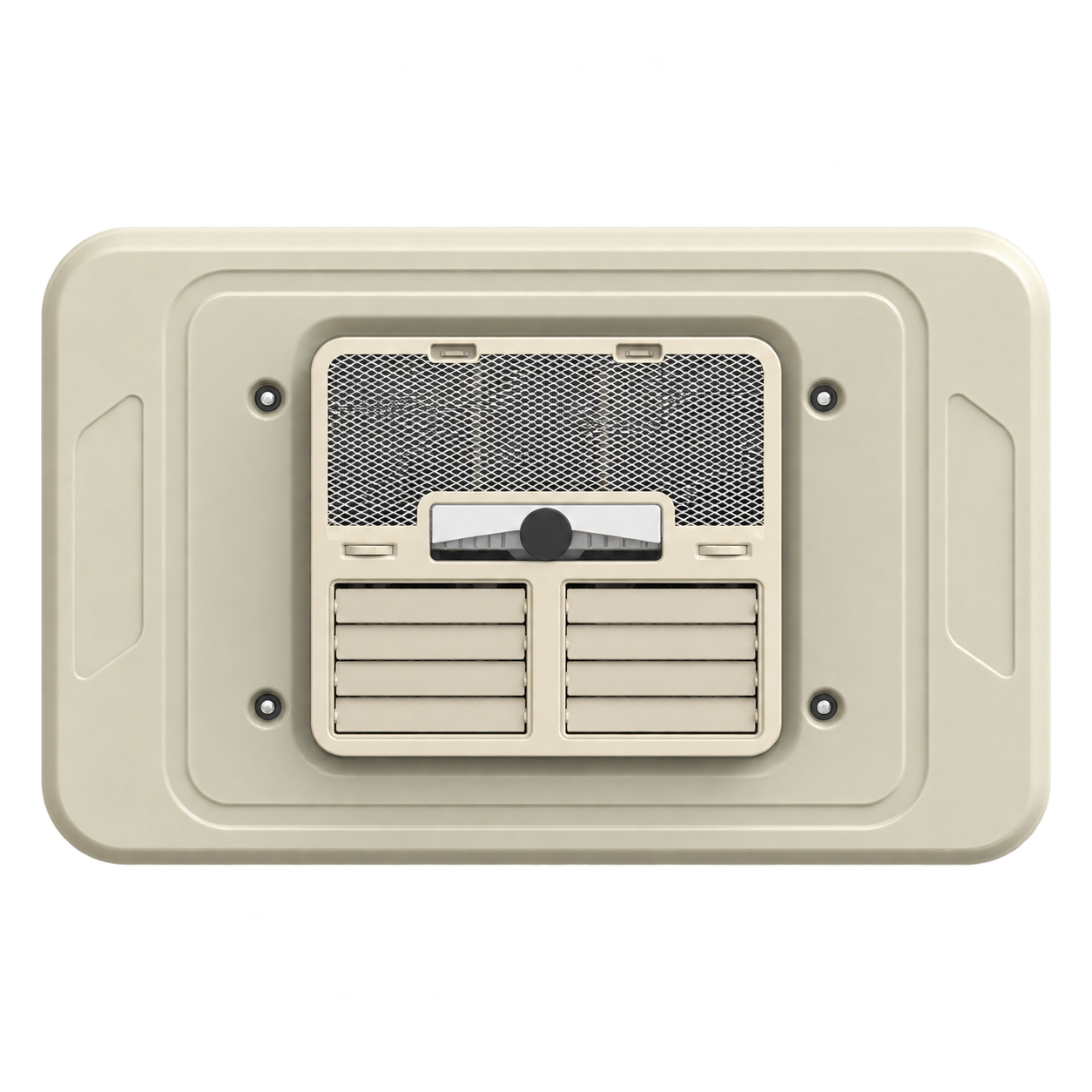
The Model A panel has independent left and right electric oscillation. That feature is relevant when one part of the cab is occupied during an early stage and another becomes important later. It gives the driver a way to discuss and adjust the direction of available air rather than expecting one fixed stream to suit every posture.
Consider a driver who first sits at the front and later lies down across the sleeper area. During the layout review, identify both positions and the normal curtain arrangement. A useful panel position should allow the available outlet adjustment to serve those zones appropriately. The installer can demonstrate that relationship with the customer rather than deciding it solely from an exterior roof photograph.
Good distribution can make the cooling already being produced more useful to the person. It does not create additional rated capacity, and it should not be sold as a measured power reduction without evidence. The practical value is clear enough: air reaches the occupied space, the person can avoid an intrusive direct stream, and the chosen setting can be discussed in terms of comfort rather than a cold spot near the panel.
Reduce avoidable demand before judging the energy result
The vehicle can impose extra work on the cooling package through sunlight, repeated door openings or an unnecessarily large occupied zone. Some of these conditions are part of the assignment and must be accommodated. Others can be reduced through ordinary choices that the driver and installation team agree in advance.
For example, a suitable shade or curtain arrangement can limit the area being conditioned when only the bunk is occupied. The arrangement must still respect the air paths and vehicle requirements. A curtain pressed against an outlet may undermine the very circulation the installation needs. The useful approach is coordinated layout planning, rather than adding isolation measures without considering the indoor panel.
These choices are companions to CU2700's inverter package. They help make the requested service more deliberate, particularly during the later part of the stop. Describe them as ways to avoid unnecessary load at the vehicle level. They should not become a fixed percentage saving attributed to the product simply because a different cab or a different evening happens to draw less energy.
Read the electrical references without turning them into a session average
The CU2700 record lists a named 800 W rated-power reference. It separately provides 20–40A for 12V and 9–33A for 24V, with the current entries associated with 35°C ambient. These fields help identify the manufacturer's reference information, but they do not establish a common matched test condition for every value.
The smallest current entry is therefore not a promise about average consumption throughout a warm arrival and a full resting period. The largest reference is not automatically the exact demand at every moment either. A changing cooling task needs an appropriate operating profile or measurements from the representative installation. Treating one isolated number as the whole session can make the energy plan look precise while hiding its main uncertainty.
For a serious enquiry, provide the intended duration, exposure, occupied zone and other onboard electrical loads. Ask for the relevant configuration information and a suitable way to assess the proposed service. This keeps the product's electrical references useful while directing the purchasing decision toward the actual vehicle assignment.
Use a transparent arithmetic example when comparing stages
Suppose an imaginary cooling installation averages 0.70 kW during its first hour,0.45 kW during the following two hours and 0.30 kW during another three hours. The respective energy amounts would be 0.70 kWh,0.90 kWh and 0.90 kWh. Their sum is 2.50 kWh across the six-hour illustration.
These numbers are invented to explain the method. They are not CU2700 measurements, a suggested control sequence or a prediction for a particular battery. The point is that energy combines demand and time. A lower-demand stage can remain important when it lasts longer, while a brief demanding phase may contribute less than its headline power suggests.
If a fleet uses a staged calculation, it should keep the source and measurement boundary of each input visible. The electrical system may have other loads and losses outside the chosen point. Those should be accounted for coherently rather than added twice or omitted. A transparent example is useful because it shows which information is needed next, not because its invented total becomes a product performance claim.
Include the rest of the vehicle in the available-energy discussion
An auxiliary supply may also serve lighting, communications equipment, personal devices and other agreed loads. The usable energy available for cooling depends on the complete arrangement and the reserves required by the vehicle. Nominal battery capacity alone does not identify the service that can safely be allocated to an air conditioner throughout a particular stop.
The purchasing brief should state which loads share the system and who is responsible for the power design. A professionally defined arrangement gives CU2700 the support needed to perform its intended job. It also helps avoid a later misunderstanding in which the air conditioner is expected to compensate for an energy plan that did not include the rest of the cab.
For repeated operations, replenishment matters as well as the energy used during one stop. Ask how the vehicle restores the energy allocated to cooling before the next similar assignment. A single successful demonstration does not automatically describe consecutive days with different driving and parking patterns. The goal is a repeatable service for the customer's route, with the selected product and supply arrangement understood together.
Make a session record useful to both the driver and fleet
A practical record does not have to begin as a complex spreadsheet. It can identify the truck, CU2700 voltage version, arrival condition, occupied positions and major changes during the stop. Where electrical measurements are collected, note the measurement point and which loads are included. That makes the record interpretable when someone reviews it later.
Driver observations should be retained alongside the technical information. A measured energy total does not reveal whether air reached the bunk comfortably or whether the curtain obstructed circulation. Likewise, a report that the cab felt comfortable does not establish the electrical energy used. Both types of information are useful when their meanings remain clear.
The resulting record helps the team refine the recommendation. It can reveal that the chosen panel position works well, that a particular storage habit needs attention or that the representative parking assignment is different from the original brief. CU2700 remains the identified product at the center of the assessment, while the observations explain how it serves that vehicle's routine.
Discuss quiet comfort over time, not only at one moment
A customer interested in calm rest may care about changes in the operating experience as much as the sound during one settled observation. Air direction, fan character and the surroundings can become more noticeable when the person moves into the bunk or the background environment becomes quieter.
The inverter twin-rotary package and brushless airflow are relevant features to present, while the completed cab provides the place to assess their practical result. Let the person experience the normal resting position and ordinary belongings. If an observation is shared with other buyers, retain its context so a personal impression does not become a universal numerical acoustic claim.
This time-based approach fits the article's energy discussion. The desired service changes through the stop, and so do the person's priorities. A good CU2700 recommendation addresses those transitions through layout, controls and clear expectations. It is not limited to proving that cold air emerges from the outlet while the vehicle is empty.
Decide what the initial order should make explicit
Name CU2700 and the selected voltage in the quotation. Identify the supplied panel and the installation scope agreed with the customer. If the offer includes supporting electrical equipment or workshop work, describe those items as part of the actual package. The customer should understand how the defined air conditioner becomes a usable cooling installation.
Include the intended parking pattern in the project record, especially if it is central to the recommendation. A later request for a longer stop or more onboard loads may change the energy discussion even when the air-conditioner model remains the same. Keeping the operating brief visible helps the supplier respond to that change accurately.
The parking AC enquiry guide can help collect the necessary details. The most useful first information is the vehicle, supply voltage, interior arrangement and a typical stop. Those inputs allow VETHY to discuss the CU2700 configuration in relation to an identifiable cooling service rather than an assumed universal battery duration.
Choose a representative parking case before comparing two vehicles
A fleet may want to compare two possible CU2700 installations or understand why two drivers report different results. Start by checking whether the assignments are sufficiently similar for the intended decision. One truck parked in full afternoon sun and another arriving after dark do not provide a direct comparison of hardware merely because their cabs have the same model name.
The useful comparison boundary can be simple. Identify the initial exposure, the occupied zone, the period being assessed and the major shared electrical loads. If an important condition differs, record it and interpret the result accordingly. The objective is not to eliminate every real-world difference; it is to understand which difference the comparison is intended to investigate.
For example, a team choosing between two indoor panel locations might keep the same vehicle and supply arrangement while observing the occupied positions in each proposed layout. A team reviewing a longer route schedule would ask a different question about the complete parking period. These are both reasonable assessments, but they should not be combined into one broad claim that a particular configuration saves a stated amount in every situation.
Where a second person takes over the truck, include the handover in the routine. The next driver may move the curtain, adjust the outlets or use additional devices. Recording the ordinary handover helps the fleet understand the service it is actually purchasing. It can also make driver guidance more useful because it addresses the changes that occur during work, rather than assuming a permanently fixed interior arrangement.
Recognize when several short stops create a different task
Some regional assignments contain repeated short parking periods rather than one long rest. Door activity and changing occupancy can then remain important throughout the shift. The cooling system may repeatedly serve a cab that has just been opened or occupied in a different way. That is a distinct operating brief, even if the sum of the parking minutes resembles a longer uninterrupted stop.
A recommendation for this assignment should describe the recurring arrival conditions and the driver's actual movements. The useful product discussion may focus on air delivery at the seated position, the transition between vehicle services and a clear routine for requesting cooling. It should not simply reuse an assumed overnight profile and divide it into smaller portions.
CU2700's independent outlets and inverter architecture remain relevant, but the evidence needed for the purchase should reflect this repeated-stop pattern. A representative route observation can help the supplier understand the demand sequence. The resulting quotation is then based on the customer's work, giving the buyer a clearer reason for choosing the model and a more realistic picture of how its cooling service will be used.
Questions about CU2700 session energy
Does inverter cooling guarantee the same consumption every night?
No single session value is established by the inverter description. Ambient conditions, initial cabin heat, occupancy, control behavior and the supply arrangement influence the result. The architecture is relevant to changing demand, while a representative operating profile or installation measurement supports a useful energy estimate.
Why does the arrival condition matter so much?
The cab's exposure before parking affects the task at the beginning of the session. Warm interior surfaces and sunlight can remain relevant even after the air stream feels cooler. Describe the starting condition when comparing demonstrations so that different vehicles or evenings are not treated as identical situations.
Should I use the minimum current to size the whole stop?
The listed current range does not identify an overnight average. Use the appropriate product documentation and a complete supply assessment for the required service. A lower current observation from one stage cannot represent the entire session without evidence that the same condition applies throughout.
What is the best reason to consider CU2700 for this use?
It combines a documented inverter twin-rotary cooling package with brushless air movement and independently directed outlets. That makes it relevant to a vehicle whose demand and occupied position change during parking. The recommendation becomes convincing when its layout and auxiliary supply match the actual stop.
Recommend the cooling service, then identify the hardware
Use CU2700 when its rooftop package, voltage version and control arrangement can serve the customer's changing parking routine. Its features provide useful reasons to consider the product, while the complete session explains how those features will be used. Start with the CU2700 application library, then describe the vehicle and normal stop so the recommendation can move toward a defined configuration and installation offer.
Product sources
- VETHY CU2700 model-specific technical specifications — VETHY.
- CU2700 technical reference sheet — VETHY.
VETHY product recommendation and application analysis. Specification references identify the selected model and voltage. Installation examples are planning examples; measured project results are identified explicitly when available.
Discuss your CU2700 application
Send your vehicle, supply voltage, occupied space, parking schedule and installation photographs for a model-specific recommendation.
Prepare your vehicle brief ↗