
VETHY / CU2700 / PRODUCT AND APPLICATION GUIDE
CU2700 12V: Matching 2200 W Cooling to a Sleeper-Cab Assignment
The 12V CU2700 is a relevant candidate when a sleeper-truck project needs a rooftop R134a inverter twin-rotary unit with 2200 W reference cooling. Plan its single-fan outdoor air path and Model A indoor distribution around the cab. Confirm the auxiliary supply and operating assignment before making an installed performance or runtime commitment.
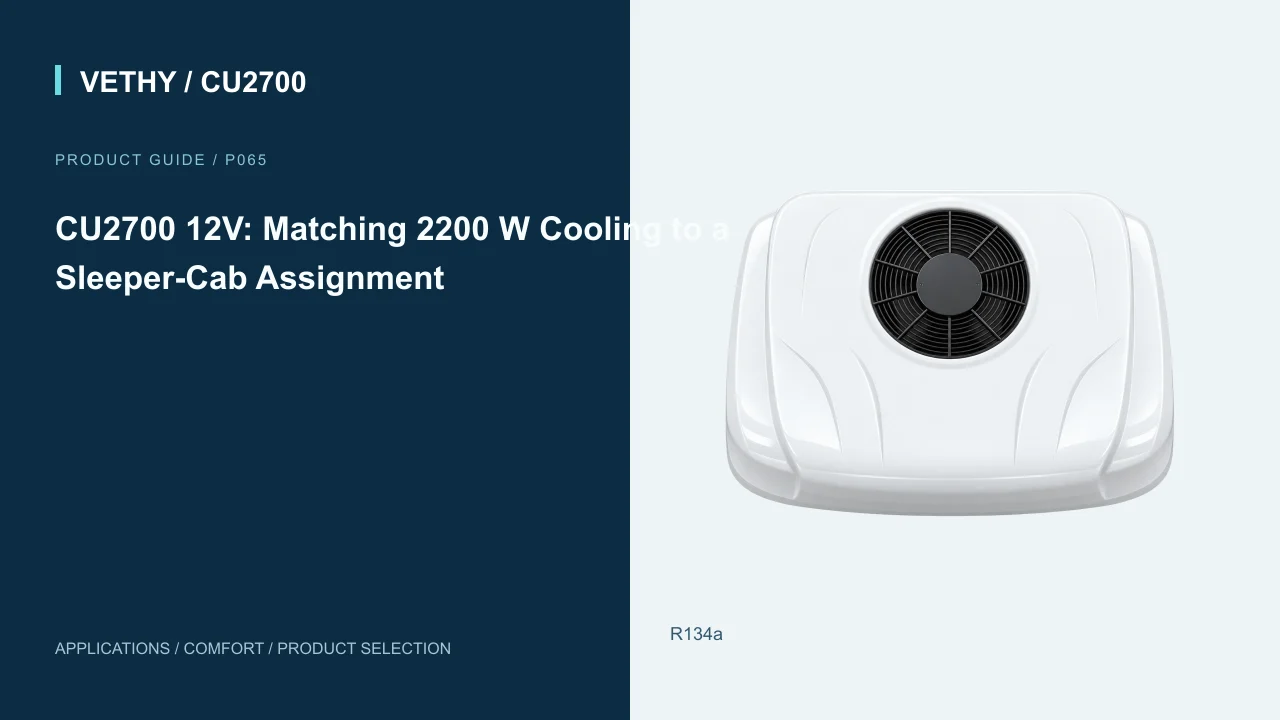
The 12V CU2700 offers a clear product proposition for a sleeper-cab project:2200 W manufacturer reference cooling, R134a DC inverter twin-rotary technology and a single brushless condenser fan in a rooftop assembly. Its Model A indoor panel adds independent left and right electric oscillation, giving the installer a defined way to discuss air delivery around the occupied bunk.
Recommend this version when the truck's electrical architecture and cooling assignment align with a 12V package. The appeal is the complete combination, including documented copper heat exchangers and brushless airflow. A useful recommendation then turns those features into a particular installation, with the roof, occupied space and auxiliary supply considered together.
Make 12V the starting point of the product selection
A truck owner may use 12V as a shorthand for the entire vehicle electrical system, but the installation team needs a more precise picture of the supply available for cooling. Identify the proposed source, the other loads it serves and the person responsible for the electrical design. This establishes the setting in which the 12V CU2700 will be considered.
The model family also has a 24V version, with a different cooling reference. Keep that alternative separate while discussing the 12V project. Quoting the larger capacity from another voltage column would make the offer harder to understand and could leave the customer expecting equipment that has not actually been selected.
Use the product identity consistently from the first enquiry: CU2700,12V, single-fan rooftop cooling, R134a. That description connects the customer, distributor and installer to the same configuration. It is a simple foundation for a professional offer, especially when a supplier also carries related twin-fan products or several voltage versions.
Give the 2200 W reference a useful meaning
The 2200 W figure is the manufacturer's cooling-capacity reference for this version. It describes cooling output, rather than the electrical input taken from the supply. The number is useful for initial selection, but it does not independently determine the cab size, parking duration or weather conditions the installed unit can serve satisfactorily.
The vehicle's cooling task depends on its exposure, construction, glazing, occupancy and starting condition. A cab parked in direct sun after a working shift can present a different task from one occupied after sunset. The right recommendation describes the conditions the customer expects, then considers whether the configured unit is appropriate for that assignment.
This is a constructive way to sell the product. The buyer receives a named capacity and a practical explanation of how it will be evaluated, rather than an unexplained promise that any 2200 W unit suits every sleeper. CU2700 remains a concrete candidate, and the vehicle brief supplies the information needed to make that candidate more than a number on a list.
Summarize the 12V package without mixing reference fields
The following facts identify the configuration being discussed. They help a customer review the product and prepare an installation enquiry. They are not a complete electrical design or a set of measurements from one common operating point.
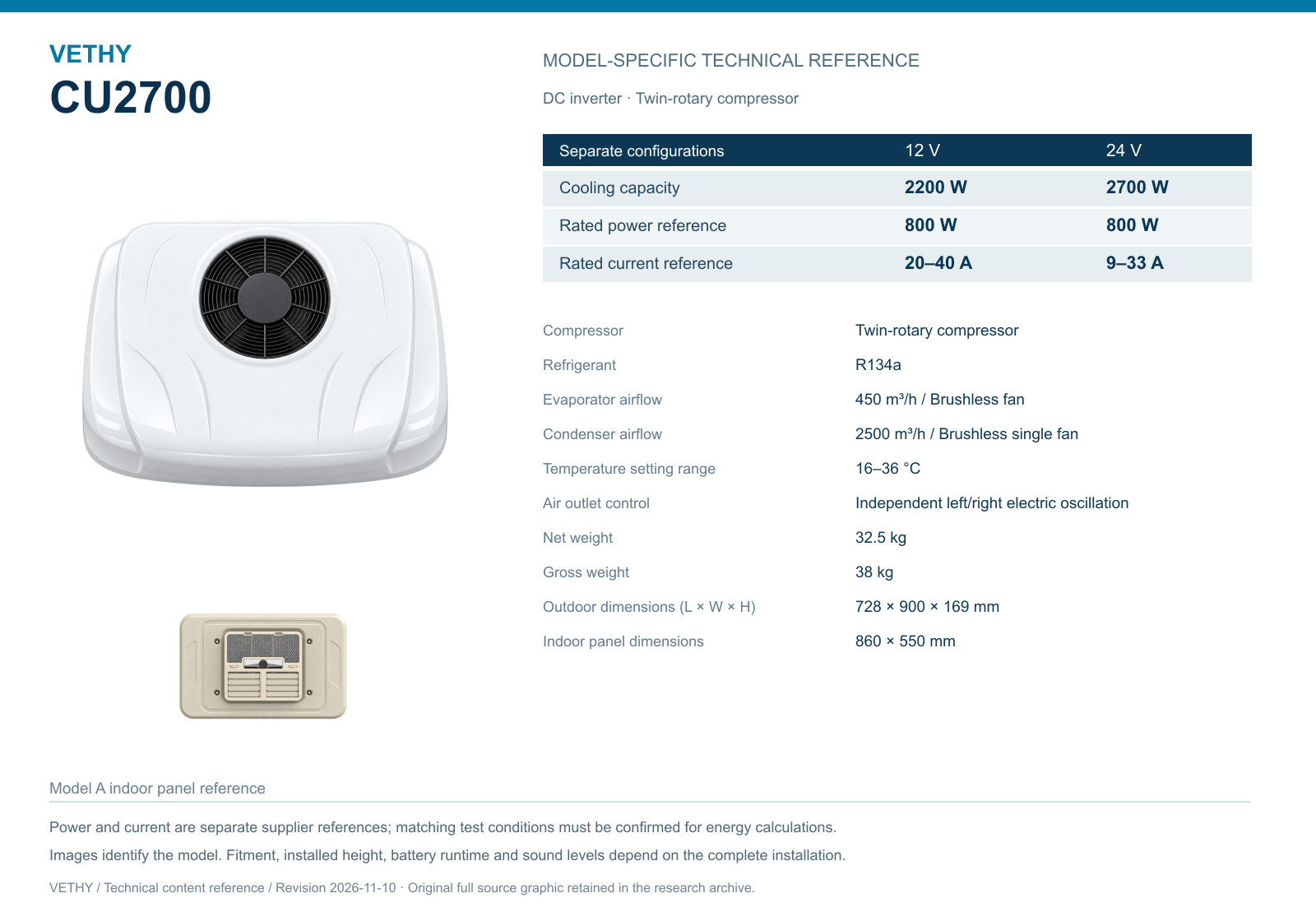
| Product detail | 12V CU2700 reference | Application use |
|---|---|---|
| Cooling capacity | 2200 W | Starting point for the sleeper-cab cooling review |
| Compressor technology | DC inverter, twin-rotary | Identify the cooling architecture and discuss supplied controls |
| Refrigerant | R134a | Keep product and service identification consistent |
| Rated-power reference | 800 W | Retain the manufacturer's named field without treating it as a session average |
| Current reference | 20–40A at 35°C ambient | Request the appropriate operating and electrical information |
| Evaporator airflow | 450 m³/h, brushless fan | Plan cabin circulation and outlet position |
| Condenser airflow | 2500 m³/h, single brushless fan | Review the outdoor air path |
| Outdoor dimensions | 728×900×169 mm | Check roof packaging with vehicle-specific installation information |
| Indoor panel | Model A,860×550 mm | Review the available interior space and air direction |
The separate power and current fields should remain labelled in the offer. Their endpoints do not establish a matched condition for calculating an efficiency value or guaranteed duration. That does not diminish their value as product information; it tells the project team how to use them responsibly while completing the vehicle assessment.
Describe the sleeper zone the driver actually occupies
The bunk is not an empty test chamber. It contains bedding, storage, personal items and often a curtain that changes the occupied zone. Ask the owner to show the ordinary resting arrangement, including where the head and upper body are located. Those details help the installer judge whether a proposed panel position can deliver useful air to the person.
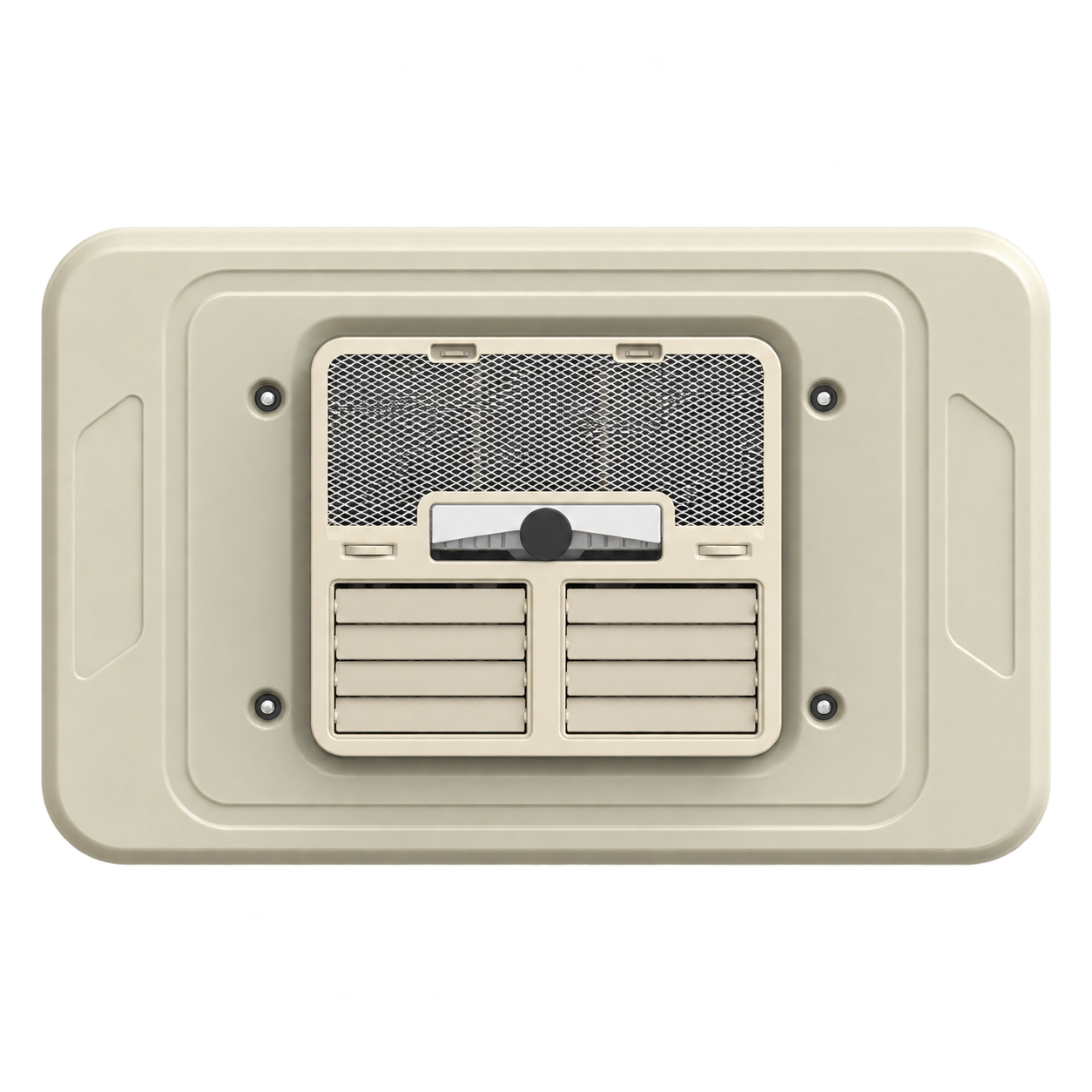
CU2700's independent left and right oscillation is a tangible feature in this conversation. It provides a way to discuss different directions on each side of the panel. The driver may prefer circulation across the bunk while avoiding a concentrated stream near the face. A suitable layout allows the available adjustment to address that preference.
The return-air path deserves attention as well. Air delivered into an obstructed area cannot be judged solely by how cold it feels near the outlet. Show the circulation route with the curtain and usual belongings in place. This makes the product recommendation specific to everyday comfort, which is the reason the owner is buying parking cooling in the first place.
Match the roof position to the indoor result
Choosing the roof location involves more than finding a rectangle large enough for the outdoor housing. The location also affects where the indoor panel sits relative to the bunk, seats and storage. A convenient outside position can become a poor interior choice if the air stream is blocked or the panel crowds an important part of the cab.
Start with both views of the truck. Use roof photographs to identify nearby accessories and interior photographs to show the occupied layout. The 728×900×169 mm outdoor reference supports early screening, while the final roof interface depends on the correct installation information and vehicle structure. Panel dimensions must not be substituted for the required opening.
The source provides a 380×490 mm minimum installation-opening reference, but that value is not approval to cut a particular roof without a proper review. The useful next step is to obtain a drawing and a suitable installation plan for the order. This protects the buyer's interest in a complete fit while allowing the product's compact outdoor profile to remain part of the recommendation.
Plan the single-fan heat-rejection path
CU2700's outdoor arrangement has one brushless condenser fan. Its 2500 m³/h airflow reference belongs to the heat-rejection side of the cooling system. The installation should preserve the intended intake and discharge access, rather than treating the fan as a decorative feature visible in a photograph.
Consider the truck with the equipment it normally carries. Roof accessories may be present during work even if removed for a sales display. The person reviewing the layout should know what will remain near the assembly and how maintenance access will be provided. A unit that fits physically can still need a different surrounding arrangement to support its air path and service requirements.
For the owner, the benefit of this review is understandable cooling equipment that has a suitable place on the vehicle. For the distributor, it is a clearer product offer with fewer unresolved assumptions. The product's single-fan identity becomes useful installation information, while the overall recommendation continues to depend on the complete 12V cooling assignment.
Connect inverter operation with the owner's routine
The DC inverter description is relevant to a cab whose demand changes between warm arrival and later rest. The owner may initially occupy the seat, then close the curtain and move into the bunk. Sunlight and activity can also change during the stop. These ordinary transitions provide a meaningful context for discussing the supplied control arrangement.
The source identifies the technology, but it does not define a universal speed range, a particular named night mode or a guaranteed electrical profile. Ask VETHY which controls belong to the quoted configuration and how the driver should request the desired comfort. This keeps the recommendation accurate while acknowledging the value of controlled operation.
A sensible user routine can support that architecture. Keep the chosen occupied zone clear, direct air usefully and avoid unnecessary heat entry where the assignment allows. Those are practical ways to pursue energy-conscious comfort with the CU2700 package. Any numerical consumption claim should remain associated with the conditions and configuration that actually support it.
Treat auxiliary power as part of the installed service
The cooling unit is one load within a vehicle electrical arrangement. A suitable proposal considers usable energy, the required reserve and other onboard equipment. It also identifies who will design and implement the supply path. General product information cannot replace that responsibility or establish a universal battery size for every truck.
The useful discussion concerns the parking service the customer wants. State the expected period, the likely cab condition and whether other devices will be used at the same time. If the owner wants repeated cooling stops on consecutive days, include how the available energy is restored between them. These details help the supplier assess the complete assignment.
The result should be an offer the owner can understand. It identifies the selected 12V CU2700 and explains which installation and supporting items are included. If a vehicle survey is still required, the proposal can state the open information clearly. A defined next step is more useful than a runtime estimate based only on a nominal battery label.
Understand why a 12V supply needs a specific installation review
At a given electrical power, a lower supply voltage corresponds to a higher current. That basic relationship explains why the supply path deserves attention in a 12V cooling project. It does not mean the CU2700 must be assigned a current derived from an unrelated voltage or cooling-capacity number; the actual product and installation information still govern the design.
For illustration only, an imagined 500 W electrical load would correspond to about 41.7A at an assumed 12V, or about 20.8A at an assumed 24V. This is simple power arithmetic, not a CU2700 operating result or a way to choose a cable or protective device. The example shows why an installer considers the complete circuit rather than assuming that a supply called 12V is automatically adequate for every accessory.
The physical route, connections and relevant vehicle conditions belong in that review. A general product article cannot determine a universal cable size from the nominal voltage alone. A clear enquiry can nevertheless help: identify the planned power source and show the installation surroundings so the responsible electrical professional can establish an appropriate arrangement for the actual unit and vehicle.
Keep ampere-hours and usable energy in their proper roles
Battery capacity is often discussed in ampere-hours, while a cooling session is more usefully evaluated through electrical energy over time. Ampere-hours need a voltage context before they describe a nominal energy quantity. The energy actually available for a particular cooling assignment also depends on the complete battery arrangement, operating limits and other requirements of the vehicle.
When an owner supplies a battery label, treat it as an input to the review rather than a complete runtime answer. Ask which energy can be allocated to cooling and which other loads need to be supported. Where an estimate uses an assumed average input, make that assumption visible. A useful estimate should make its uncertainty understandable instead of producing an apparently precise duration from incomplete information.
This strengthens the 12V product recommendation. CU2700 is being considered for a defined service supported by an adequate electrical arrangement, not sold as if one nominal battery capacity produces the same experience in every truck. The owner can understand what information is still required and why a suitable installation matters to the comfort they want.
Keep cooling energy and vehicle starting needs distinct
An owner often asks whether the truck will be ready to leave after a cooling period. That concern belongs in the electrical design and operating plan. The air-conditioner specification does not independently establish the reserve or protection behavior of the complete vehicle, and the supplied CU2700 data should not be used to invent those system functions.
Explain which part of the installation provides the relevant electrical management and how the driver will use the agreed arrangement. Any product or vehicle operating limits should come from the appropriate documentation. A general recommendation should not supply arbitrary cutoff settings or instructions that could conflict with the actual equipment.
This clear division helps the customer buy with confidence. CU2700 provides the identified cooling package, while the vehicle project defines how that package is supported and how the truck's other needs are preserved. The two decisions are connected, but they should not be blurred into an unsupported claim that the air conditioner automatically solves every auxiliary-power concern.
Make a representative demonstration answer a buying question
Choose the purpose of the demonstration before collecting observations. The owner might want to understand airflow at the bunk, the effect of the curtain position or the suitability of an intended roof location. A fleet may be assessing whether a representative installation provides useful comfort during a particular parking pattern. Those are practical questions with different evidence needs.
Show the actual 12V configuration and describe the starting conditions. Let the customer occupy the normal resting and seated positions. If energy or sound is measured, retain the measurement boundary and relevant conditions. An observation from one installation can be valuable without being converted into a promise about every vehicle.
The demonstration should lead to a decision. It may confirm the proposed panel location, reveal a storage conflict or identify information the supplier still needs. Those results make the next quotation more specific. A customer who understands how CU2700 will serve the actual cab has a stronger basis for purchase than someone shown a cold outlet without an installation context.
Present the documented copper and brushless components clearly
CU2700's material description names a copper evaporator, copper condenser and copper refrigerant piping. These details can matter to a buyer who wants an identified construction package. Keep the description attached to those named components; it does not establish that every part of the unit, every fin or the exterior housing is copper.
The source also distinguishes brushless evaporator and condenser fans. This gives the distributor concrete air-moving components to describe alongside the inverter twin-rotary system. A clear presentation explains what each part does for the cooling task rather than treating every technology term as a separate numerical efficiency improvement.
For repeat orders, retain the same model-specific information with the customer's record. A similar housing should not become a reason to substitute another refrigerant or voltage reference in a quotation. The value is a product configuration that remains consistent from recommendation through delivery and service, allowing the buyer to know what has actually been selected.
Support everyday ownership with a useful handover
The owner should leave the installation process knowing how to operate the supplied controls, adjust the available air direction and obtain support. Show the intended curtain and storage arrangement during the handover. A feature demonstrated in an empty cab can be less useful if the owner cannot reproduce its benefit with ordinary belongings in place.
Keep the relevant documentation and equipment identification with the truck. The installed panel position, roof surroundings and electrical arrangement can be recorded for future reference. If a later accessory or interior change affects the cooling installation, the record provides a starting point for reviewing the change rather than relying on memory.
Ordinary maintenance should follow the appropriate product information. A customer can be encouraged to notice changes in air delivery or operating character and communicate them clearly, without being instructed to open the refrigerant circuit or improvise an electrical modification. Useful ownership support helps the 12V CU2700 remain a comprehensible part of the vehicle rather than an isolated purchase.
Compare the complete offer with the customer's priorities
A product recommendation becomes more persuasive when it explains why this version fits the buyer. An owner-driver may prioritize bunk comfort and a clear installed package. A fleet may want repeatable records across similar trucks. A distributor may value a distinct single-fan 12V offering with consistent photographs and technical information.
For each buyer, identify the decision that remains. It may concern the occupied zone, supply design, installation location or included workshop work. The product's 2200 W reference cooling, inverter architecture and independent outlets are reasons to consider CU2700, while the vehicle details establish whether those features form the right solution.
Compare quotations on equivalent scope. Ask which equipment, installation work and supporting items each offer includes. This avoids comparing an uninstalled unit with a complete vehicle package as if the difference were only the product price. Clear scope supports a professional recommendation and gives the customer a useful way to move from interest to an order.
Questions about the 12V CU2700
Is 2200 W the amount taken continuously from the battery?
It is the listed cooling-capacity reference, not a continuous electrical-input statement. Electrical use over a parking period needs an appropriate operating profile or representative measurements, along with a defined supply arrangement. Keep cooling output and battery energy distinct when reviewing the offer.
Can I use the 24V capacity figure for a 12V order?
The two versions have separate references. The 12V CU2700 lists 2200 W cooling, while 24V lists 2700 W. Identify the selected voltage throughout the quotation, supplied documentation and installation record so every person involved is considering the same configuration.
What helps make this model suitable for sleeper comfort?
Its documented package combines inverter twin-rotary cooling with brushless fans and independently directed left and right air delivery. A suitable panel position, clear circulation and an appropriate roof installation help those features serve the occupied bunk. Evaluate the finished arrangement in the intended cab.
What information moves a serious enquiry forward?
Provide the vehicle, available 12V supply arrangement, roof and interior photographs, typical parking period and other relevant onboard loads. Explain the normal curtain and bedding positions. These inputs help VETHY turn a general product interest into a configuration-specific cooling proposal.
Shortlist the 12V version for a defined installation
Choose the 12V CU2700 for further review when its 2200 W cooling reference and single-fan rooftop package fit the truck's requirements. The documented compressor, materials and air-distribution features give that recommendation a concrete foundation. Use the CU2700 product library and vehicle enquiry guide to connect those strengths with the actual sleeper, supply and parking assignment.
Product sources
- VETHY CU2700 model-specific technical specifications — VETHY.
- CU2700 technical reference sheet — VETHY.
VETHY product recommendation and application analysis. Specification references identify the selected model and voltage. Installation examples are planning examples; measured project results are identified explicitly when available.
Discuss your CU2700 application
Send your vehicle, supply voltage, occupied space, parking schedule and installation photographs for a model-specific recommendation.
Prepare your vehicle brief ↗