
VETHY / CU2700 / PRODUCT AND APPLICATION GUIDE
CU2700 24V: Planning a 2700 W Rooftop Cooling Installation
The 24V CU2700 offers 2700 W reference cooling with R134a DC inverter twin-rotary technology and a single brushless condenser fan. It is a useful fleet candidate when the truck's 24V supply and roof layout suit the installation. Group vehicles by their actual configuration, then validate a representative package before repeating the arrangement.
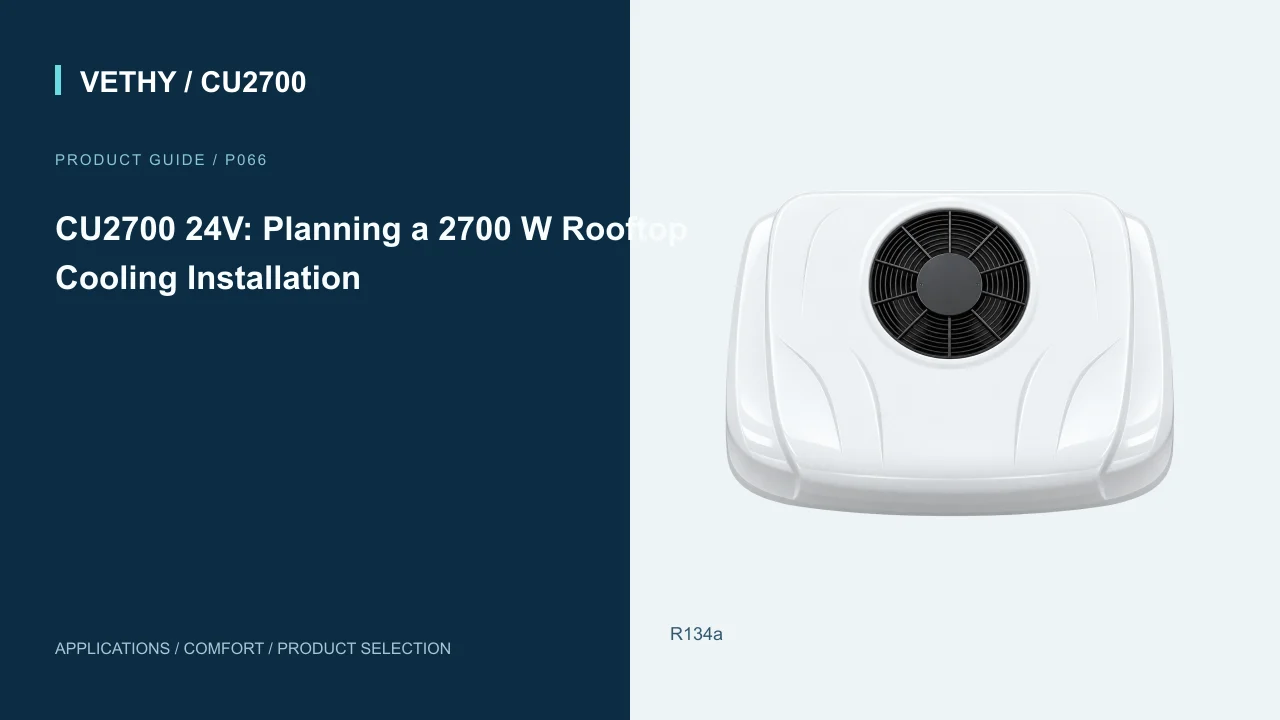
The 24V CU2700 is a practical candidate for a commercial-truck program that wants an identifiable rooftop parking-cooling package. Its manufacturer reference is 2700 W cooling, with R134a DC inverter twin-rotary technology, brushless fans and a Model A indoor panel. The product gives a fleet a concrete starting point for a repeatable installation rather than leaving each workshop to select an unspecified cooler.
A fleet recommendation should make both the common equipment and the vehicle differences visible. The same product can be considered across several trucks, but roof structure, interior trim, accessory layout and available supply arrangements still need attention. CU2700 becomes more convincing when its documented features are connected to an installation that can be understood, repeated and supported.
Define the 24V vehicle group before ordering the hardware
Begin by identifying which trucks actually belong to the proposed installation group. A fleet name or cab badge alone may hide differences in roof equipment, sleeper layout or electrical arrangements. Collect enough information to distinguish vehicles that can reasonably share a reviewed installation from vehicles that need a separate assessment.
For each group, identify the available 24V supply arrangement, the occupied cab zone and the normal parking service. Include the equipment that remains fitted during work. This prevents the first demonstration truck from representing a simplified configuration that the workshop cannot reproduce on later vehicles.
The commercial benefit is a clearer rollout proposal. CU2700 can be named as the common cooling model while the installation record explains which vehicle group the proposal covers. A fleet then buys a defined package for a stated population, rather than an assumption that identical units eliminate every difference between trucks.
Identify the 2700 W cooling version accurately
The 24V CU2700 lists 2700 W cooling capacity. That reference should remain associated with the 24V configuration throughout the product page, quotation and installation record. The 12V family member has a separate 2200 W cooling reference and should not be treated as the same selection with a different label.
Cooling output and electrical demand also describe different parts of the specification. The 2700 W capacity is not a statement that the battery must continuously supply 2700 W of electrical input. Electrical planning needs the appropriate configuration information, a defined operating assignment and an adequate understanding of the complete supply arrangement.
Keeping these distinctions visible improves the buying conversation. A fleet can compare the required cooling service with an identified candidate, then review the supporting installation and operating evidence. The capacity figure remains useful without being asked to answer questions about duration, control behavior and vehicle fit that it cannot resolve on its own.
Use the documented package as the common specification
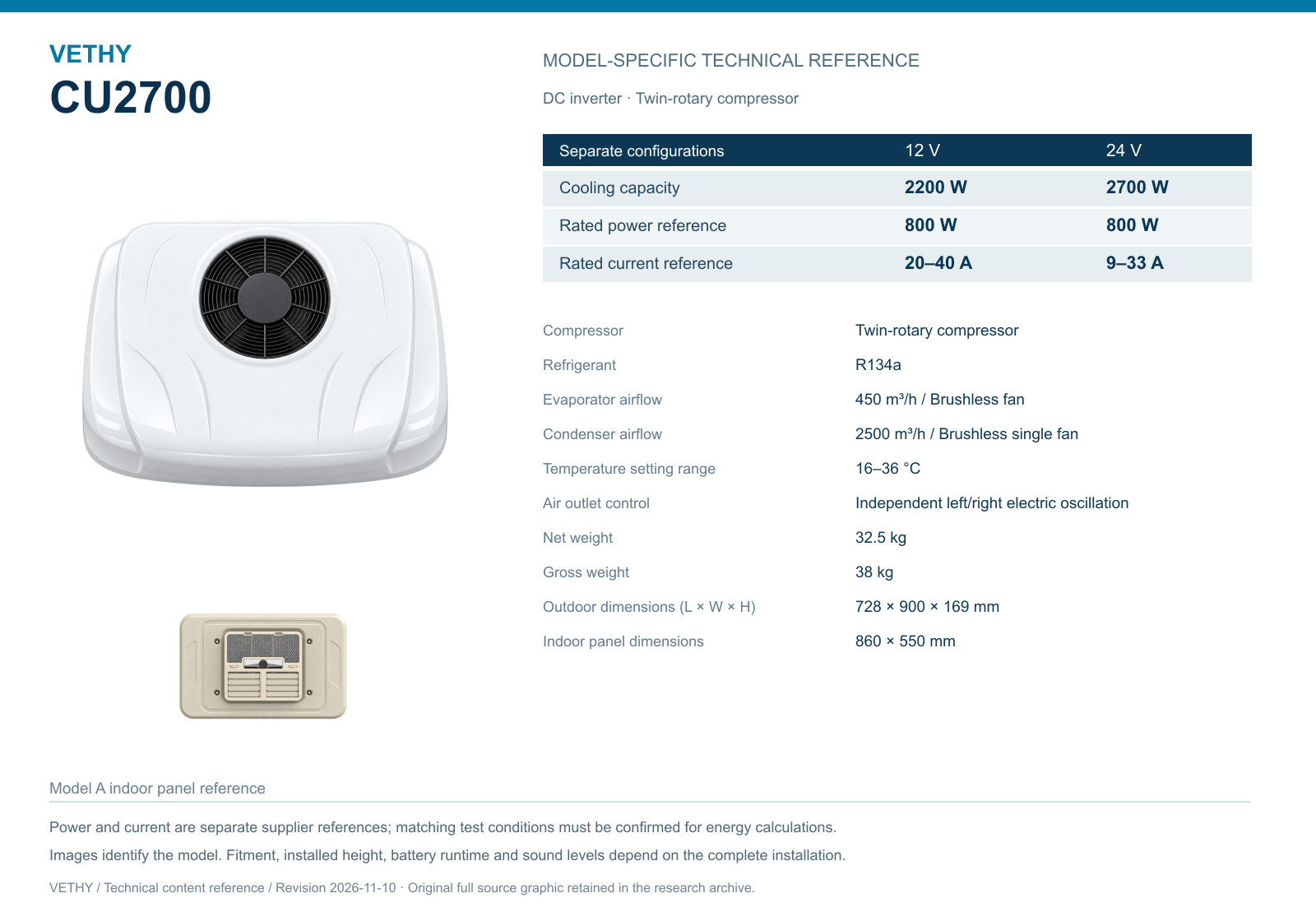
The following facts identify the 24V CU2700 equipment proposed for the fleet. They can form part of a configuration schedule, with installation details added for the relevant vehicle group.
| Equipment item | 24V CU2700 reference | Fleet planning use |
|---|---|---|
| Cooling capacity | 2700 W | Identify the selected cooling version |
| Refrigerant | R134a | Keep equipment and service documentation aligned |
| Compressor architecture | DC inverter, twin-rotary | Describe the product platform and review supplied controls |
| Rated-power reference | 800 W | Retain the named manufacturer field without assuming a session average |
| Current reference | 9–33A at 35°C ambient | Obtain the appropriate electrical operating information |
| Indoor air movement | 450 m³/h, brushless evaporator fan | Plan occupied-zone circulation |
| Outdoor air movement | 2500 m³/h, single brushless condenser fan | Review roof surroundings and heat-rejection access |
| Air outlets | Independent left/right electric oscillation | Support different driver positions and preferences |
| Outdoor envelope | 728×900×169 mm | Start the roof packaging review |
The power and current references are separate source fields, with no common matched condition established for every endpoint. A rollout document should preserve their meaning rather than invent an efficiency figure from a convenient combination. The fleet needs a complete operating plan, not an apparently precise calculation detached from the selected configuration.
Distinguish inverter cooling from a separate mains-power inverter
The word inverter can refer to different equipment in a vehicle conversation. CU2700's description identifies its cooling technology as DC inverter. That does not mean a purchasing team should assume that a separate device producing household mains power is included in the air-conditioning package.
This distinction matters when several departments contribute to the project. One person may be discussing the compressor drive, while another is thinking about an onboard mains socket or a battery-to-AC converter. Both may use the same word even though they are referring to different functions. A clear equipment schedule states what is actually supplied and the required input arrangement for the ordered unit.
For the 24V CU2700 review, keep the product's DC supply requirements explicit and obtain the correct installation documentation. If the vehicle also has a separate mains-power system, describe it independently. This prevents an avoidable misunderstanding about the package while letting the cooling unit's inverter architecture remain a meaningful part of the recommendation.
Keep nominal voltage separate from the operating envelope
A24V label identifies the nominal product configuration, but it does not provide every allowable supply condition. Vehicles can present different electrical states during charging, resting and the operation of other equipment. The relevant installation and product information must establish the conditions the ordered unit is designed to accept.
A general guide should not invent a permissible voltage band or cutoff setting for CU2700. Instead, the fleet's electrical review should use the actual documentation and planned vehicle arrangement. That is particularly important when auxiliary equipment has been added at different times or different workshops have used different approaches across the fleet.
The useful purchasing question is straightforward: who confirms the complete supply arrangement for each vehicle group? A named responsibility helps the model-specific recommendation become an implementable offer. The fleet then understands both the cooling equipment being selected and the work needed to support it in its own trucks.
Review the roof as a working vehicle location
The 169 mm outdoor assembly height is relevant to packaging, but completed vehicle height also depends on mounting and the truck's roof geometry. The 728×900 mm plan dimensions provide an initial envelope, while air access and maintenance requirements extend the review beyond the enclosure itself.
Include communication equipment, racks and other normal accessories in the roof survey. Consider how technicians will approach the unit and whether the proposed arrangement remains serviceable with the vehicle's ordinary equipment fitted. The goal is an installation that works as a complete vehicle layout, not merely a housing that fits within two measured lines.
If a fleet uses more than one roof configuration, keep separate records. A later truck may share the model name but carry a different accessory or interior structure. Recording that distinction allows the workshop to review it before installation rather than discover it after assuming the first vehicle's arrangement applies everywhere.
Match indoor air distribution to the sleeper layout
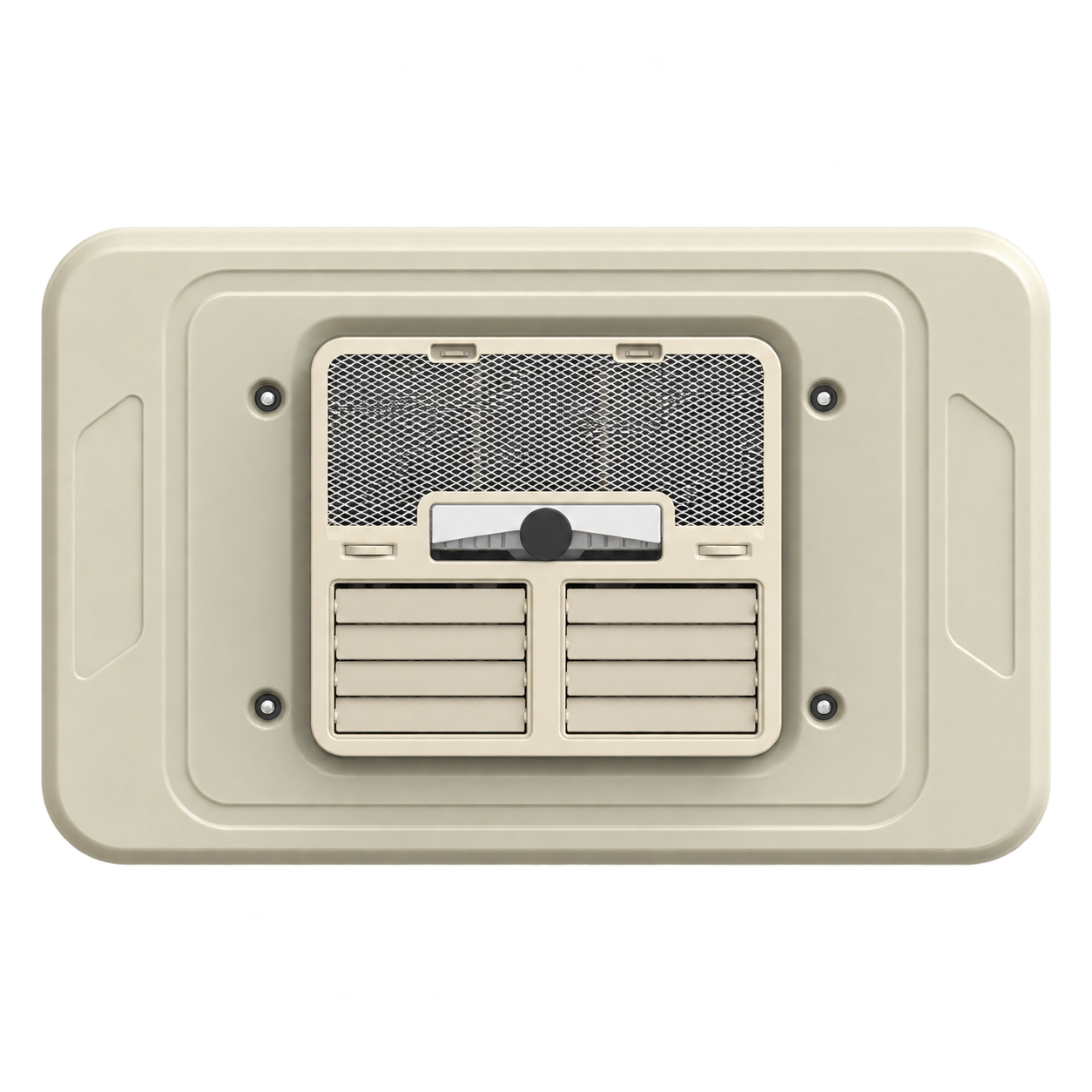
CU2700's Model A panel provides independent left and right electric oscillation. The feature is useful for a fleet whose drivers have different resting positions or who use more than one area of the cab during a stop. The panel can be demonstrated as an adjustable distribution arrangement rather than a fixed cold stream aimed at one location.
Review the normal curtain, bedding and storage positions with the panel location. The 450 m³/h evaporator reference gives context, but the air must still travel usefully through the occupied space and return to the unit. A layout that looks open before drivers load their belongings may behave differently during ordinary work.
A fleet can turn a successful arrangement into practical driver guidance. Show the intended air route and how the available direction adjustment relates to the seat and bunk. This helps different drivers understand the same installed equipment without claiming that identical thermostat settings or outlet positions will suit every person.
Use a representative first installation to resolve the right questions
The first truck should represent an identifiable group, not simply the most convenient vehicle available in the yard. Choose a configuration that allows the team to examine the intended roof arrangement, interior layout and supply system. State which parts of the result are expected to apply to later trucks and which differences still need review.
Observe the parking service the fleet is actually purchasing. A short lunchtime demonstration may answer an air-direction question but cannot stand in for an overnight assignment or several repeated stops. Select the evaluation around the decision being made, then retain the conditions with the observations.
The result should be a usable installation record and an explicit set of unresolved items. That record can support the next vehicles, workshop instructions and the driver's handover. A defined first installation gives CU2700 a stronger place in the fleet program than an informal demonstration whose important details were never recorded.
Make quiet comfort part of the acceptance discussion
The CU2700 source positions the product qualitatively around quiet, energy-efficient operation. Its inverter twin-rotary system and brushless airflow components provide relevant features to discuss. The fleet still needs to consider the sound and air-delivery experience in the completed cab, where mounting, trim and occupancy affect the result.
Ask drivers about the normal resting position and any intrusive direct stream or sound they notice. Where measurements are used, retain the operating configuration and observation conditions. A result from one truck can inform the rollout without becoming an unsupported decibel claim for every installation.
This approach makes driver feedback useful to the project. A comment about a rattle, a draft near the pillow or a blocked circulation route can lead to a specific review. It is more informative than collecting a broad approval score without knowing what the driver experienced or whether the issue relates to the equipment, installation or surrounding cab arrangement.
Coordinate the energy plan with the route schedule
The fleet should describe how long cooling is needed, what conditions usually precede parking and which loads share the auxiliary supply. An inverter package is relevant to changing demand, while the route determines the actual sequence of use. A truck arriving after dark may present a different profile from one waiting in afternoon sun between assignments.
Repeated use also requires an appropriate replenishment plan. The vehicle may have another parking period before the energy used during the first one has been restored. A successful isolated test does not automatically establish the same service on consecutive days with different schedules.
Keep the supply responsibility and operating brief connected to the chosen CU2700 version. Where estimates rely on assumed demand, show the assumption. Where representative measurements exist, identify their boundary and conditions. The purchasing team can then assess whether the complete package supports its intended assignment rather than treating a single current entry as a route-wide average.
Control configuration changes during the rollout
Once a representative installation has been agreed, preserve its identity. Record the CU2700 voltage version, supplied panel, relevant installation arrangement and supporting documentation. If the proposed equipment or vehicle layout changes, identify the difference before assuming that the earlier review still applies.
This is especially useful when the fleet orders in stages. A later delivery may reach a different workshop or be installed on a truck with modified storage or roof equipment. The original record gives the next team a defined reference and a reason to review differences explicitly rather than rely on a familiar product photograph.
The buyer should also know what constitutes the actual commercial package. A product assembly, installation work and auxiliary electrical equipment may be supplied through different parties. Keep those responsibilities visible so a configuration change does not become an unrecorded assumption passed from one team to another.
Give workshops information they can reuse
A useful fleet installation record includes the vehicle group, relevant photographs, supplied configuration and the approved installation information. It should distinguish product dimensions from the roof interface and identify the electrical design responsibility. This allows the workshop to recognize when a later truck belongs to the reviewed group and when it does not.
The aim is repeatability through clear information, not a claim that every installation can be performed without further judgment. A technician needs the correct documentation and an appropriate review of the actual truck. A standardized product offer works best when it reduces ambiguity while preserving the responsibility to notice meaningful differences.
For CU2700, the matching outdoor image and Model A panel reference are useful parts of that record. They help identify the single-fan package and intended indoor arrangement. Combine them with the correct 24V technical reference so the visual and numerical descriptions continue to support the same equipment selection.
Plan maintenance access before the trucks return to service
A fleet benefits when the roof arrangement allows appropriate inspection and ordinary maintenance using the correct procedures. Consider how technicians approach the unit with the truck's usual accessories fitted. Do not let the first installation's service access depend on removing items that later vehicles will carry permanently.
Record the indoor panel and surrounding storage layout as well. Drivers may rearrange belongings or a workshop may add trim after the initial fit. A later comfort question can then be reviewed against the intended circulation path rather than treated immediately as a failure of the cooling unit.
Support arrangements should identify the product, voltage version and relevant contact route. The exact parts and procedures belong to the supplied configuration and service information. A general guide can help the fleet prepare useful records, while qualified support determines the appropriate response to a specific technical issue.
Check the auxiliary arrangement within a nominal 24V fleet
A fleet described as 24V can still contain different auxiliary-power arrangements. The installation team should identify the actual source intended for the air conditioner rather than infer it from the vehicle's general description. Equipment added by previous owners or workshops can make this review particularly important when the fleet includes used trucks or several bodybuilder configurations.
Consider two trucks that appear similar from outside. Their roofs and sleepers may allow the same broad cooling concept, but the proposed auxiliary supplies could differ. That difference belongs in the project information before the order is treated as a common 24V installation. The correct response is a documented electrical review, not an assumption that a product label automatically reconciles the two arrangements.
The practical benefit is better purchasing accuracy. The fleet can group vehicles according to the installation that will actually be built and keep any additional work visible in the offer. A truck needing a different supporting arrangement is not necessarily excluded from the program; its requirements simply need to be understood. CU2700 can then be recommended within a complete plan that reflects the equipment already present and the services the fleet intends to provide.
Keep the driver's handover separate from workshop commissioning
A completed installation needs both an appropriate technical assessment and a usable explanation for the driver. These serve different purposes. The workshop confirms the relevant installation and operating requirements using the supplied information. The driver learns how the configured equipment serves the occupied cab during the fleet's ordinary parking routine.
For the handover, show the normal curtain position, the available outlet adjustment and the support route. Explain any relevant operating limits through the actual documentation, rather than inventing a control feature or warning behavior. A driver who understands the arrangement can communicate a later comfort concern more precisely and is less likely to treat a blocked air path as an unexplained loss of product capacity.
If several drivers share a truck, make the guidance easy to find. The next person may have different airflow preferences or use the storage differently. A brief explanation of the intended circulation route allows those preferences to be discussed within the installed package. It also gives the fleet a consistent starting point for feedback without insisting that every driver experiences comfort in exactly the same way.
Review the next vehicle against a short decision list
Before repeating the arrangement, confirm the CU2700 version, roof configuration, panel position and proposed supply. Compare the surroundings with the representative installation, including normal accessories and interior storage. Check that the correct installation information is available to the team performing the work and that unresolved differences have an identified owner.
This review can be concise because it builds on a defined reference. Its value is recognizing meaningful variation before it becomes an assumption in the workshop. The fleet can then expand a successful product program with a clear understanding of which details are common and which require individual attention.
Questions about a 24V CU2700 fleet project
Does the 24V label specify every allowable supply voltage?
No. It identifies the nominal configuration. The permissible operating conditions and required installation details must come from the appropriate documentation for the ordered unit. The fleet's electrical review should consider the actual source arrangement and vehicle operating states rather than invent a voltage band.
Is an external household-power inverter part of this product description?
The DC inverter label describes CU2700's cooling technology. It does not establish that a separate mains-power converter is included. List the actual supplied equipment and input arrangement in the quotation so the compressor-drive discussion is not confused with another vehicle electrical service.
Can one installation record cover every truck in the fleet?
It can provide a reference for a defined group with relevant common characteristics. Trucks with different roofs, interiors, accessories or supply arrangements need their differences reviewed. The purpose of the record is to make repetition informed and efficient, rather than assume a familiar vehicle name removes all variation.
Why put CU2700 on a fleet shortlist?
Its 24V version combines 2700 W reference cooling with inverter twin-rotary technology, documented copper components and independently directed indoor air. It is a useful candidate when that single-fan rooftop package fits the fleet's vehicle groups and parking assignments. A representative installation helps turn those product features into an assessed fleet offer.
Move from a model choice to a repeatable cooling package
Choose the 24V CU2700 for further review when its documented features match the commercial-truck assignment. Organize the vehicles, roof layouts, supply responsibilities and driver expectations around the identified configuration. Use the CU2700 guide library and technical enquiry route to develop an offer that the fleet can understand, install consistently and support through ordinary work.
Product sources
- VETHY CU2700 model-specific technical specifications — VETHY.
- CU2700 technical reference sheet — VETHY.
VETHY product recommendation and application analysis. Specification references identify the selected model and voltage. Installation examples are planning examples; measured project results are identified explicitly when available.
Discuss your CU2700 application
Send your vehicle, supply voltage, occupied space, parking schedule and installation photographs for a model-specific recommendation.
Prepare your vehicle brief ↗