
VETHY / VEHICLE HVAC NEWS AND ANALYSIS
Volvo’s Parking-Climate Update: Separate Cabin Requests from Battery Readiness
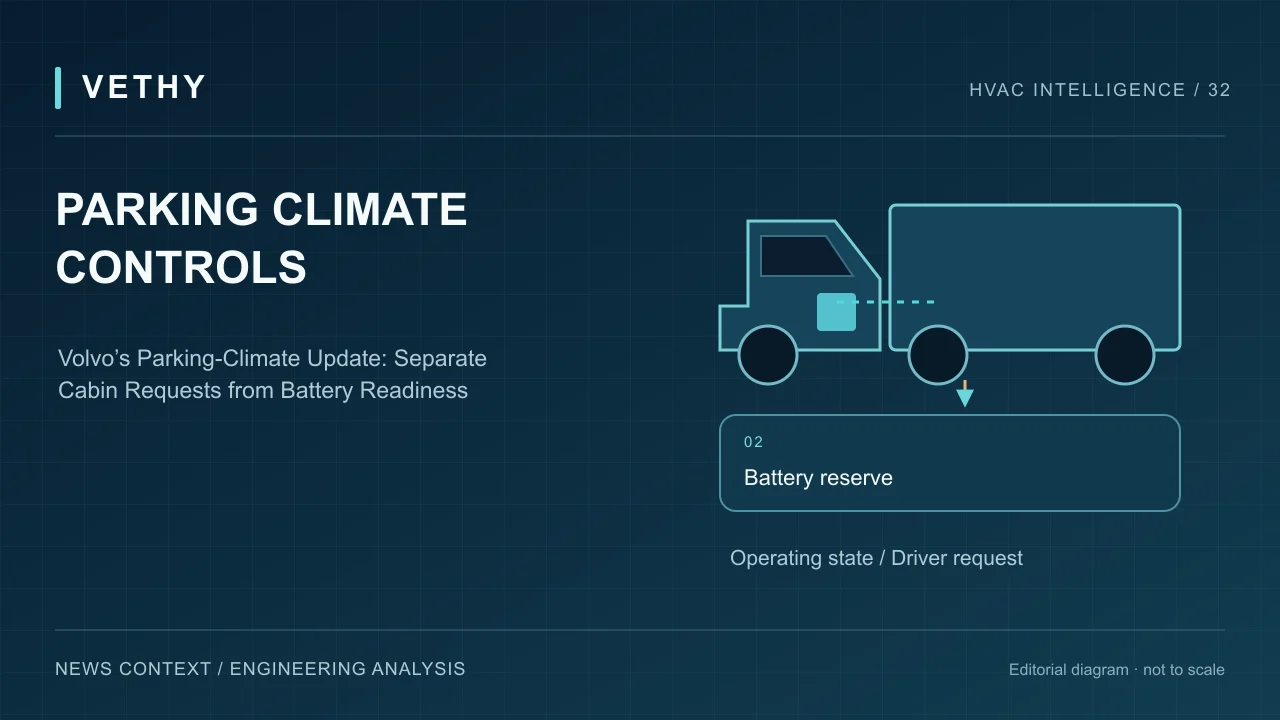
A cabin-temperature request, an accepted parking-climate command and a ready traction battery are different states. Volvo’s June 2026 fact sheet distinguishes those functions. Fleets should make the same distinction in driver instructions and fault reporting, so a scheduled command or displayed setpoint is not mistaken for confirmed cabin comfort or vehicle readiness.
News facts: a dated technical-document update
Volvo Trucks’ climate-unit fact sheet, English Version 03 dated June 15, 2026, distinguishes Ready to Run battery preparation from parking climate for the cab. It describes cabin heating or cooling with the electric drive unit off, initiated through vehicle controls, a timer or the My Truck app. The document also states that parking climate draws from the traction batteries, has operating limitations and stops if battery state of charge becomes too low. It does not provide a universal runtime or a shutdown threshold in the material reviewed. Read the Volvo fact sheet.
This is a technical-document update, not a newly announced product launch. Its practical lesson is about operating states: requesting comfort, receiving a command and being ready to depart are different events. The independent guidance below helps fleets describe those distinctions without changing vehicle protections or assuming that every truck has the same controls.
A request is not the same as a delivered service
When a driver selects a temperature, the control system receives an intention. The vehicle still has to determine whether the requested service can operate under its current conditions. Power availability, operating mode, protective limits and the installed configuration can affect the outcome. A displayed setpoint therefore does not establish that the cabin has reached that temperature.
Remote commands add another distinction. A phone interface might show that a request was sent, while the vehicle still needs to receive and accept it. A useful operating procedure should identify what confirmation is available at each stage and what the driver should do if the expected confirmation does not appear. The exact indications belong to the vehicle’s current documentation, not a generic article.
For a fleet, the simplest improvement is consistent language. Use separate terms for request sent, request accepted, climate service active and required cabin condition achieved. These terms describe different pieces of evidence. Combining them into one word such as on makes it harder to understand a missed preparation event or a complaint about comfort.
Cabin readiness and battery readiness answer different questions
Cabin readiness concerns the environment experienced by occupants. Battery readiness concerns the vehicle’s energy-storage operating conditions as defined by its manufacturer. The functions may be coordinated, but one does not automatically prove the other. A comfortable cab is not evidence that every vehicle system is prepared for departure, and a prepared battery is not proof of a comfortable sleeper.
This matters when a driver or dispatcher uses a scheduled departure feature. The fleet should understand which services the selected function actually requests and which require separate action or confirmation. Do not assume that a broad label such as preparation includes every possible cabin, battery and accessory function. Verify the specific configuration and current operating instructions.
A handover record can keep the distinction simple. Record whether the vehicle is assigned, connected where required, prepared according to the approved process and ready for the scheduled service. If an item is unknown, mark it unknown. That is more useful than allowing a successful action in one part of the process to imply that every other requirement has been met.
Build a mode map that drivers can understand
A mode map describes the services expected during ordinary vehicle states. It should be based on the exact vehicle manual and fleet policy, then written in language drivers use. The purpose is to reduce uncertainty, not to expose technical implementation details or encourage users to work around limitations.
| Operational state | Question for the fleet instructions | Evidence to identify |
|---|---|---|
| Before departure | Which preparation functions were requested? | Accepted schedule and relevant readiness indications |
| Parked with occupants | Which comfort functions are permitted? | Active mode, displayed status and cabin result |
| Connected for charging | Which services remain available? | Approved vehicle behavior and charging status |
| Low available reserve | What changes, and what should the driver do? | Warning, limitation and approved response |
| Command unavailable | Was the request received and accepted? | Current interface indication and escalation route |
| Return to driving | What must be checked before departure? | Vehicle readiness according to manufacturer instructions |
Do not fill the map with assumptions from another truck brand or software revision. Different vehicles can use similar words for different behavior. The value comes from an accurate, configuration-specific explanation that remains understandable when the driver is tired, unfamiliar with the truck or dealing with a disrupted schedule.
Explain protective limits without presenting them as faults
A climate system may deliberately reduce or stop service when an approved boundary is reached. That can be frustrating to an occupant, but it is different from a failed component. The driver needs to know how the vehicle communicates the condition and what action the fleet permits. Instructions should never encourage bypassing a reserve threshold or other protective function.
The fleet should also avoid using protection as a reason to dismiss every comfort complaint. A repeated intentional shutdown may reveal that the assigned operating pattern does not fit the planned service. The vehicle could be functioning correctly while the business process is inadequate. That requires an operational or specification review, not simply telling drivers that the system is normal.
For example, if a scheduled rest period repeatedly begins with less available reserve than the approved plan assumes, investigate why. The cause might be vehicle assignment, missed preparation, an unexpected earlier duty or a configuration issue. A clear distinction between technical fault and service-planning failure helps the right team respond and prevents unnecessary component replacement.
Make scheduled preparation accountable
A timer is useful only when the schedule reflects the actual assignment. A vehicle scheduled for a later departure may not be prepared when dispatch unexpectedly advances its work. A truck left with an obsolete schedule may perform an action that is no longer useful. The fleet needs a process for updating preparation when assignments change.
Assign responsibility for setting and confirming the schedule. In a small operation, that may be the driver. In a larger depot, dispatch or another authorized role may coordinate it. Whatever the arrangement, define the handover when a vehicle changes drivers. The new driver should not have to infer which settings were left by the previous person.
Use a simple exception process. If the departure time changes, identify who updates the approved settings and who verifies readiness. If the vehicle cannot meet the revised requirement, dispatch needs that information early enough to respond. The schedule is part of the operating system of the fleet, not merely a convenience feature inside the cab.
Remote control needs clear confirmation and access ownership
A remote interface can make preparation easier, but it introduces practical questions about connectivity, user access and the meaning of status messages. A fleet should know which authorized person can control which vehicle and how access is changed when responsibilities change. Avoid shared personal accounts that make actions difficult to trace or revoke.
The instructions should describe what to do when the remote interface is unavailable. That might involve using an approved in-vehicle control or contacting the designated fleet role, depending on the system. The alternative should be taken from the manufacturer’s current guidance. It should not involve repeated unverified commands or changes to protected vehicle settings.
Confirmation should be interpreted conservatively. A message that an instruction was sent is not necessarily a measurement of the cabin environment. If the operation depends on the cab being ready by a specific time, identify the available evidence that supports that decision. Where the system does not provide such evidence remotely, the fleet may need an appropriate local readiness check.
Avoid accidental competition between comfort and the next assignment
Parking climate forms part of the vehicle’s energy use while it is not driving. The fleet should account for that service in its assignment planning, especially when a vehicle is expected to work again soon. This does not mean sacrificing necessary comfort; it means defining the service and the recovery opportunity together.
A useful operating plan states the intended occupied period, the conditions under which the service is expected and the approved response if those conditions change. It also identifies who decides whether a vehicle remains suitable for its next assignment. The driver should not be expected to resolve a conflict between rest-period comfort and dispatch expectations without guidance.
This article does not calculate battery runtime or recommend a connection to a particular electrical circuit. Those are separate engineering questions. Here, the key is operational permission: what service the vehicle is allowed and able to provide in a defined state, how that state is communicated and how the fleet responds when it changes.
Distinguish ventilation, temperature and visibility functions
Occupants may use the word air conditioning to describe several different experiences: airflow, cooling, heating or window clearing. A vehicle can limit or coordinate these functions differently depending on operating state. The fleet instructions should use the manufacturer’s terms and explain the functions available in the delivered configuration.
A fan running does not by itself establish active cooling, just as a temperature setting does not prove a measured cabin condition. A driver report should therefore describe what was observed: airflow present or absent, air apparently warm or cool, a displayed message, or a visibility concern. This gives service staff more useful information than a single statement that the AC is broken.
Visibility-related concerns need an approved safety response according to the vehicle instructions and operating policy. Drivers should not be encouraged to continue in an unsafe condition while collecting data. The reporting framework is intended to improve diagnosis after the immediate situation is handled appropriately, not to substitute for the driver’s responsibility to operate the vehicle safely.
A practical event record for an interrupted rest period
The best first report is short enough to complete and specific enough to investigate. Record the vehicle identifier, time, selected operating mode, displayed message and the event that preceded the interruption. Note whether the vehicle had just parked, begun charging, changed driver or received a remote command. Include the location of discomfort within the cab if relevant.
Avoid asking drivers to guess a technical cause. Statements such as battery failed or compressor faulty can anchor an investigation prematurely. Observations such as cooling stopped after a warning or the timer showed a different departure time are more useful. Qualified personnel can then compare those observations with approved diagnostic information.
The record should protect personal information. A technical climate-control investigation rarely needs detailed personal rest habits beyond the occupied period necessary to understand the service. Collect only relevant information, restrict access appropriately and explain why it is being used. A clear operational purpose supports better reporting than a system perceived as monitoring every driver action.
Investigate three common misunderstandings
In the first scenario, a driver sends a preparation command remotely and assumes the cab will be ready. At the vehicle, the desired condition has not been achieved. Investigate the command chain: was the request sent, received and accepted; what mode was active; and what evidence exists of the cabin response? Do not skip directly to replacing a thermal component.
In the second scenario, the system stops during a parked period with a clear reserve-related indication. Confirm the approved operating behavior and compare the actual starting state with the fleet’s intended plan. If the protection operated as designed, the next question is whether the assignment and recovery process need revision. If the indication or behavior differs from the documentation, escalate the technical discrepancy.
In the third scenario, two drivers report different behavior in trucks with the same model name. Compare installed options, software or controller revisions where relevant, selected modes and operating conditions. Similar badges do not establish identical configuration. A controlled comparison can reveal whether the difference is expected, a training gap or an issue requiring service investigation.
Test the instructions as well as the vehicle
Before issuing fleet guidance, ask a small group of drivers to use it for ordinary tasks on the approved configuration. Can they identify which preparation function they need? Can they tell whether a request was accepted? Do they understand the response to a limitation? Can they find the correct contact without searching through several unrelated documents?
Observe where the wording creates ambiguity. If several people interpret a term differently, revise the instructions rather than treating the confusion as a failure to read. Use screenshots or illustrations only when they match the actual interface and current version. A familiar-looking but outdated image can be more misleading than a clear text instruction.
Include a handover exercise between drivers. The incoming driver should be able to identify the current schedule, active mode and any unresolved issue without relying on an informal conversation. This is particularly valuable for shared vehicles. It turns the operating procedure into a repeatable process rather than knowledge held by one experienced driver.
Keep configuration changes connected to training
Software updates, option changes or a different control interface can affect how users interpret the system. The fleet needs a way to determine whether an update changes driver actions, status meanings or service procedures. Ask the supplier for the relevant change information and revise the operational guidance where necessary.
Maintain a simple version record for the fleet instructions. It should identify the applicable vehicle configuration and the date of the guidance. When a truck receives a change, confirm whether the current instruction remains valid. This is a small administrative step that can prevent repeated confusion across a large fleet.
Do not assume that a new software revision automatically resolves a reported problem. Record what changed and verify the relevant behavior under the appropriate conditions. If the complaint disappears, preserve the evidence that links the result to the update rather than an unrelated change in weather, schedule or starting condition. That makes the improvement useful for other vehicles.
Define success at the operational level
Useful measures include preparation events completed as intended, unexplained climate interruptions, repeated configuration misunderstandings and the time required to restore an approved service. These measures describe whether the fleet can use the system reliably. They are more actionable than simply counting how often a feature is switched on.
Interpret the measures in context. A high number of reserve-related interruptions could reflect a demanding route assignment, poor preparation, configuration differences or another issue. The count alone does not identify the cause. Combine it with the event records and investigate patterns before making a broad technical conclusion.
Close the loop with drivers. Explain when an issue has been identified, what changed and which guidance now applies. If an operating limitation remains, state it clearly and provide the approved response. Trust improves when reports lead to accountable action rather than disappearing into a maintenance system without a visible outcome.
Check time, freshness and the vehicle identity
A scheduled action depends on the correct vehicle and the intended time. When dispatch changes a truck allocation, verify that the preparation request follows the new assignment rather than remaining attached to the previous vehicle. Where an operation crosses time zones or changes local clock settings, use the manufacturer’s documented handling of schedules and confirm the displayed departure time. Do not assume that every interface presents time in the same way.
Status freshness is another practical issue. A displayed condition may have been recorded earlier rather than measured at the moment the user views it. Identify whether the interface shows a timestamp or another indication of current communication. If freshness is uncertain, treat the status as unconfirmed and use the approved verification route. A stale but plausible value can be more misleading than an obvious connection failure.
These checks are particularly valuable in a shared fleet with several similar vehicles. Use a clear vehicle identifier in the operating workflow, and make assignment changes visible to the people responsible for preparation. The driver should not discover a mistaken remote selection only after arriving at the truck.
A short readiness review can therefore ask four practical questions: is this the correct vehicle, is the schedule correct, is the status current, and does the status represent the service required? None requires the user to understand the internal thermal control logic. Together they reduce avoidable command and handover errors while leaving technical decisions and protective settings with the vehicle’s approved system.
Frequently asked questions
Does Ready to Run mean the cab is already comfortable?
Do not assume that from the name alone. The reviewed Volvo document distinguishes battery preparation and parking climate. Check the current instructions for the exact truck and identify which functions were requested and which readiness indications are available. A successful action in one system does not prove every departure condition.
Does a fan running prove that parking cooling is active?
No. Airflow and active temperature control are different observations. Report the selected mode and actual behavior, using the vehicle’s current terminology. Service staff can then determine whether the behavior is expected for the operating state or requires investigation.
Should a low-reserve shutdown threshold be bypassed?
No. Follow the vehicle’s approved instructions and fleet response. Repeated loss of comfort under a protective limit is a reason to review the assignment, preparation or configuration, not to defeat the protection. Technical changes require the responsible qualified parties.
Is this a new parking air-conditioner launch?
No. The news basis is a dated technical fact-sheet revision. The article uses it to examine operating clarity and fleet procedures. It does not claim a newly launched Volvo product, universal market availability, a specific runtime or a VETHY compatibility approval.
Write a clearer parking-climate operating brief
For a fleet or integration project, identify the exact vehicle configuration, required occupied period, preparation process, approved operating modes and the people responsible for each step. Add the status information drivers can actually see and the response expected when a request is unavailable or a service is constrained.
The truck application page frames the use case, while the parking AC project-input guide helps organize the vehicle and operating details. For a new control interface or integrated module, use the engineering review to define requests, permissions and status evidence. Clear distinctions between those states make a climate system easier to operate, support and specify.
Sources and editorial scope
- Climate unit fact sheet, CU-ECC and CU-ECC2, English Version03 — Volvo Trucks, 2026-06-15.
Analysis by VETHY, published November 7, 2026. Source news dates are shown separately. Manufacturer claims are attributed; examples and decision frameworks are editorial analysis, not VETHY test results. Mention of another brand does not imply a commercial affiliation or approved compatibility.