
VETHY / VEHICLE HVAC NEWS AND ANALYSIS
Valeo Expands A/C Service Parts: Building a Repair Plan Beyond a Refrigerant Top-Up
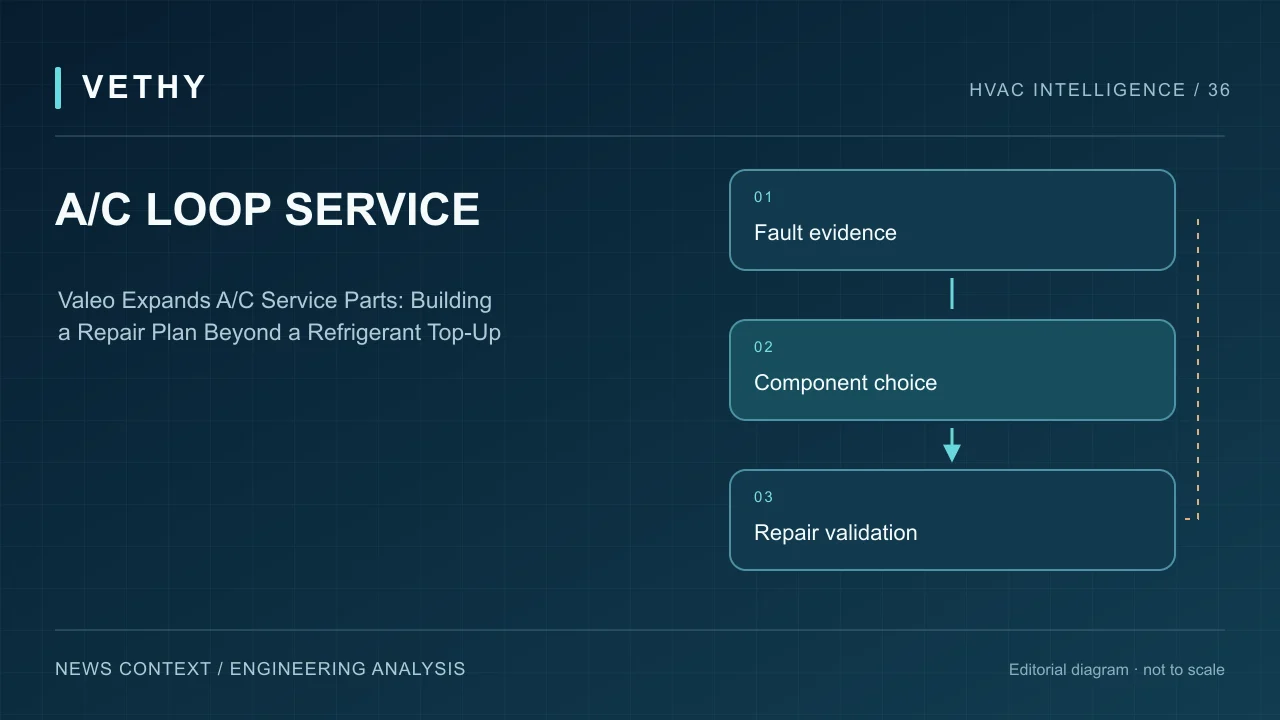
A wider A/C parts range helps only when the workshop identifies the correct application and justifies the repair scope. Separate a diagnosed failure, an associated replacement and a warranty condition. Valeo’s new range announcement is a useful prompt to review repair packages and repeat failures, but it does not establish universal replacement rules or fitment.
News facts: Valeo widens its A/C service-parts offer
Valeo Service's climate-control update, dated October 30, 2026 in the page's publication metadata, describes additions covering expansion valves, receiver driers and pressure sensors. It reports more than 140 expansion-valve references and more than 220 receiver-drier references. Its text still describes over 60 pressure-sensor references as planned for the second half of 2026, so buyers should confirm individual availability rather than treating the complete range as delivered. The release concerns Valeo's aftermarket offer; it does not establish compatibility with an arbitrary truck, bus or parking air conditioner. Read the Valeo Service announcement.
For a fleet workshop or distributor, the useful question is how to assemble a repair that addresses the cause of a cooling complaint. The independent analysis below focuses on diagnosis, repair scope and evidence, rather than turning a catalogue expansion into a universal replacement rule.
A cooling complaint is not yet a parts order
“The air conditioning is weak” describes an outcome experienced by a driver. It does not identify a failed part. The same complaint can arise under different circumstances: a hot cabin after a long stop, a problem that appears only at low vehicle speed, an intermittent shutdown, or inadequate airflow at the occupied position. A parts order placed before those circumstances are recorded can begin a costly sequence of substitutions.
The first useful workshop record describes when the complaint occurs and what the vehicle is doing. Note ambient conditions, operating mode, recent repairs, the selected temperature and blower setting, and whether the problem affects all outlets. Ask whether cooling was previously satisfactory under similar conditions. These details help the technician choose an appropriate diagnostic path without implying a diagnosis from the customer's wording alone.
For a fleet, consistency matters. If each depot records the same complaint differently, the maintenance team cannot distinguish repeated faults from ordinary differences in operation. A short standard intake form is often more valuable than a long unstructured description. It should retain the driver's experience while adding enough context for a qualified technician to reproduce the problem safely.
Think in functions before thinking in part numbers
An air-conditioning circuit has to move heat, circulate refrigerant, manage flow and provide the controller with useful information. The air side must also deliver the resulting comfort to the occupants. These functions interact, so a component can be blamed for a symptom that originates elsewhere. The purpose of a functional view is to organize the investigation, not to replace the manufacturer's diagnostic procedure.
A pressure-related complaint, for example, may involve an actual operating condition or an inaccurate representation of that condition. A technician needs evidence that separates those possibilities. Similarly, a temperature complaint may require checking the air reaching the occupant rather than looking only at a refrigerant-system value. A well-written repair order preserves these distinctions instead of declaring a component defective before it has been assessed.
The workshop should use the approved vehicle or equipment documentation to determine the required measurements and interpretation. Generic internet tables can omit important operating assumptions. Refrigerant type, system architecture and control behavior must match the actual unit. The buyer's role is to ensure that the repair supplier follows a documented method and records the evidence supporting the proposed work.
Separate a diagnosed failure from a preventive replacement
A failed part, a part replaced because the circuit has been opened, and a part replaced under a supplier's repair conditions are three different reasons for inclusion in a quotation. All can be legitimate, but they should not be mixed into one unexplained list. The distinction matters for the customer's understanding and for later reliability analysis.
When a workshop identifies a failed component, record the evidence and the applicable diagnostic basis. When another component is included as a preventive measure, identify the manufacturer's procedure or assessed condition that supports replacement. When a warranty condition governs the repair package, record the relevant written terms for that supplied product. Do not assume that one brand's general service article defines every vehicle manufacturer's requirements.
This approach prevents two opposing mistakes. A minimal repair can leave a known cause unresolved, leading to repeat failure. An indiscriminate repair can replace functioning parts without showing why the additional work is justified. A transparent quotation explains the repair logic and gives the customer a useful record of what was found, what was changed and what remains uncertain.
| Item in a repair proposal | Evidence to request | How to describe it to the customer |
|---|---|---|
| Diagnosed failed component | Recorded observation and approved diagnostic result | Necessary corrective work |
| Associated component replacement | Equipment-specific procedure or documented condition | Protection of the completed repair |
| Additional inspection | Reason the condition is not yet established | Investigation before a final decision |
| Optional unrelated maintenance | Separate condition assessment | A separate maintenance choice |
| Warranty-related requirement | Applicable written supplier terms | A condition of the offered repair coverage |
Contamination changes the scope of the question
When contamination is suspected, the question is no longer simply whether the visibly failed part can be replaced. The workshop must determine the appropriate scope of inspection and repair for the complete affected circuit. That scope depends on the equipment and the nature of the findings. A generic instruction to replace everything, or to clean everything, is not an adequate substitute for the applicable service procedure.
Ask the repairer to document what was observed and which components were assessed. Photographs can be useful, but they should be tied to the actual work order and accompanied by a clear explanation. An unattributed image of damaged material proves little about a specific vehicle. The record should also distinguish a confirmed finding from a precaution taken because the full condition could not be established.
For a distributor, this is where support quality becomes visible. Selling a replacement compressor without understanding the customer's repair context can create a dispute when the replacement develops another problem. A better process directs the installer to the correct technical information, records the product supplied and preserves the conditions under which the repair was performed. This is a service system, not merely a wider stock list.
Treat moisture exposure as a documented service event
Opening a refrigerant circuit changes the service context. The relevant equipment documentation should determine handling, replacement and restoration requirements. The important commercial point is that these requirements must be included in the planned repair, rather than discovered after the vehicle has already occupied a workshop bay.
A buyer should ask whether the quotation includes the associated consumables, required service operations and final verification. Keep these items specific to the actual equipment. Do not turn a general statement about moisture management into a universal time limit or replacement interval. Storage condition, packaging integrity, installed configuration and the manufacturer's instructions all matter to the decision.
Parts handling also deserves attention before installation. A package with unclear identification or compromised protection can create uncertainty that a low purchase price does not compensate for. Record receipt condition and preserve traceability until the repair is complete. If a part cannot be confidently matched to the job, resolve that issue before it becomes part of an installed circuit.
A sensor fault and a system fault need different evidence
A control system acts on the information it receives. When a signal is implausible, a shutdown may be the intended protective response rather than evidence that the controller itself has failed. Conversely, a plausible-looking signal does not automatically prove that the physical condition is acceptable. Qualified diagnosis must connect the reported value with the actual operating context.
The practical procurement lesson is to request both symptom information and diagnostic findings before approving an electronic part. A connector that fits does not establish the correct signal characteristics or calibration. The component must match the relevant vehicle application and revision. These details are particularly important when visually similar parts appear in the same distributor catalogue.
After repair, confirm that the customer complaint is resolved under a relevant operating condition. Clearing a fault code is an action, not a complete acceptance result. A useful closeout record states which checks were performed, what the system reported and whether the original symptom could still be reproduced. If the symptom remains intermittent, say so explicitly rather than describing an uncertain outcome as a confirmed fix.
Build repair kits around a defined job
A repair kit can reduce delays when its contents correspond to a known equipment configuration and an approved repair procedure. It becomes less useful when the name suggests universal coverage but the contents leave essential choices to the technician. A good kit description should identify its intended application, included parts and the conditions under which additional work may be needed.
For a fleet with several vehicle variants, start with the actual installed population. Identify which configurations account for recurring jobs and which require separate treatment. Then map the kit to those configurations. This prevents a purchasing team from combining several superficially similar jobs into one stock code that works only some of the time.
Keep the repair procedure independent from the package marketing. A kit may simplify ordering, but it does not prove that every item must be replaced in every case. Nor does the absence of an item prove that it is unnecessary. The technician's assessment and the approved documentation still determine the final repair scope. The kit should support that process rather than quietly redefine it.
Stock the causes of downtime, not just the most visible part
A workshop can hold an expensive major component and still lose days because a small associated item is unavailable. That does not mean every possible item belongs on the shelf. It means inventory decisions should use actual job history, lead times and repair dependencies instead of concentrating only on the largest component in the circuit.
Separate frequent demand from critical demand. A frequently used item may justify routine local stock. A rarely used item may still need a reliable supply arrangement if its absence immobilizes a high-priority vehicle. Another rare item may be acceptable on a longer lead time because the fleet has spare capacity. These are operating decisions that depend on the customer's service model.
For illustration, imagine two depots that each complete ten similar repairs a month. One loses time waiting for associated seals and documentation; the other loses time identifying the correct vehicle variant. Buying more compressors would not address either delay. The first depot needs a better job package, while the second needs better identification at intake. The example is hypothetical, but the distinction is useful when reviewing inventory proposals.
Use repeat repairs as a learning signal
A returned vehicle should trigger a review of the original evidence, not an immediate assumption that the replacement part is defective. Compare the reported symptom with the earlier complaint. Establish whether the same operating conditions were involved and whether anything else changed after the repair. This helps separate a repeated problem from a new issue with a similar description.
The review should retain part identification, installation date, work performed and final checks. When a component is returned for assessment, protect the traceability between that component and the vehicle record. A parts supplier may need specific information to investigate, and the fleet may need a different set of information to decide whether its maintenance process should change. Both needs should be anticipated.
Avoid using a simple return count as a supplier quality verdict. A return can reflect misidentification, incomplete diagnosis, installation damage, an unresolved system condition or a genuine product defect. Classifying the reason makes the data useful. Without classification, a purchasing team may switch suppliers while carrying the same underlying repair problem into the next order.
Make the quotation readable without oversimplifying it
A customer should be able to see the original complaint, the findings, the proposed work and the acceptance check. Technical detail can sit underneath those four elements. This structure makes the quotation easier to approve and makes later disputes easier to resolve because the intended outcome is visible from the start.
If the diagnosis is incomplete, show the investigation as a separate stage with its own scope. Do not disguise uncertain work as a fixed repair promise. Likewise, if a repair depends on the condition of another component, state that dependency before the vehicle is dismantled. Clear staging protects both the customer's schedule and the workshop's ability to make a technically sound decision.
For international buyers, specify the language and format of the service information. A distributor may be able to supply the part but not the application support expected by the installer. That gap should be resolved before a broad market launch. A service offer becomes credible when the buyer understands how an unfamiliar failure will be handled after the sale.
What this means for parking air conditioners
A conventional vehicle A/C aftermarket announcement should not be read as a compatibility list for independent parking air conditioners. Their components, refrigerants, electrical systems and service arrangements can differ. The correct reference remains the documentation for the exact installed unit and variant. Similar function is not enough to establish interchangeability.
The relevant lesson is the need to support a complete repair pathway. An importer evaluating a parking-air-conditioning supplier should ask how model identification works, what technical information is available and how a service question is escalated. Those questions are more useful than asking only whether spare parts exist. Availability, correct identification and a justified repair decision must work together.
For a new project, use the VETHY technical enquiry guide to record the vehicle and operating conditions. For a broader system discussion, the HVAC modules page can help frame the integration scope. Neither route should be used to assume that a component reported in this news article is supplied by, approved for or interchangeable with a VETHY product.
A practical workshop handover record
Before the vehicle leaves, record the configuration serviced, the complaint investigated, the work completed and the verification conditions. Include the relevant part references and any unresolved observation. A short, accurate handover is more useful than a generic statement that the air conditioning has been checked.
Explain the result in terms the driver can recognize. If the repair addressed an intermittent shutdown, state the conditions under which operation was verified. If the vehicle could not be tested under the original conditions, state that limitation and agree how the customer should report a recurrence. This avoids turning a limited workshop observation into an unsupported promise about every future operating condition.
The fleet should retain that record in a searchable form. Over time, it can show whether repeated complaints cluster around a vehicle configuration, a particular operating pattern or a repair process. That evidence helps purchasing decisions more than a catalogue reference count alone. It also allows a supplier to respond to a defined problem instead of trying to diagnose a vehicle from an isolated replacement request.
Verify a new range before announcing it to customers
A distributor introducing newly listed components should separate catalogue visibility from stock readiness. Confirm the orderable reference, intended application, packaging quantity, technical documentation and expected supply date. If a range is being introduced in stages, a customer-facing list should show which items can actually be supplied and which remain subject to confirmation. This avoids creating urgent workshop demand for a part that has only been announced.
Review the first customer enquiries carefully. An unexpected volume of questions about a reference can indicate unclear application data rather than strong demand for that exact part. Feed those questions back into the catalogue description and support process. A range expansion is easier to manage when the first orders improve the identification system instead of generating the same manual clarification repeatedly.
Measure whether the repair process is improving
Choose a few measures that describe the customer's experience: time to identify the correct job, time waiting for missing material, first-visit completion and recurrence of the original complaint. Define each measure before comparing periods. For example, a job delayed by an unavailable vehicle should not be classified in the same way as a job delayed by a missing service part.
Keep the sample and limitations visible. A small depot with only a few repairs can see large percentage changes from one unusual event. Review the underlying cases rather than presenting a percentage as conclusive proof. Also distinguish seasonality from a process change; a cooler month may reduce complaints without improving repair quality.
Use the findings to make one targeted change at a time where practical. If associated materials are the main delay, improve the job package. If repeat symptoms dominate, review diagnostic and acceptance evidence. This gives the workshop a way to assess whether its investment in a broader parts offer is solving the actual problem.
Frequently asked questions
Does a larger aftermarket range mean my vehicle is covered?
No. Coverage must be established for the exact vehicle and component reference. Confirm the application information, revision and availability through the supplier's current catalogue or support channel. A product family announcement is evidence of an offer expansion, not proof of fitment for an individual job.
Must every associated part be replaced whenever cooling is weak?
No. A symptom alone does not establish the repair scope. Use qualified diagnosis and the applicable equipment manufacturer's procedures. Distinguish a diagnosed failure, a required associated operation and an optional maintenance recommendation in the quotation so that each decision has a clear basis.
Should an importer advertise universal repair kits?
Only a genuinely defined application scope can support a kit claim. A safer commercial description identifies the compatible configuration and included parts, with the service procedure governing the actual job. Avoid implying that one package resolves every cause of poor cooling or every version of a system.
What is the most useful next step after this news?
Review recent repeat repairs and waiting time. Determine whether the main gap is diagnosis, application identification, associated parts, technical documentation or supply lead time. Then use the expanded market offer to address that specific gap. More available references create an opportunity; a documented repair process turns it into reliable service.
Sources and editorial scope
- Keep Cool and Heat the Road with Valeo’s Climate Control Range Expansion — Valeo Service, 2026-10-30.
Analysis by VETHY, published November 7, 2026. Source news dates are shown separately. Manufacturer claims are attributed; examples and decision frameworks are editorial analysis, not VETHY test results. Mention of another brand does not imply a commercial affiliation or approved compatibility.