
VETHY / VEHICLE HVAC NEWS AND ANALYSIS
Truma's 2026 Service Update: Is an RV AC Retrofit Network Ready for the Work?
A service-network announcement is useful, but retrofit buyers need location-specific evidence. Confirm that the intended workshop supports the exact product and installation, has trained staff available, can obtain the required parts and owns commissioning and follow-up. A map listing alone does not establish those capabilities or an appointment date.
News facts: service and training accompany product plans
In a January 28, 2026 update, Truma North America discussed its product and support priorities for the year. Alongside an Aventa air-conditioning offering with heat-pump functionality, the company described a service program and several training formats. It reported more than 500 trained Service Partners and Premium Partners across North America. That is a manufacturer-reported network statement, not confirmation that every location supports every product or can accept a particular retrofit immediately. Read Truma's official update.
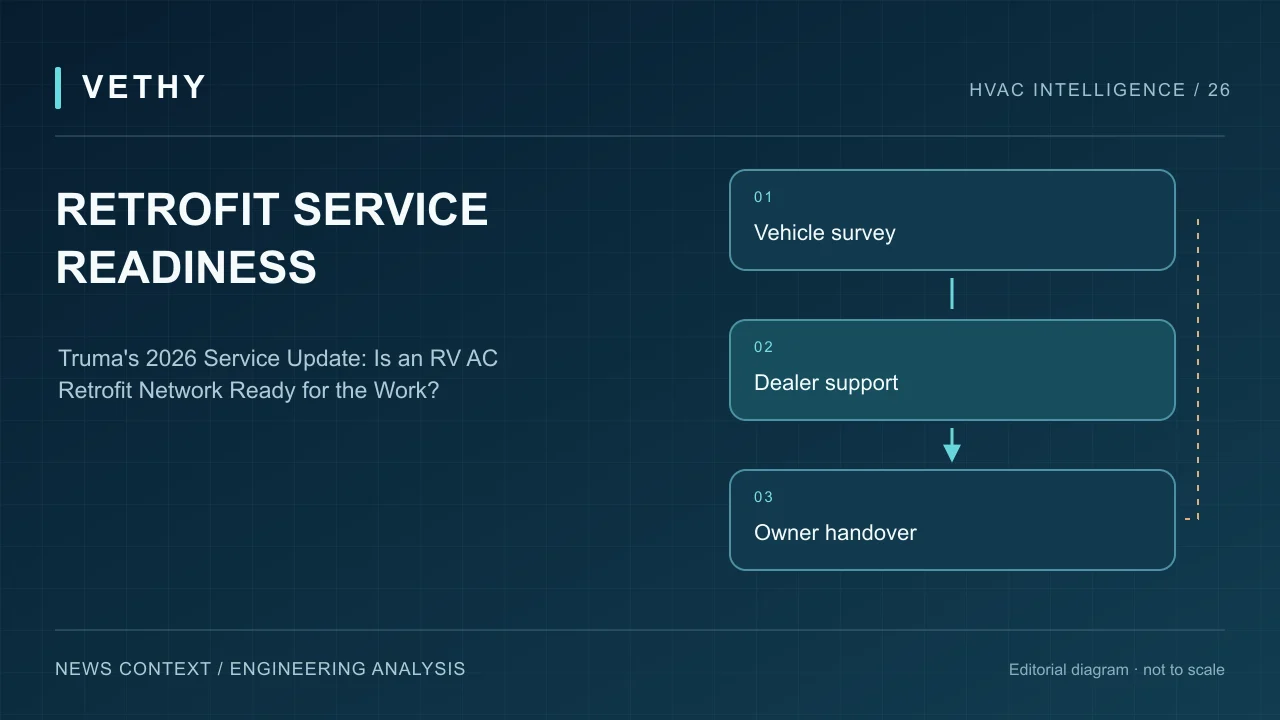
For RV owners and distributors, the practical issue is local execution. A new air conditioner becomes a successful retrofit only when the vehicle can be surveyed, the correct installation completed and the owner supported afterward. This article examines how to evaluate that chain without confusing network size with readiness for an individual job.
Start by defining the job the workshop must perform
A direct replacement, a change to a different air-conditioning architecture and a broader electrical upgrade are not the same service task. A workshop may be well prepared for one and need specialist support for another. The buyer should describe the intended change before asking whether the location can handle it.
Provide the vehicle identification, current equipment details, relevant photographs and the symptoms or improvement sought. Explain whether the vehicle has ducted air distribution, a shared controller or an existing battery-and-inverter arrangement. If those details are uncertain, ask for an inspection rather than presenting guesses as confirmed facts. A good first conversation establishes what the workshop needs to know before it can give a reliable scope and schedule.
A network listing is an entry point, not a complete qualification
A public directory can help identify a nearby location. It may not describe the current availability of trained staff, the products that location supports or whether it undertakes installations as well as repairs. These details can change over time.
Confirm them for the specific job. Ask who will review the installation, whether the location supports the exact equipment and what information is needed before booking. This is ordinary project planning, not an adversarial audit. It protects both parties from a vehicle arriving with an expectation the workshop never accepted. For a fleet, documenting this confirmation can also help purchasing staff avoid sending similar work to a location that only agreed to a narrower service.
Distinguish training, authorization and experience
These terms describe different forms of evidence. Training can show that a person attended or completed a relevant program. Authorization can define the work a manufacturer or organization permits a location to perform. Experience can show that the workshop has completed comparable tasks. None should be casually substituted for the others.
Buyers do not need confidential staff records, but they can ask for appropriate confirmation that the assigned team is prepared for the task. A workshop should be able to explain when it will escalate an unfamiliar configuration. Claiming expertise in every possible vehicle is less useful than identifying the supported work and the process for resolving exceptions. This is particularly important when a retrofit involves interfaces outside the appliance itself.
Separate the pre-installation survey from the sales quotation
An initial quotation can establish a likely cost range and equipment option. A survey establishes what is actually present in the vehicle and whether the proposed scope is suitable. Depending on the project, the survey may be completed from reliable records or require physical inspection.
The buyer should know which stage has been completed. A fixed-looking price based on unverified assumptions can create conflict when the installer discovers a different ceiling arrangement, wiring provision or access constraint. A provisional quotation can be perfectly useful if its assumptions are explicit. The problem is not uncertainty itself; it is uncertainty hidden inside a promise that appears final.
Define ownership across the retrofit journey
| Stage | Main output | Responsibility to clarify |
|---|---|---|
| Initial inquiry | Vehicle and requirement record | Who collects missing information? |
| Survey | Confirmed existing configuration | Who accepts the fitment assessment? |
| Scope approval | Equipment, work and exclusions | Who authorizes changes discovered later? |
| Installation | Approved completed configuration | Who coordinates work across trades? |
| Commissioning | Documented functional checks | Who decides whether open items block handover? |
| Aftercare | Contact route and service record | Who owns follow-up if the complaint returns? |
An owner may deal with one company for the whole journey, but the internal responsibilities still matter. A distributor supplying equipment should also understand where its role ends and where the installer's or manufacturer's role begins.
Booking capacity is a separate constraint
A technically capable workshop may have limited appointment capacity during peak travel periods. The presence of trained staff does not guarantee that those staff are available when the customer needs the vehicle. Ask for the expected inspection and installation dates separately if they are different stages.
For fleets, consider how many vehicles can be taken out of service at once and whether the workshop can support that cadence. A pilot installation may reveal preparation tasks that affect later appointments. It is better to adjust the rollout schedule after that pilot than to assume every subsequent vehicle will take exactly the same time. Similar vehicle models can still contain different installed equipment or previous modifications that need attention.
Parts availability includes the supporting items
A roof unit in stock does not necessarily mean every item for a particular retrofit is available. A ceiling assembly, controller, approved adapter or other required part can determine whether the job is ready to proceed. The correct list depends on the exact configuration.
Ask the workshop to confirm the complete installation package before the vehicle is immobilized. If a part is awaiting confirmation, identify the effect on the schedule and the available choices. Do not substitute an unapproved item merely to preserve an appointment date. For distributors, maintaining a configuration-based parts list helps avoid selling a main unit that cannot be installed as expected with the components supplied.
Commissioning should match the agreed functions
A basic power-on demonstration is not always enough. The installer should confirm the functions included in the project using the appropriate manufacturer procedures and the actual vehicle configuration. If the quotation includes control integration, that integration should be demonstrated. If it includes a supported heating function, the relevant behavior should be explained and checked where conditions allow.
The buyer should receive a record of what was verified and what could not be tested at handover. A limitation caused by the day's weather or available supply should be stated, not silently ignored. Open items need an owner and a plan. This preserves the difference between a completed installation and a fully demonstrated performance commitment without overstating either.
The first trip is a useful observation period
The owner's first representative trip can reveal usage questions that a workshop demonstration does not encounter. Encourage the owner to record the conditions, selected mode and any message when a concern occurs. That information is more useful than a general statement that the new system “does not work properly.”
The workshop should explain how to report those observations and when a problem requires stopping use or contacting qualified support according to the equipment instructions. It should not ask the owner to carry out undocumented technical procedures. A planned follow-up can identify a simple control misunderstanding early, while preserving evidence if a genuine installation or equipment issue needs investigation.
Make handover a practical lesson
A good handover shows the owner how to perform ordinary tasks on the installed system. It explains the meaning of important controls and messages, the supported supply conditions and the routine care described by the manufacturer. It should be specific to the vehicle, not a generic lecture about the product family.
Ask the owner to repeat the essential actions rather than merely watching a technician. This can reveal confusing labels or an assumption that the owner already knows how the power system works. Provide the correct documents and record where they can be found later. A concise, accurate explanation reduces the chance that a normal operating limitation becomes a support complaint during a trip.
Build escalation around evidence rather than blame
Some complaints involve the appliance, vehicle installation and energy supply together. The service process needs a way to move between those boundaries without leaving the customer to coordinate several companies alone. Identify the party responsible for collecting the evidence and managing the next step.
A useful escalation package includes the exact configuration, symptom, conditions and checks already performed. It distinguishes confirmed observations from suspected causes. The aim is to avoid repeated basic questions and unnecessary part replacement. A manufacturer can respond more effectively to a clear record than to a message that says only that the customer is unhappy. The customer should receive a plain-language update explaining what is known, what remains open and when to expect the next action.
A fleet pilot should test the support process too
When a fleet evaluates a new HVAC package, it often focuses on comfort and energy. It should also evaluate how the installation and support process works. Was the survey complete? Did the parts package match the vehicle? Were records accurate? Could staff understand the controls and obtain a useful answer to a technical question?
These are not secondary concerns. A fleet can accept a well-performing product and still suffer disruption if every installation requires improvised coordination. Use the pilot to refine the scope, documentation and appointment plan before scaling. Record the changes made after the pilot so later vehicles receive the approved configuration rather than an informal version remembered by one technician.
Measure service outcomes carefully
A distributor or fleet may want indicators such as installation completion time, return visits or time to resolve a reported problem. Define each measure before comparing locations or periods. A return visit for a planned inspection is different from a return caused by an incomplete installation. Waiting for customer availability is different from waiting for technical diagnosis.
Small data sets can be misleading, so avoid publishing broad success rates from a handful of jobs. The early purpose of measurement is to identify practical improvement opportunities. A pattern of missing parts may call for a better survey form. Repeated control questions may call for clearer handover material. These targeted changes are more useful than an impressive network statistic that does not explain the customer's actual experience.
Plan for staff and product changes
Training does not remain current automatically when products, software or workshop staffing change. A service organization needs a way to identify which knowledge applies to the equipment it is supporting. Buyers can ask how the workshop keeps its installation and service information current without demanding access to internal training systems.
For a distributor, the same principle applies to sales claims. A salesperson should not promise a feature based on a previous generation or another market's version. Keep approved product information connected to the exact equipment being sold. When a change affects installation or operation, ensure that the workshop and customer-facing staff receive consistent information. This reduces the gap between what was sold and what can actually be delivered.
Three buyers need different service evidence
A private owner preparing for a single trip may prioritize a clear appointment, a complete installed price and a nearby follow-up route. The useful evidence is specific to that vehicle and timeframe. A large network can help locate options, but it cannot replace a confirmed local arrangement.
A rental operator may prioritize repeatable installations, clear user instructions and rapid triage across several locations. It needs a shared record format and a defined escalation owner. A vehicle manufacturer may need prototype support, production guidance and a plan for the geographic markets in which vehicles will be sold. The service organization should explain which of these needs it can meet rather than presenting one generic support promise to every buyer.
Do not let warranty language replace a service plan
Warranty terms and practical support arrangements are related but different. A buyer should read the applicable terms for the exact product and market, then ask how a claim is initiated and who performs any required assessment. Do not infer coverage, reimbursement or turnaround from a general statement about service commitment.
A useful service plan also addresses situations that may fall outside a warranty claim, such as owner instruction, inspection or a vehicle-side issue. The parties should understand how those tasks are authorized and communicated. This article does not interpret specific warranty obligations. It recommends keeping the contractual terms and the operational process visible so the customer knows how to obtain help.
What a distributor should prepare before promoting a retrofit offer
Prepare an application intake form, a confirmed equipment package and a clear installation scope. Identify the workshops or integration partners that have agreed to support it, together with the conditions of that agreement. Provide sales staff with approved claims and a way to escalate uncertain fitment questions.
For a VETHY-related project, start with the technical inquiry guide and discuss installation responsibility through the engineering route. The objective is a supportable offer for the correct application. This coverage of another manufacturer's announcement does not imply that VETHY is an authorized service location for that brand or that its network supports VETHY equipment.
A hypothetical retrofit timeline shows where delays arise
Imagine an owner books a replacement roof air conditioner shortly before a trip. The workshop confirms that the main unit is available, but the existing ceiling assembly has not yet been identified. When the vehicle arrives, the installer finds that an additional approved component is needed. The resulting delay is not necessarily evidence of poor equipment quality; it exposes a gap in the preparation process.
A better sequence would identify the uncertain assembly before confirming a completion date. If photographs and records cannot resolve it, the workshop could schedule an inspection or make the booking conditional. The owner then understands the risk while there is still time to adjust travel plans. This hypothetical example illustrates process design, not an actual incident involving any named company.
Now consider a second case: the installation is complete, but the owner cannot operate the intended mode because the handover used terminology from another controller version. The next service call may be avoidable with configuration-specific instructions. The lesson is that parts readiness and user readiness are separate. A successful workshop visit should address both.
Set a useful standard for appointment confirmation
An appointment confirmation should identify the vehicle, proposed work, current status of required parts and any unresolved assumptions. It should state whether the booking is for diagnosis, installation or a combined visit. Where an inspection may change the scope, explain how approval for additional work will be obtained.
For a fleet, include the expected vehicle release process and the person who can accept the completed work. This avoids a technician finishing the physical installation while the vehicle waits for an unavailable decision-maker. The confirmation does not need to be a long contract; it needs to remove the ambiguities most likely to disrupt the job.
Also distinguish an estimated duration from a guaranteed completion commitment. Either can be useful when stated accurately. A workshop should not be penalized for identifying a genuine condition that requires more review, but the customer deserves prompt communication about its effect on the schedule. Clear preparation creates room for responsible decisions when the vehicle differs from the initial assumptions.
Make the aftercare route visible before the customer leaves
Owners should know whom to contact, which information to provide and how urgent concerns are handled under the product's instructions. A generic contact address without ownership can lead to repeated handoffs. The selling dealer, installer and manufacturer may have different roles, so explain the route for the type of support the customer is likely to need.
For a traveling owner, ask how assistance is arranged away from the original workshop. Do not assume that another location will automatically perform the same work under the same terms. The applicable support and warranty arrangements need confirmation. The value of a network is greatest when the owner understands how to use it, not merely that it exists.
The workshop should retain a record of the advice given. If a later issue is escalated, the next technician can see the installed configuration and previous observations. That continuity prevents the customer from becoming the only person carrying information between organizations.
Use early feedback to improve the offer, not to manufacture testimonials
The first group of installations can provide useful operational feedback. Ask whether the scope was clear, whether the handover explained normal use and whether any unexpected work occurred. Record the answers as internal improvement evidence unless the customer has specifically agreed to a public statement.
Do not turn a short successful trip into a claim of long-term reliability. Do not describe an unresolved issue as a satisfied customer merely because the vehicle left the workshop. Honest feedback can still support a strong commercial offer: it shows where the process is dependable and where it needs adjustment before wider rollout.
Frequently asked questions
Does a large service network mean a retrofit can be booked immediately?
No. Availability depends on the location, staff, required parts and scope of work. Confirm the exact job with the intended workshop and distinguish an initial inspection appointment from a completed installation booking.
Should an owner choose the nearest listed location automatically?
Distance matters, but so does relevant capability. Confirm that the location supports the exact product and the type of work required. A slightly different service arrangement may be more suitable if it provides the necessary inspection, installation and follow-up responsibilities.
Is training proof that every installation will be successful?
No. Training is useful evidence of preparation, but the actual vehicle, approved configuration, workmanship and commissioning still matter. Evaluate the complete process rather than treating one credential or directory entry as a guarantee of every outcome.
What should be retained after the retrofit?
Keep the installed equipment identification, scope of work, relevant configuration, commissioning record, operating documents and support contact. Those records help future technicians understand what is present and reduce reliance on the original installer's memory.
What is the main purchasing lesson from the service update?
Buy the delivery process along with the equipment. A credible retrofit offer explains how the vehicle will be assessed, who will complete the work, how the result will be checked and how the owner will obtain help. That is the practical meaning of support capacity for an individual customer.
Sources and editorial scope
- Truma is heading into the new year with optimism and readiness — Truma North America, 2026-01-28.
Analysis by VETHY, published November 7, 2026. Source news dates are shown separately. Manufacturer claims are attributed; examples and decision frameworks are editorial analysis, not VETHY test results. Mention of another brand does not imply a commercial affiliation or approved compatibility.