
VETHY / VEHICLE HVAC NEWS AND ANALYSIS
Truma's CombiNeo Recognition: Planning Heating, Hot Water and Cooling as One Travel Day
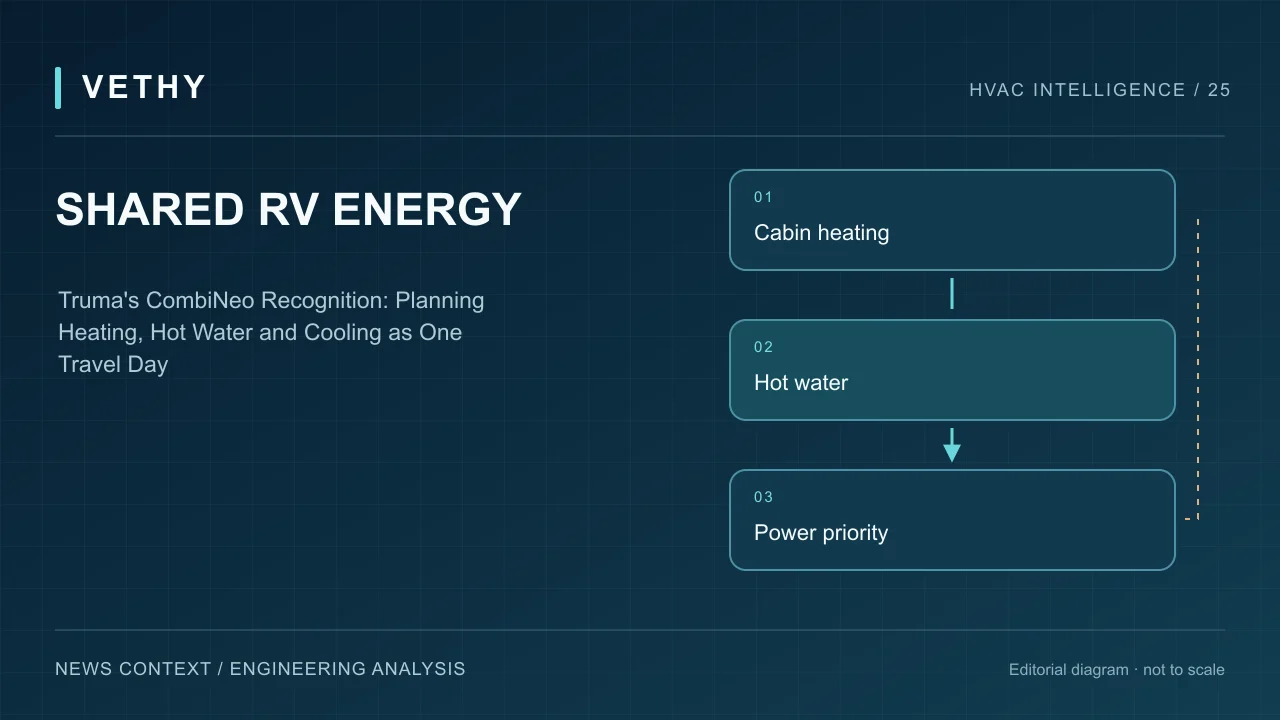
An RV thermal plan should define when occupants need cabin heat, hot water and cooling, then match those services to the vehicle's available energy and controls. Combining functions can simplify some interfaces, but buyers still need separate requirements, sensible priorities and clear behavior when resources are limited.
News facts: recognition for a combined comfort product
Truma's English news page dated January 30, 2026 reported a European Innovation Award for its CombiNeo two-in-one heater in the Technology category. The same announcement noted recognition for the second-generation Aventa roof air conditioner in another category. The release is evidence of those awards, not a measured comparison of whole-vehicle energy use or a guarantee that every combination of equipment will satisfy every travel pattern. Read Truma's announcement.
The practical question for vehicle designers goes beyond individual products: what comfort services do occupants need at each point in the day, and how should the vehicle provide them? This analysis uses that question to structure an RV thermal plan. It does not claim that a named appliance has functions or interfaces beyond its verified documentation.
A travel day is a sequence of thermal demands
A camper might need cabin heat and hot water before breakfast, little heating during a midday drive, cooling after arriving at a sunny campsite and more hot water in the evening. Overnight, occupants may value stable conditions and low disturbance. These requirements occur at different times and under different supply conditions.
Writing that sequence down often reveals information missing from a conventional equipment list. The list might identify a heater, water appliance and air conditioner while saying nothing about when they operate together. A schedule helps the designer understand the intended service rather than simply adding up nameplate ratings. It also gives the owner a clear basis for explaining what “comfortable off-grid travel” actually means in the context of the vehicle.
Keep the services separate before integrating them
Cabin heating, domestic hot water and cabin cooling solve different problems. Even if some functions share equipment or controls, each needs its own requirement. A cabin temperature objective is not a hot-water delivery objective, and neither establishes a cooling requirement.
Start with simple descriptions that a user can recognize. For cabin heat, identify occupied areas and expected conditions. For hot water, describe fixture use and timing. For cooling, identify the occupied period and whether the vehicle starts hot. Once these are clear, examine where the services interact. Integrating an undefined set of requirements usually produces an attractive control panel and unresolved expectations. Integrating well-defined services gives the engineering team something meaningful to coordinate and test.
Define “simultaneous” carefully
An owner may expect two services to be available during the same general period without needing both to operate at maximum output at every instant. Another use case may genuinely require concurrent performance. These are different design commitments.
Ask practical questions. Must hot water be available while the cabin warms from a cold start? Is a short delay acceptable after a user changes modes? Can an owner choose a priority, or should the system use a fixed approved strategy? The answers should come from the intended use and the equipment's supported behavior. Do not promise unrestricted simultaneous operation because a product combines two functions. The relevant evidence is the documented capability of the selected configuration and the completed vehicle.
Match priorities to the available energy source
A vehicle connected to an appropriate external supply may have different options from the same vehicle parked away from services. Driving can create another operating condition. The thermal plan should identify these states without assuming that every energy source is always available.
| Travel period | Comfort request | Resource question | User information needed |
|---|---|---|---|
| Morning departure | Warm cabin and planned hot-water use | Which approved sources are available before driving? | Expected readiness and any priority setting |
| Daytime travel | Maintain the agreed cabin condition | Which auxiliary services are supported in this state? | Normal control mode and relevant restrictions |
| Arrival | Cool or warm a previously unoccupied interior | What energy is available after the journey? | Difference between a request and achieved comfort |
| Evening | Occupied comfort and hot-water use | Can the intended services operate together? | Any sequencing or supply limitation |
| Overnight | Stable conditions with limited disturbance | What reserve must remain? | Clear low-resource and unavailable-state messages |
This is a generic planning table. It is not a feature list for the award-winning product or a claim that any specific RV supports these states automatically.
Establish an energy budget without reducing comfort to one number
A daily energy budget connects the schedule to resource use. It should include each major thermal service and the other loads that share its supply. Where multiple energy sources exist, record them separately rather than pretending they are interchangeable.
The budget does not need false precision. Early estimates can use ranges and identified assumptions. Later development should replace the important assumptions with manufacturer information or representative measurements. The key is to preserve the connection between an estimate and its use case. A number developed for mild-weather cabin maintenance should not quietly become the basis for a cold-start or hot-afternoon promise. A useful budget helps the team decide where further evidence matters most.
A worked schedule illustrates priority decisions
Imagine an illustrative RV with an electrical supply limit that cannot accommodate every desired load at once. The owner wants a heating service averaging 1.0 kW for thirty minutes and another comfort load averaging 1.2 kW for the same period. Together, the assumed average demand would be 2.2 kW. Running them sequentially changes the timing of service, even if their combined energy requirement remains approximately the same.
This example is not a specification for a heater, water system or air conditioner. It shows why peak demand, energy and user waiting time must be considered separately. Sequencing may help with a supply constraint, but it may be unacceptable if the user needs both services immediately. The designer must therefore agree the priority rule with the owner rather than choosing it solely to make an electrical table look easier.
Avoid unnecessary heating and cooling conflicts
When separate controllers manage the same occupied space, the project should consider whether their settings can create conflicting requests. The right solution depends on the equipment and supported integration, but the issue should not be left to chance.
Define which control is responsible for the room condition and how other equipment participates. Where fully coordinated control is unavailable, clear user instructions and appropriate supported settings may be necessary. Do not improvise wiring or override safety functions to force a desired relationship. The goal is an understandable system that performs the intended task without asking users to remember a complicated set of undocumented exceptions every time the weather changes.
Sensor placement affects what the control system knows
A controller can only act on the information available to it. The temperature near a doorway, a warm appliance or a direct air stream may not represent the occupied area. This matters when one system is expected to coordinate several comfort functions.
During design review, identify the sensing locations and the spaces they represent. If the vehicle has separated sleeping and living areas, ask how their conditions will be evaluated. Avoid assuming that a single displayed value proves uniform comfort throughout the interior. A prototype evaluation should compare the control's view with observations at relevant occupied positions. Any difference becomes a design question to resolve, rather than an unexplained complaint after the vehicle reaches the customer.
Distinguish room conditioning from water availability
A thermal system can show an active heating mode while the specific service an owner wants is not yet ready. For example, a user may see a general status indicator and assume that hot water is available immediately. The interface and handover should make the distinction clear.
Use plain descriptions of requested, active, ready and unavailable states where the equipment supports them. Do not label a display “ready” merely because a command has been accepted. If the appliance does not expose that level of information, explain the limitation honestly rather than inventing a status signal. This is particularly useful in rental vehicles, where users may never have seen the controls before and need to understand them quickly.
Transition tests reveal problems that isolated tests miss
Testing the heater, water function and air conditioner separately can show that each works. It may not reveal what happens when the owner changes the operating state. A supply change, vehicle shutdown or shift from a daytime setting to a night setting can expose assumptions hidden in individual tests.
Create a short sequence of representative transitions and record the expected behavior. Does the previous request remain active? Is a new confirmation required? What message appears if a resource is unavailable? The correct answers depend on the approved system, but they should be deliberate. An unexpected restart or silent loss of a requested service can damage user confidence even when no individual component has failed.
Treat quiet operation as a schedule-specific requirement
The equipment that is unobtrusive during daytime activity may become noticeable when occupants are sleeping. The relevant concern can include airflow, switching events or other operational sounds. A generic quiet-mode label does not identify what the owner will experience in the installed vehicle.
Evaluate the intended overnight configuration from the sleeping position. Record which services are operating and which settings are selected. If the system changes behavior during the night, include that transition in the observation. This does not require inventing a universal acceptable sound level. It requires agreement about the use case and a demonstration that the selected configuration is suitable for it. The owner should also understand any tradeoff between reduced disturbance and the available thermal output.
Plan for the day when the preferred source is unavailable
A travel plan can change because an external connection is unavailable, a charging opportunity is shorter than expected or the owner stays parked longer. The system needs a clear response that respects its approved operating limits.
Describe the supported alternatives and the services that remain available under each. If a function cannot operate, the user should receive understandable information rather than a vague error that suggests a broken appliance. Avoid calling a vehicle fully autonomous unless the claim has a defined duration, resource starting point and operating conditions. A realistic contingency plan is more valuable than an expansive description that ignores the supplies on which the comfort functions depend.
Separate normal owner choices from technical settings
A well-designed interface exposes useful choices without turning every trip into a commissioning exercise. Owners may need to choose a desired temperature, schedule or supported energy mode. They should not have to alter undocumented configuration values to obtain ordinary comfort.
The manufacturer and installer should identify which settings are intended for routine use and which belong to qualified service personnel. Handover instructions should follow that distinction. If a system only performs well after an expert makes several hidden adjustments, the project should examine whether those adjustments belong in the approved configuration. Passing them on as informal tips is a poor substitute for a reproducible setup that can be supported later.
A rental fleet needs consistent operating language
Rental customers may use different vehicles within the same fleet. If similar functions have different names or instructions, support staff spend time translating between configurations. Standardized handover material can help, provided it accurately reflects what each vehicle supports.
Create a concise operating map for each approved configuration. Identify the main comfort controls, the meaning of key states and the first step when a service is unavailable. Keep model-specific restrictions attached to the correct vehicle. A fleet-wide instruction should not erase important differences between systems. The aim is consistency where possible and clear distinction where necessary, allowing staff to give accurate help without pretending that every unit is identical.
Give the service team a useful fault history
When a customer reports a comfort problem, the sequence before the problem can be as important as the final symptom. Record the operating mode, available supply, recent changes and displayed messages. An owner does not need to diagnose the cause; the purpose is to preserve observations that help a qualified technician investigate.
A good support process distinguishes a resource limitation, a control misunderstanding and an equipment fault. They may produce similar user complaints but require different responses. Avoid repeatedly resetting a system without recording what happened. For an OEM or fleet, aggregated observations can reveal a recurring transition or instruction problem. That is a more useful improvement signal than counting every call as a defective appliance.
Compare architecture choices with the same service schedule
A combined appliance, separate appliances and a more integrated vehicle system can all be reasonable approaches. Compare them against the same required services and operating schedule. Include space, energy supply, controls, installation effort and service access in the decision.
Do not assume that fewer boxes always mean less total complexity. Shared functions can simplify some interfaces while creating dependencies that deserve attention. Separate equipment can offer flexibility while adding controls and installation work. The buyer should understand these tradeoffs in relation to the actual vehicle, rather than treating integration as a slogan. A clear responsibility map helps whichever architecture is chosen: someone must own the completed experience across the components.
Write a thermal brief that can be reviewed
A useful brief describes the vehicle, occupants, destination conditions and daily comfort sequence. It identifies available supplies and known constraints, then lists the services that must operate together. It should also state which questions remain open and who will provide the missing information.
For a VETHY project, discuss the vehicle-level objective through the engineering route and identify whether the request concerns an HVAC module or a broader integration interface using the module overview. The objective is to define a credible scope. Reporting another brand's award does not establish that VETHY supplies, supports or is affiliated with that brand's equipment.
Two travel patterns can justify different priorities
Consider two hypothetical customers using similar vehicle layouts. The first regularly connects to a suitable external supply and wants the cabin ready before returning from an afternoon activity. The second spends several days away from that supply and accepts a more deliberate operating schedule. Their desired comfort may be similar, but their resource assumptions are different.
For the first customer, the design conversation might emphasize convenient scheduling and predictable transitions between heating and cooling. For the second, it might emphasize reserve visibility, clear source selection and an explicit plan for replenishment. Neither pattern is inherently more advanced. The equipment and controls should fit the actual behavior rather than a marketing image of how every owner travels.
A sales discussion can make this distinction with a few concrete questions: Where is the vehicle usually parked overnight? Which services are expected before the first drive? How often does the plan change? Who operates the controls? The answers turn a broad request for comfort into a specification that can be reviewed.
Keep the comfort schedule separate from the installation schedule
The travel-day plan describes what the owner needs. The installation plan describes how the vehicle will deliver it. They should be connected but not confused. For example, a requirement for morning hot water does not prescribe a particular appliance location or control architecture. Those choices still need engineering review.
This distinction helps an OEM compare suppliers fairly. Give each supplier the same service requirements and ask it to explain its proposed implementation, limits and dependencies. Different approaches can then be assessed against the same outcome. If a supplier proposes changing the operating requirement, make that change visible so procurement understands that the offers are no longer equivalent.
The final approved design should preserve this connection. Each important service requirement should point to the configuration and evidence that support it. That makes later changes easier to assess and prevents a production revision from unintentionally altering a promise made to the customer.
A simple transition record improves future troubleshooting
When evaluating a prototype, record the starting state, user action, available supply and observed result for each important transition. For example, a user may request a new comfort mode after reconnecting to an external supply. The record should show what the system actually does, including any delay or message, without assuming what the designer intended.
These observations can become concise handover explanations and support references. If a customer later describes the same transition, the service team has a known baseline. If the behavior differs, the team can investigate the configuration or conditions. This is more useful than relying on a general statement that the system was tested and worked correctly.
The record also helps distinguish a confusing interface from a technical failure. A function may be unavailable for a documented reason while the message leaves the user uncertain. That finding may call for clearer instructions or a supported interface improvement, rather than replacing hardware that is functioning normally.
Review the plan when the vehicle's use changes
An owner may add occupants, travel in a different season or begin spending more time away from external supplies. A rental fleet may change its customer profile. These changes can alter the assumptions behind the original thermal design even when no equipment has failed.
Retain the original service brief and revisit the relevant parts when the use changes substantially. The result may be a different operating schedule, additional information for users or an engineering review of the configuration. Treating the brief as a living description of intended use makes thermal management more useful than a static list of appliances installed at delivery.
Frequently asked questions
Does combining cabin heat and hot water remove the need for separate specifications?
No. The functions still have different service requirements. Specify each one, then describe the intended simultaneous use and acceptable priorities. Integration becomes useful when it coordinates clear requirements, not when it hides them inside a general comfort claim.
Can a central control panel guarantee energy management?
Not by itself. The available functions depend on the connected equipment, supported interfaces and approved configuration. Ask which decisions the system actually makes and which remain with the user. A single screen is not proof that every load is automatically coordinated.
Should hot water always take priority over cabin comfort?
There is no universal answer. The appropriate rule depends on the application, equipment and occupants' needs. The priority should be deliberate, supported by the system and understandable to the user. Where essential comfort is involved, the responsible designer must address the relevant requirements directly.
What should be tested before a new vehicle configuration is released?
Test the agreed services and the transitions between important operating states. Include supply changes, representative simultaneous requests and the intended nighttime arrangement. Record the conditions and keep unresolved items visible rather than treating a successful demonstration of one appliance as acceptance of the whole system.
What is the practical lesson from integrated comfort-product news?
It is an opportunity to specify the travel day more carefully. The strongest thermal design connects equipment capabilities to an explicit operating plan, with clear controls and realistic resource limits. That gives the owner a vehicle whose comfort services are predictable and gives the support team a system it can explain.
Sources and editorial scope
- Truma wins European Innovation Award 2026 in the Technology category — Truma, 2026-01-30.
Analysis by VETHY, published November 7, 2026. Source news dates are shown separately. Manufacturer claims are attributed; examples and decision frameworks are editorial analysis, not VETHY test results. Mention of another brand does not imply a commercial affiliation or approved compatibility.