
VETHY / VEHICLE HVAC NEWS AND ANALYSIS
Thermo King’s TDDE Announcement: Validate Double-Decker HVAC One Zone at a Time
A double-decker bus needs evidence that both decks and the driver zone receive the intended climate service. Total heating or cooling capacity cannot establish that distribution. Thermo King’s September 2026 TDDE announcement is a prompt to specify zone loads, airflow paths, control priorities and acceptance measurements for the exact bus body and route.
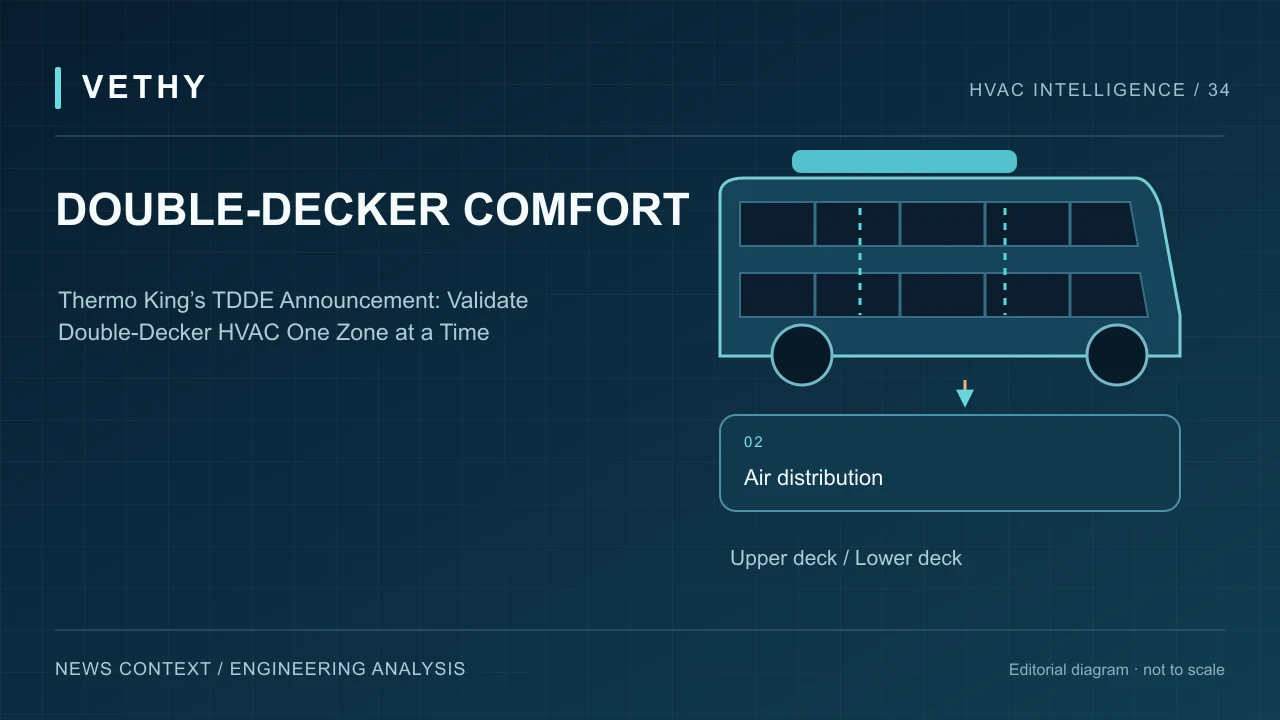
News facts: a heat pump for electric double-decker buses
Thermo King’s September 29, 2026 announcement for APTA TRANSform lists TDDE, described as a new electric heat pump designed for North American electric double-decker buses. The release also presents other transit climate products for the October 4–7 Chicago event. It does not provide the TDDE capacity, refrigerant, dimensions or detailed airflow arrangement in the material reviewed. Those specifications should not be inferred from the announcement or from another product in the range. Read Thermo King’s dated release.
The application itself raises an important design question: how should a bus with two passenger decks demonstrate useful climate control? The analysis below develops a zone-based approach for vehicle builders and operators. It is not a reconstruction of TDDE’s design, an independent test of the product or a claim that VETHY is involved in its development.
The whole-bus average can conceal an uncomfortable deck
A double-decker bus has more than one occupied environment. The upper and lower decks can experience different solar exposure, occupancy, door effects and airflow paths. The driver’s workplace has a separate set of operating needs. A single whole-vehicle temperature or total capacity figure cannot establish that every occupied area receives the intended service.
For example, a hypothetical bus could have one deck cooler than desired and the other warmer than desired while an average falls close to the target. That arithmetic result would not describe either passenger experience. A control sensor in one convenient location can create a similar blind spot if its reading is assumed to represent all zones without supporting measurements.
Define the important zones before selecting acceptance measurements. At minimum, consider each passenger deck and the driver area, then identify local positions with distinct exposures. The final arrangement should reflect the actual body design and route. The objective is not to add sensors everywhere, but to ensure that the evidence can reveal a meaningful distribution problem instead of hiding it in an average.
Describe the loads by location and time
The thermal demand of a zone changes through the assignment. Solar exposure, outside conditions, passenger numbers and door activity can affect different areas at different times. A design review should therefore describe where demand occurs and when it changes, rather than using one undifferentiated passenger-space assumption.
An upper deck may have substantial exposure through roof and glazing, but it should not simply be labelled the hot deck under every condition. Direction of travel, shading, occupancy and season can alter the pattern. The lower deck may be more directly affected by boarding and door openings. These are reasons to examine the real vehicle and route, not universal numerical design rules.
Build a load narrative for representative operating periods: morning preparation, initial boarding, a busy service interval, a layover and a return to the depot. The narrative should identify the likely demand changes without pretending to replace a qualified thermal calculation. It gives the engineering team a common application description and helps the operator understand why a system must handle more than one steady condition.
Total capacity and delivered distribution are separate questions
A heating or cooling source must have an appropriate capability for the assignment, but the useful service also depends on delivering that capability to occupied zones. Air paths, outlets, return arrangements and controls influence where the effect reaches passengers. Increasing a headline capacity does not automatically resolve an uneven distribution problem.
The supplier should define the boundary of its rating and the vehicle integrator should define the installed distribution system. Ask how those two descriptions connect. A module may meet its stated performance under specified conditions while the finished bus requires further work on ducts or controls. Conversely, an apparent distribution problem may result from a different operating mode or an incorrect configuration. The evaluation needs evidence before selecting a remedy.
This is why procurement should avoid one-line acceptance based solely on total kilowatts. State the required zone results and relevant operating conditions, then ask the responsible team to show how the selected module and installation achieve them. The capacity number remains important, but it becomes one part of an accountable vehicle-level argument.
Review supply and return paths together
A useful distribution review follows the complete path of conditioned air through the occupied space and back through the intended return arrangement. Looking only at outlets can miss restrictions, short circulation paths or installation details that affect how the space is served. The exact design should be evaluated by the responsible HVAC and body engineers.
Ask for drawings that distinguish the module interfaces from the vehicle ductwork and passenger-zone openings. Identify access panels, filters and other elements that need inspection or service. If trim or passenger fittings change, review whether they alter the accepted airflow arrangement. A visually small interior change can matter if it obstructs a path the original design relied on.
The review should also consider production consistency. A prototype may have carefully fitted ducts that are difficult to reproduce on every bus. The manufacturing process needs inspection points relevant to the approved arrangement. The aim is to make the accepted distribution repeatable, rather than treating each vehicle as a separate tuning exercise after delivery.
The staircase connects spaces but does not replace zone design
A staircase and other openings can connect the environments of two decks, but they should not be assumed to balance them adequately. The direction and amount of air movement can change with operating conditions, doors and the active distribution system. A project needs evidence of the resulting passenger environment rather than relying on a general idea that warm or cool air will find its way to the right place.
This is especially important when interpreting complaints. A person near the staircase may experience a different condition from someone at the far end of a deck. Measuring only near the connection can make the two decks appear more similar than the occupied seating areas actually are. Select observation points that represent both the connection and the remote locations where distribution problems might persist.
Where a design change affects the staircase enclosure, interior partitions or return paths, the team should review its thermal effect alongside the architectural change. The purpose is not to impose one particular layout. It is to recognize that a double-decker interior forms part of the HVAC installation and should be treated as a controlled engineering interface.
Give the driver zone an explicit requirement
The driver’s environment cannot be treated as an incidental extension of the passenger space. The workplace has its own controls, visibility needs and operating exposure. The vehicle design must establish the approved functions and how they interact with the rest of the climate system. This article does not prescribe a defrost strategy or operational safety limit.
For procurement, identify the driver-zone result and the information needed when a function is unavailable. A driver should not have to compromise an essential operating requirement to improve conditions elsewhere. The control priorities must come from the responsible vehicle design and applicable requirements, with clear instructions for the operator.
During acceptance, record driver-zone behavior separately from passenger-deck results. A successful average passenger condition cannot stand in for that evidence. Likewise, a comfortable driver workplace does not prove that both decks are being served. Separate observations make it easier to identify the actual problem and assign it to the appropriate part of the system.
Define zone control without promising impossible independence
A system may provide separate sensors, separate requests or separate air paths, but those features do not automatically mean that every zone can operate independently under every condition. Shared sources and vehicle limits can create dependencies. Buyers should ask what independence actually means in the offered configuration and which constraints remain.
Describe several simultaneous requests in plain language. What happens when one deck needs cooling while another is near its target? How does the system respond after a door-intensive service interval? Which priorities apply when the driver zone requires a particular function? The supplier should explain the approved behavior and the status information available to the operator.
Avoid a specification that simply says each deck shall be independently controlled without defining the required outcomes. Such wording can produce disagreement about whether separate setpoints, separate fans or fully separate thermal systems were intended. Start from the passenger and operating requirements, then let the engineering review establish an appropriate and verifiable control arrangement.
Use a zone-level acceptance matrix
| Operating case | Locations to examine | Question the evidence should answer |
|---|---|---|
| Predeparture preparation | Both decks and driver zone | Is the required environment available at the planned boarding time? |
| Representative occupied service | Front, middle and rear positions on each deck | Are local differences within the agreed application limits? |
| Repeated boarding | Door-adjacent lower-deck positions and comparison points | Does the system recover as required after disturbances? |
| Strong exposure change | Relevant glazing and remote seating positions | Does control respond without hiding a persistent zone problem? |
| Layover | Occupied zones and control status | Does the approved stationary mode provide the required service? |
| Return after a limitation | Affected zones and status indications | Is recovery understandable and consistent with the approved design? |
The matrix should be adapted to the actual bus and route. It is not a universal test standard or a set of numerical acceptance limits. The parties need to agree those limits using the intended service and applicable requirements. What the matrix provides is a structure that keeps the test focused on delivered passenger conditions rather than a single convenient sensor.
Choose measurements that explain the passenger experience
Temperature measurements should be located and documented consistently. Measurements directly in a supply jet can describe outlet behavior rather than the environment at a seat. Measurements near glazing can be influenced by local exposure. Both may be useful for specific questions, but the test team should state what each location is intended to represent.
Combine the measurements with time-linked observations of occupancy, doors and selected operating mode. If a deck becomes uncomfortable after a particular event, that context helps distinguish a load change from a control or distribution issue. A chart without those events can show the symptom while leaving the team unsure what caused it.
Occupant feedback should be structured rather than reduced to a single comfort score. Ask where and when the issue occurred and whether it involved uneven temperature, excessive local airflow, lack of airflow or an unstable response. Feedback does not replace instrumented evidence, but it can guide a focused investigation and reveal a position the original measurement plan did not adequately represent.
A simple example shows why averages need care
Consider an illustrative test with four representative readings: 21 and 22 degrees Celsius on one deck, and 28 and 29 degrees on the other. The simple average is 25 degrees. That average could appear acceptable against a loosely stated target, yet it masks a substantial difference between the measured locations. These are invented teaching values, not results from a Thermo King unit or any real bus.
The lesson is not that a particular spread is always unacceptable. The project must define its own criteria and measurement method. The lesson is that a whole-bus average should be accompanied by location-level results and relevant time histories. Otherwise, a summary can conceal the problem the test was supposed to detect.
The same caution applies over time. An average calculated across preparation, normal service and a long interruption can hide a short but important failure to meet the boarding requirement. Choose summary metrics that match the service question, and preserve the underlying data so the team can examine the event rather than argue about an ambiguous final number.
Heat-pump operation adds mode-transition questions
A heat-pump system can serve different thermal functions according to its design, but the operator needs to understand the behavior relevant to the vehicle. The acceptance plan should examine the approved transitions and constraints, not only stable heating or cooling. The exact sequence and protective actions must come from the manufacturer’s current documentation.
For example, a project may need to examine a change in requested mode, a restart after a planned stop or recovery from an approved limitation. During these events, record what each occupied zone experiences and what status information reaches the driver. The goal is to establish predictable service across the assignment, including moments when the system is changing state.
Do not infer detailed capabilities from the phrase heat pump. The available functions, operating envelope and integration requirements belong to the specific product and vehicle configuration. The public TDDE announcement establishes the intended application, but it does not provide enough technical detail to determine those parameters for a purchasing decision.
Inspect service access by deck and component
A double-decker installation can create service tasks in several physical locations. The maintenance review should identify where filters, controls, distribution elements and the main module are accessed, using the actual design. A technician should be able to follow the approved procedure without unnecessary disturbance of unrelated interior parts.
Ask which inspections are routine and which repairs require special access equipment or vehicle withdrawal. Those answers affect the fleet’s maintenance plan and workshop capability. An installation that is easy to assemble in a factory may still need a carefully planned service method once the bus is operating. Include that method before accepting the production arrangement.
Keep service changes connected to the accepted distribution. If an interior panel or duct section is removed and refitted, the approved condition should be restored and checked as required. A maintenance event should not unintentionally create a new restriction or an unsealed path. Configuration records help the workshop preserve the vehicle-level result established during acceptance.
Diagnose a deck imbalance before increasing capacity
If one deck is uncomfortable, begin by confirming the operating conditions and comparing the observed behavior with the accepted configuration. Check whether the complaint is persistent or linked to a particular route phase. Qualified personnel can then investigate the relevant controls, distribution and equipment using approved procedures.
Replacing the main unit with a higher-capacity alternative may be unnecessary if the limiting issue is elsewhere. It can also introduce new electrical, structural or control requirements. A proposed change should therefore be supported by evidence of the actual cause and a review of the complete installation. The aim is to solve the identified problem, not merely to select a larger number.
After a correction, repeat the measurements that exposed the issue and confirm that other zones remain acceptable. A change that improves one deck while degrading another is not a complete resolution. Retain the before-and-after context so the fleet can recognize whether the same issue occurs on other vehicles with the same configuration.
Preserve evidence when the body layout changes
Different seating layouts, glazing options, partitions or interior finishes can change the assumptions behind an accepted HVAC arrangement. A bus builder should review those differences before transferring a result from one body configuration to another. The required response may be a focused assessment rather than a complete new program, but it should be explicit.
Create a change record that identifies what changed, which thermal assumptions may be affected and what evidence supports continued acceptance. This is particularly useful when a fleet orders several variants under one commercial program. The common platform can simplify work, but it does not eliminate application differences.
The operator should retain the final accepted configuration with its service documentation. Later interior modifications can then be reviewed against a known baseline. Without that reference, a distribution complaint years later may be difficult to separate from changes made after delivery. Traceability protects the value of the original engineering work.
Translate zone information into useful driver reports
The fleet can make reporting easier by using the same location names in the cabin, maintenance records and technical drawings. A report that says upper deck rear is more useful than a complaint that the bus is warm, especially when a vehicle has several distinct air paths. The driver should not need to identify a component or diagnose the system to describe the affected place.
Keep reporting focused on observations: location, time, selected mode and whether the condition followed boarding, a layover or another recognizable event. Where passenger feedback is collected, avoid unnecessary personal details. Qualified staff can then compare the report with the accepted zone map and decide which evidence is needed next.
Consistent location names also improve fleet learning. Similar reports from several vehicles can be compared without guessing whether different people meant the same area. This turns local comfort complaints into clearer engineering evidence while keeping technical investigation with the appropriate personnel.
Frequently asked questions
Is total cooling capacity enough to specify double-decker HVAC?
No. It is one input. The complete requirement also needs zone results, operating conditions, airflow distribution and control behavior. A suitable source must be connected to an installation that delivers the intended service throughout the occupied vehicle.
Is the upper deck always the most demanding zone?
Do not assume that universally. Exposure, occupancy, doors, route and season can change the pattern. Examine the actual vehicle and service. The design should be based on relevant conditions rather than a fixed label that obscures another demanding location.
Does a double-decker bus require two completely separate systems?
That is a design decision, not a conclusion from this announcement. Different architectures may meet the requirements if properly engineered and validated. Specify the service and constraints first, then review the proposed arrangement and its evidence with the responsible suppliers.
Are these TDDE performance or installation specifications?
No. The article uses the announcement as a news starting point and develops a generic application framework. No capacity, refrigerant, dimensions, compatibility or measured result is claimed for TDDE. Obtain current product and vehicle documentation for a real procurement decision.
Specify the passenger result before selecting a package
A useful brief includes the body layout, deck occupancy, glazing, doors, route pattern, climate, driver requirements and intended stationary operation. Add the electrical and packaging constraints supplied by the vehicle team. Identify the zone-level evidence needed to approve the finished bus, then connect module and installation responsibilities to that evidence.
Start with the bus application overview, use the HVAC module page to discuss assembly interfaces, and bring the complete brief to an engineering review. The goal is a double-decker climate system whose performance can be understood at the places passengers and drivers actually occupy, rather than inferred from a single whole-vehicle headline.
Sources and editorial scope
- Thermo King to showcase new climate solutions supporting transit fleet decarbonization at APTA TRANSform2026 — Thermo King, 2026-09-29.
Analysis by VETHY, published November 7, 2026. Source news dates are shown separately. Manufacturer claims are attributed; examples and decision frameworks are editorial analysis, not VETHY test results. Mention of another brand does not imply a commercial affiliation or approved compatibility.