
VETHY / VEHICLE HVAC NEWS AND ANALYSIS
Suburban and Aqua-Hot's 2026 News: What an RV Heating Retrofit Really Includes
An RV heating retrofit is a system change, even when an adapter or conversion door makes the exterior opening easier to reuse. Buyers should confirm water delivery, fuel or electrical supply, operating controls, approved installation and service access before assuming that a newer appliance is a direct replacement.
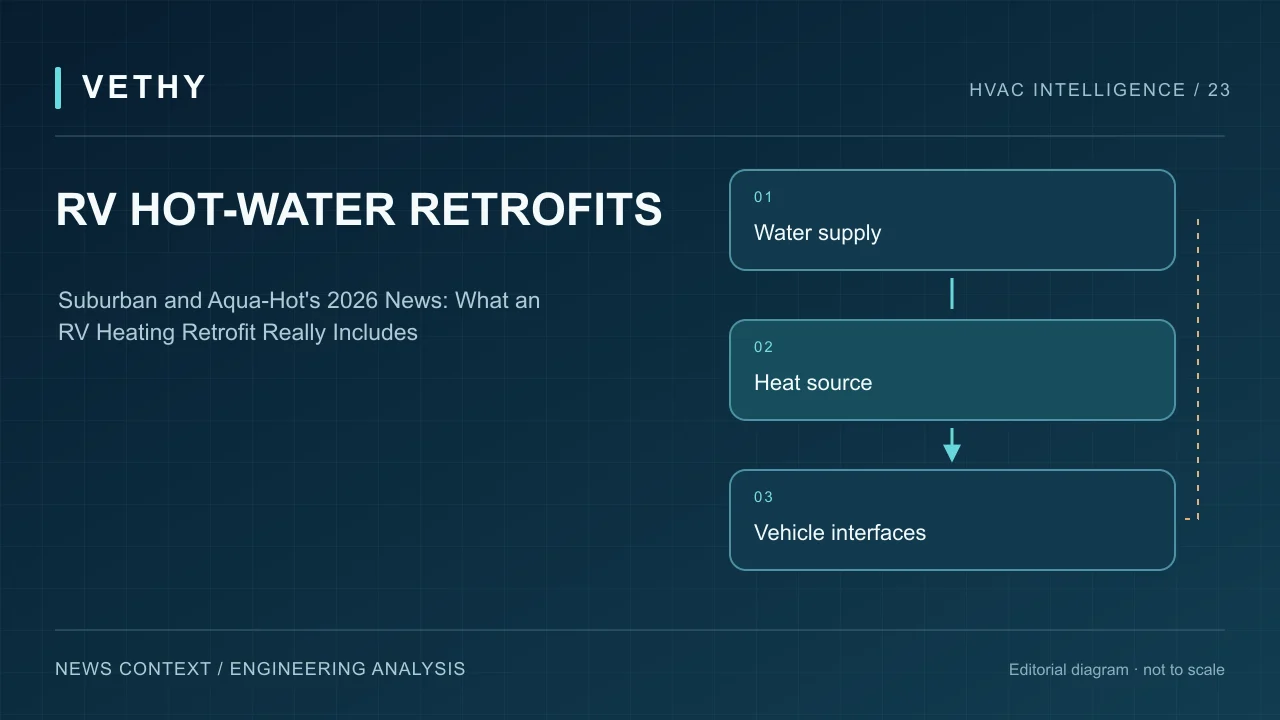
News facts: new equipment and new retrofit interfaces
On August 13, 2026, Airxcel outlined Suburban and Aqua-Hot products for its annual showcase. The announcement described a new conversion door for Suburban's ST tankless water-heater range, digital control options and several Aqua-Hot heating and hot-water configurations. Its presentation linked equipment development with both new-vehicle integration and replacement opportunities. The release establishes what the manufacturer announced; it does not prove that any particular RV can accept an appliance without further changes. Read the official showcase announcement.
For buyers, the important distinction is between an interface that helps an appliance fit and a complete installation that works correctly. Exterior dimensions, water delivery, energy supply, control behavior and future service all belong in the same project review. The following analysis is an independent planning framework, not an installation manual.
Define what the owner wants to improve
A request for “better hot water” can mean several different things. One owner wants fewer interruptions during a shower. Another wants less waiting at a distant tap. A rental operator wants simpler controls and fewer support calls. A manufacturer may want to recover interior space or reduce the number of separate control panels.
These goals do not necessarily lead to the same equipment choice. Begin by describing the current problem and the operating conditions in which it occurs. Record the vehicle layout, typical number of occupants, water source and how the existing system is used. A supplier can then evaluate whether the proposed change addresses that problem. Replacing an appliance without defining the complaint risks retaining the same limitation somewhere else in the water or control system.
An exterior conversion part solves a limited problem
An adapter, trim panel or conversion door can help manage the physical difference between an existing opening and a replacement appliance. That can be valuable for appearance and installation planning. It does not by itself confirm every other interface.
The installer still needs to verify the approved appliance position, access requirements and compatibility with the vehicle's construction. The exterior arrangement must follow the relevant product instructions rather than an improvised assumption that a visually neat opening is sufficient. Buyers should request a drawing or clear scope statement showing what is retained and what changes. This allows them to understand whether the quoted conversion is a defined package or a provisional idea awaiting inspection.
Hot-water quantity and hot-water delivery are different questions
Stored-water and on-demand systems approach the service differently. However, the owner experiences the complete path from water source to tap. Supply conditions, pipe routing, user settings and the selected appliance all contribute to that experience. A technology label alone does not establish what will happen at a particular shower.
Describe the desired use case without exaggeration. For example, “two sequential showers under these stated supply conditions” is more useful than “unlimited hot water everywhere.” If simultaneous use matters, identify which fixtures may operate together. Ask the supplier to explain the applicable limitations for the selected appliance. The answer should address the actual installation rather than borrowing a favorable condition from a demonstration or another model.
Do not confuse immediate heating with immediate arrival
The time taken for warm water to reach a fixture can involve the water already in the connecting pipework. Changing the heat source does not automatically remove that distance or the water contained along the route. This is a useful diagnostic distinction when an owner is mainly unhappy about waiting at a remote tap.
A qualified installer should review the complete arrangement and the manufacturer's supported options. Buyers should not assume that adding unapproved circulation hardware or changing plumbing will be acceptable. The procurement question is whether the proposed solution addresses delivery delay, sustained temperature, available quantity or some combination. Naming the issue clearly helps prevent a new appliance from being judged against a problem the installation was never designed to solve.
Energy supply needs a separate assessment
Heating water requires energy, and a replacement can change how that energy is supplied. Fuel type, electrical requirements and available connections must be verified for the exact model and destination market. A similar enclosure does not establish equivalence between appliances using different energy sources.
Ask the installer to identify which existing provisions are suitable, which require changes and which are still unverified. Work on fuel, combustion, electrical protection and related safety systems belongs with qualified personnel following approved instructions. A customer-facing proposal does not need to reproduce that technical procedure, but it should make the scope and responsible party clear. This avoids presenting a full thermal-system conversion as a simple cosmetic replacement.
Treat cabin heating as its own service requirement
Some configurations combine functions that owners previously obtained from separate appliances. That can change packaging and control arrangements, but it does not remove the need to specify cabin heating independently from domestic hot water.
Describe where people sit and sleep, when heat is needed and which areas are expected to remain comfortable. Identify whether an existing distribution system is retained or replaced. If a proposal includes a liquid-based heating circuit, the fluid side and the cabin heat-delivery side both need an approved design. If it uses forced air, outlet and return arrangements still matter. A central heat source is only one element of the occupied-space result.
A scope table makes quotations easier to compare
| Project element | Buyer should receive | Common ambiguity to remove |
|---|---|---|
| Exterior interface | Confirmed opening and approved enclosure arrangement | Assuming a conversion panel proves total compatibility |
| Water service | Stated operating conditions and intended fixture use | Promising unlimited performance without conditions |
| Energy supply | Exact fuel and electrical requirements | Reusing provisions without inspection |
| Cabin heat | Defined distribution and comfort objective if included | Treating hot-water capacity as cabin-heating evidence |
| Controls | Supported functions and owner operating instructions | Assuming a shared display supports every appliance |
| Service | Accessible components, documentation and support route | Leaving future repairs out of the installation plan |
This table is not a substitute for the manufacturer's instructions. It gives procurement and installation teams a common language for identifying work that can otherwise disappear between the equipment quotation and the final invoice.
A hypothetical energy example clarifies the scale
For a simple illustration, heating 20 liters of water through a 30 °C temperature rise requires approximately 0.70 kWh of heat, using a water mass of roughly 20 kg and a specific heat capacity of about 4.18 kJ per kilogram per degree Celsius. The calculation is 20 × 4.18 × 30 = 2,508 kJ, or about 0.70 kWh.
This idealized calculation excludes heat losses and appliance behavior. It is not a prediction of input consumption, recovery time or shower duration for any named product. Its purpose is to show why the requested temperature rise and quantity matter. A real design also considers water delivery, energy conversion and the operating limits of the selected equipment. A brochure's generic comfort claim cannot replace those project-specific inputs.
Consider the complete travel pattern
A vehicle used mainly at serviced campsites may have different priorities from one that spends several days away from external supplies. Water availability, energy replenishment and the owner's preferred routine all influence the practical result. A system can provide a desirable capability while still depending on resources that the trip does not reliably provide.
For a rental fleet, variation between users is especially important. Some customers will understand energy-source selection and others will expect automatic operation. The fleet should decide which choices it wants users to make and which conditions should be handled through the vehicle's approved controls. Clear instructions reduce avoidable support calls, but instructions cannot compensate for a system that was selected for an unrealistic use pattern.
Cold-weather use requires model-specific information
A claim about extended-season travel should lead to questions about the exact supported operating conditions and required care. It should not become a general promise that every part of the vehicle's water system is protected in all cold weather.
The installer and owner need the manufacturer's instructions for the appliance and the vehicle's water-system arrangement. Pipework, tanks, fixtures and other components may have separate considerations. This article does not prescribe a winterization procedure because those details vary with the system. The useful purchasing step is to obtain the correct documents and confirm who will explain them during handover. Buyers should know which tasks are ordinary owner care and which require a service professional.
Controls should reduce uncertainty, not just panel count
Combining functions on a central interface can make a vehicle easier to operate, but only if users can understand the system state. A screen should distinguish a selected request from a service that is actually available. It should communicate restrictions in a way an owner can act on without guessing.
During an evaluation, ask a person unfamiliar with the system to perform ordinary tasks: request hot water, change a cabin setting and understand an unavailable-state message. Observe where they hesitate. This is an informal usability exercise, not a certification test. It can reveal problems that an experienced demonstrator overlooks because the demonstrator already knows what every icon means. The final instructions should use the same names and states as the installed controls.
Inspect service access before approving the furniture
An appliance can fit into a compartment while remaining difficult to maintain. Decorative panels, drawers and unrelated equipment may obstruct access once the vehicle interior is complete. A replacement project can make this worse if the new appliance requires a different service approach.
Ask the installer to show how routine service items and likely replacement components will be reached. Identify which panels are removable and whether removing them affects other systems. This does not mean predicting every possible failure. It means avoiding an installation in which a common maintenance task requires dismantling a large portion of the interior. For an OEM, this review should happen with production and aftersales staff present, because both teams will inherit the consequences.
Diagnose the existing problem before replacing hardware
If an owner reports unstable water temperature or poor cabin heat, document the symptom under repeatable conditions before choosing replacement equipment. The cause might involve the appliance, its controls, its supplies or the surrounding installation. Replacing only one element may not resolve a problem located elsewhere.
A diagnostic record should separate observation from interpretation. “Temperature changed after the second fixture opened” is an observation. “The heater is undersized” is a conclusion that needs evidence. Keeping that distinction allows the installer to investigate systematically. It also helps the owner understand why an inspection may be necessary before a firm quotation. A responsible supplier can explain what is known and what remains to be checked without hiding behind vague technical language.
Three retrofit cases with different priorities
A couple replacing a failed heater may prioritize a supported fit, a predictable installation schedule and simple controls. They may not need the widest range of new functions. Their decision should compare the complete installed package and the service route available near where they travel.
An OEM revising a compact vehicle may prioritize space allocation and the relationship between cabin heat and hot water. It needs design drawings, integration evidence and repeatable production instructions. A good retrofit for one existing vehicle does not automatically provide all the information needed for a production program.
A rental operator may prioritize rapid fault identification and a consistent user experience across many vehicles. Its ideal solution may include standardized labels, handover instructions and a clear escalation route. The same appliance could serve all three customers, but the evidence and supporting services required for acceptance will differ.
Define what commissioning must demonstrate
Commissioning should confirm the approved installation and demonstrate the functions included in the contract. The exact procedure belongs to qualified installers and the applicable manufacturer instructions. From the buyer's perspective, the result should be a documented configuration and a clear explanation of operation.
Where several functions interact, demonstrate the intended combinations rather than each one only in isolation. Record any limits on simultaneous use and explain how the controls present those limits. If part of the promised service cannot yet be demonstrated, keep it as an open item with an owner and completion date. Do not label a project fully accepted simply because the appliance powers on and the exterior panel looks finished.
Preserve the records that future technicians need
Keep model and serial identification, installation documentation, relevant settings and the final scope of work together. An owner who later sells the vehicle should be able to pass on a useful service record. A fleet should be able to retrieve that record without depending on the memory of the original installer.
For a larger program, note which vehicles share the same approved configuration. A later change in a controller, appliance version or distribution arrangement may require a different service instruction. This is ordinary configuration management applied to a thermal system. It helps avoid the assumption that all vehicles with the same exterior appearance contain the same equipment and can be serviced in the same way.
Discuss the integration boundary with the right partner
A vehicle HVAC project can involve refrigeration, cabin heat, hot water and electrical power without every supplier providing every part. Buyers benefit from a clear statement of what each organization designs, supplies, installs and supports. Broad thermal-management language should be translated into defined deliverables.
For a VETHY discussion, describe the vehicle's overall requirement and the specific HVAC interface you need reviewed through the engineering route. The HVAC module overview can help distinguish a component request from a complete integration project. Mentioning other manufacturers' announcements here does not imply a distribution relationship, installation approval or technical partnership with those brands.
Test the promised fixture sequence, not an isolated tap
A handover demonstration often opens one tap for a short period. That can show basic operation, but it may not represent the use the owner described. If the purchase was based on sequential showers or a particular combination of fixtures, the agreed evaluation should address that sequence under documented conditions.
Identify the water source, initial conditions and selected settings. Note whether the test uses an external supply or the vehicle's own arrangement. If those alternatives are important to the owner, the installer should explain whether both have been assessed. A favorable result under one supply condition should not silently become a guarantee under every other condition.
The record should also state what a satisfactory result means. Is the goal a stable usable temperature, a particular service duration or recovery before the next planned use? The exact criteria belong to the project and the supported appliance capability. Defining them makes the test useful without inventing a universal performance standard. It also gives the owner a clear explanation of why the result is acceptable or why further work remains.
Understand which complaints belong to the distribution system
A vehicle can contain a capable heat source while distributing the service poorly. In cabin heating, the issue may concern how heat reaches the occupied areas. In domestic water service, the user's experience depends on the path and fixtures as well as the appliance. This is why a retrofit review should include the surrounding installation.
The buyer should ask whether the proposal includes assessment of those interfaces or only replacement of the main unit. If the existing distribution remains, record any limitations the installer has identified. A replacement can still be worthwhile while leaving some existing constraints in place, provided that is the agreed scope. Problems arise when the customer believes every aspect of the thermal experience has been redesigned but the contract covers only one appliance.
For a vehicle manufacturer, this distinction also affects supplier responsibility. A heater supplier may provide installation requirements without designing all interior distribution. A bodybuilder may construct the layout while relying on another party to validate its thermal result. The completed-vehicle owner must make sure that the space between those responsibilities is covered.
Plan how the vehicle will return to service if work is delayed
A retrofit may uncover a condition that requires additional parts or a revised approved design. Before work begins, agree how such discoveries will be communicated and who can authorize a change. The owner should know whether the vehicle can remain usable while the issue is resolved or whether it must stay out of service.
For rental and commercial fleets, this affects scheduling as much as cost. Do not book several vehicles for identical work until the first representative installation has confirmed the practical scope. Where vehicles differ, identify those differences early. A careful pilot can prevent the same unexpected issue from disrupting an entire group at once.
The final documentation should explain any departure from the original proposal. That record is useful for both warranty discussions and future service, but its immediate value is simpler: the customer can see what was actually supplied and why. A credible retrofit closes the loop between the initial complaint, the approved work and the demonstrated result.
Frequently asked questions
Does a conversion door make a tankless heater a direct replacement?
It may address part of the exterior fit, but the full installation still needs approval for the exact vehicle and appliance. Water, energy supply, controls and service access require their own checks. Obtain a complete scope before assuming that no other changes are necessary.
Will a new heater eliminate the wait at every tap?
Not automatically. The route between the heat source and the fixture can contribute to the delay. Ask the installer to identify the cause of the current complaint and explain which part of it the proposed change addresses. Avoid treating an appliance label as a guarantee for the entire plumbing system.
Can one combined system replace all existing heating functions?
Only if its documented capabilities and the completed installation meet those functions. Define cabin comfort and hot-water use separately, including any simultaneous demand. The number of appliances can change while the number of requirements remains the same.
What should the quotation say about unknowns?
It should identify them clearly, explain how they will be checked and state whether the price depends on the result. Unknown roof, compartment, supply or control conditions should not be silently converted into assumptions. A provisional item is manageable when its owner and decision point are visible.
What is the strongest evidence of a successful retrofit?
A completed installation that matches the approved configuration, demonstrates the agreed functions and comes with usable operating and service records. Attractive exterior fit is valuable, but the lasting result is a thermal system whose capabilities and limits the owner understands.
Sources and editorial scope
- Suburban and Aqua-Hot Highlight Innovative RV Heating Solutions at 2026 New Product Showcase — Airxcel, 2026-08-13.
Analysis by VETHY, published November 7, 2026. Source news dates are shown separately. Manufacturer claims are attributed; examples and decision frameworks are editorial analysis, not VETHY test results. Mention of another brand does not imply a commercial affiliation or approved compatibility.