
VETHY / VEHICLE HVAC NEWS AND ANALYSIS
Spheros’s Australasia Update: Measure Bus HVAC Support by Time to Restored Service
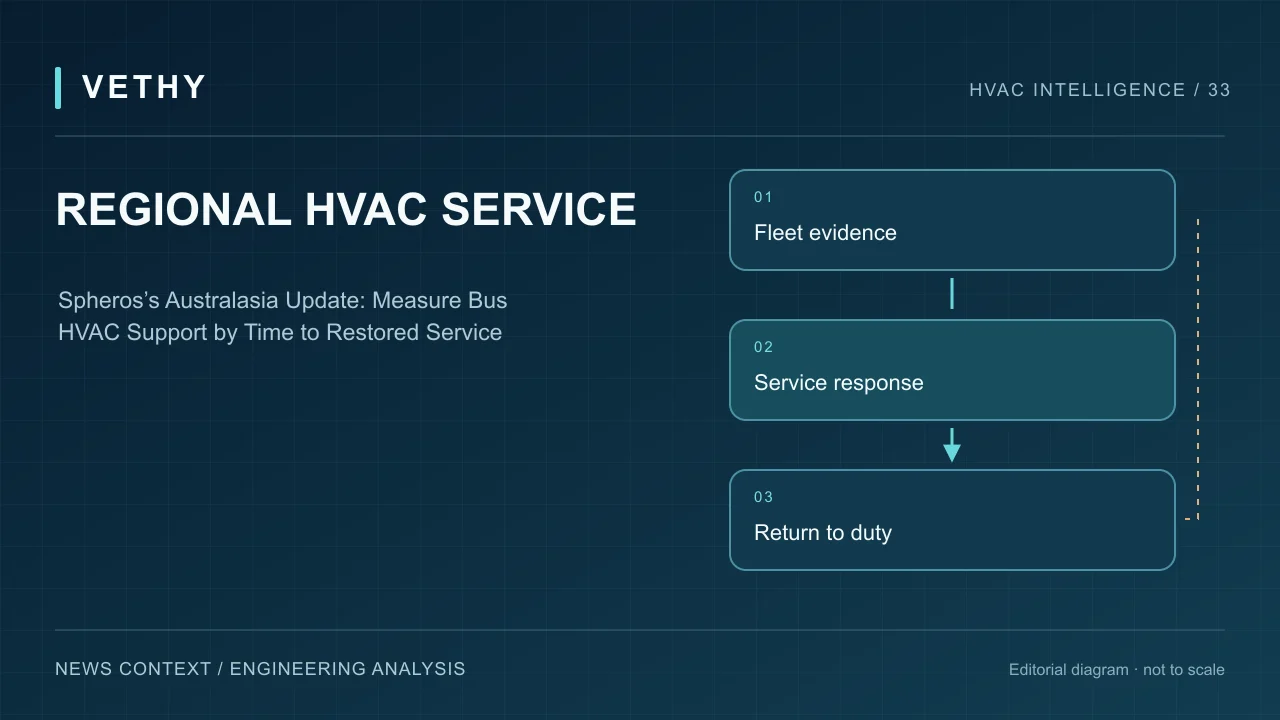
Bus HVAC support should be judged by the complete time from a useful fault report to verified restored service. Spheros’s June 2026 Australasia announcement highlights regional service capacity, but a fleet still needs configuration-specific diagnosis, ownership, parts decisions and repair confirmation. A network map alone cannot establish the response available to a particular vehicle.
News facts: regional support is part of the announcement
In a June 24, 2026 announcement ahead of the Australasia Bus and Coach Expo, Spheros describes an expansion of its Australian service-technician network, a dedicated service department in Sydney and parts held across Australia. The company presents these support arrangements alongside its bus climate-control portfolio. The release does not specify a guaranteed response time for every location, vehicle or fault. Read the manufacturer announcement.
The useful question for an operator is how regional capability becomes a working response when a bus loses an agreed climate service. A workshop location or parts warehouse is only one step in that process. The following analysis develops a practical fault-to-restoration workflow; it is not an assessment of Spheros’s actual service performance or a claim that VETHY operates that network.
Count the time until the service is restored
Repair time and downtime are different measures. A component replacement may take a short period once the correct part and technician are available. The vehicle may nevertheless spend much longer waiting for a useful diagnosis, a commercial authorization, transport or a suitable workshop slot. A fleet needs visibility of those intervals to understand what is actually delaying service.
Define the start and end of the service event. The start might be the first reported loss of the required climate function, while the end should be verified restoration or an approved alternative disposition. Do not close a case merely because a part was shipped or a technician completed a job entry. The operator needs evidence that the agreed vehicle service is available again.
Record the intermediate milestones as well. Acknowledged, diagnosed, action authorized, part available, technician available, repaired and verified are useful distinctions. They allow the fleet and supplier to identify a recurring bottleneck. Without them, a general complaint about slow service may hide several unrelated problems requiring different solutions.
A useful first report reduces avoidable delay
The initial report should identify the vehicle, installed HVAC configuration, time, symptoms and relevant operating context. Include the displayed fault indication exactly where it can be recorded safely. Describe whether the problem concerns the whole cabin, one zone, heating, cooling, airflow or an unexpected control behavior. The driver should report observations rather than guess the failed component.
A short structured form can help, but it should not become an obstacle to reporting. Start with the minimum information needed for triage, then let qualified staff request additional evidence. If a driver is dealing with an immediate safety or service concern, the approved operational response takes priority over completing a form. No one should be asked to open protected equipment or refrigerant circuits to provide a better report.
Good evidence also includes what changed before the event. Recent service, a vehicle configuration update, a new route or an unusual operating sequence may be relevant. Record these as context, not as proof of cause. A disciplined report keeps several explanations open until the technical team has enough information to distinguish them.
Separate service severity from technical diagnosis
Dispatch needs to know what the vehicle can safely and acceptably do now. Maintenance needs to know what is causing the problem. Those are related but different decisions. A fault can require urgent operational action before its technical cause is established, especially when passenger conditions or visibility requirements are affected.
Define the fleet’s approved severity categories with the responsible technical and operational teams. The categories should describe the required response: immediate escalation, withdrawal from a particular assignment, use of an approved alternative or planned investigation. This article does not establish legal operating limits or authorize continued service with a defective system. Those decisions depend on the vehicle, route and applicable requirements.
Avoid using the absence of a fault code as proof that service is acceptable. A passenger-zone problem can exist without a convenient electronic indication, and a displayed code may need interpretation in its operating context. The fleet should combine the actual service impact with qualified diagnosis rather than relying on one signal alone.
Assign one owner to the active case
Integrated bus HVAC can involve the vehicle builder, module supplier, local installer, service workshop and operator. Their responsibilities may be divided by contract, but the live case still needs one visible coordinator. The fleet should know who will acknowledge the report, request evidence, arrange the next action and communicate the expected update.
Case ownership does not mean one organization must perform every task. It means someone tracks the complete path to restoration and prevents an issue from stalling between parties. If the next action belongs to another supplier, the coordinator should record the handover and confirm that it was accepted. A message sent without a response is not a completed handover.
The update should state known facts, open questions, the current owner and the next decision time. Avoid a vague status such as being processed when the actual delay is waiting for an installation drawing or a commercial approval. Clear reporting lets operations make a realistic vehicle plan while the technical investigation continues.
Use a staged diagnosis instead of shipping parts by guesswork
A structured diagnosis first confirms the affected function and configuration, then examines the relevant operating evidence. The next step should be selected by qualified service personnel using the approved documentation. The aim is to reduce uncertainty enough to choose an effective action without collecting irrelevant data or replacing several components speculatively.
Remote support can be useful where distance is significant, but it has limits. Some observations can be made through approved diagnostic tools or safe external inspection; others require a qualified person at the vehicle. A remote adviser should state what can and cannot be concluded from the available evidence. The fleet should not mistake a likely explanation for a confirmed diagnosis.
When a part is proposed, record why it is expected to resolve the problem and whether further checks are needed after installation. If the action fails, that record helps the next technician understand the reasoning rather than starting again. It also provides a fair basis for reviewing whether the original evidence was adequate or a different fault emerged.
Make geography part of the service design
A regional support offer should be evaluated against the actual routes and parking locations of the fleet. A workshop that is convenient for a metropolitan operation may be far from an intercity coach or a vehicle working at a remote site. The relevant question is the response available to that vehicle, not the total number of locations shown on a map.
Map the important assignments and identify likely restoration paths. Can a qualified technician attend the vehicle? Must it travel to a workshop? Is an approved temporary replacement available? Which party arranges transport and access? These practical questions often determine downtime more than the repair procedure itself.
Seasonal demand should also be discussed. A service network can face many simultaneous climate-control complaints during a demanding period. Ask how urgent cases are prioritized and what communication the operator receives when capacity is constrained. A realistic, transparent response plan is more useful than an unqualified promise that every vehicle can be attended immediately.
Keep parts decisions tied to the installed configuration
Parts availability only helps if the correct item is identified. The vehicle record should connect the installed HVAC unit to the applicable revision and approved replacement references. A common product name can cover several configurations. The service process should therefore verify identity before a part is dispatched, especially where transport to the vehicle takes significant time.
The parts decision should include the supporting items needed for an approved repair. A major component may require associated consumables, updated documentation or a qualified service procedure. Those requirements belong to the manufacturer’s instructions. The fleet should ask whether the proposed shipment is a complete repair package rather than assuming the main component alone is sufficient.
This is different from simply increasing stock. Holding more parts can tie up resources without resolving diagnosis or configuration errors. Review actual case history to identify which items and locations influence restoration time. The goal is a targeted service capability connected to the fleet’s installed equipment, not an impressive inventory count disconnected from real demand.
A worked example of where a day can disappear
Consider a hypothetical service event, unrelated to any named supplier. A driver reports reduced cooling at 08:00. The report is acknowledged at 08:30, but the installed configuration is not confirmed until 11:00. Qualified diagnosis identifies the required action at 13:00. Authorization arrives at 16:00, after the day’s parts dispatch has closed. The part leaves the next morning, and the vehicle is repaired later that day.
The physical repair might take two hours, but that figure does not explain the complete loss of service. The largest avoidable delays may have occurred before a technician touched the vehicle. A correct configuration record at the first report and an agreed authorization path could change the timeline without altering the equipment design or adding a workshop.
The example is not a promised saving. It illustrates why milestone data is useful. Review the actual sequence, identify which delays were necessary and which were preventable, then change the process that caused them. A fleet that records only the final invoice date cannot make that distinction reliably.
Define service commitments in measurable terms
| Commitment | What should be defined | What it should not be confused with |
|---|---|---|
| Acknowledgement | When a useful report receives a named response | A completed diagnosis |
| Technical triage | Evidence reviewed and next qualified action identified | A guaranteed final cause |
| Parts confirmation | Correct reference, location and dispatch plan | A part already installed |
| Attendance | Technician capability and confirmed visit arrangement | Restored vehicle service |
| Repair completion | Approved work recorded on the correct configuration | Verified performance under relevant conditions |
| Case closure | Service result confirmed and unresolved items stated | Administrative closure alone |
An agreement should also identify the conditions needed for each commitment. A response may depend on receiving a vehicle identifier, gaining site access or obtaining customer authorization. Make these dependencies visible. A fair service agreement defines what both parties must do and how exceptions are communicated, rather than placing a single unrealistic time target over every possible event.
Verify the repair against the original complaint
After repair, the test should address the function that was lost and the conditions under which the problem appeared. A system that starts in the workshop has not necessarily demonstrated the passenger result needed on the route. Qualified personnel should select the appropriate verification using the approved service information and the original event record.
Document the relevant outcome in plain terms. Was the affected zone restored? Did the fault indication recur? Was the planned operating sequence completed? Were any limitations left unresolved? The record should distinguish a confirmed repair from a provisional return with further monitoring, where such a disposition is approved by the responsible parties.
If the issue cannot be reproduced, do not automatically close it as no problem. Record the conditions examined and the limits of the conclusion. The next occurrence may provide the missing context. This preserves trust with drivers and avoids forcing them to repeat a vague complaint that the system has already classified as resolved.
Use repeat events to improve the whole response
Recurring reports should be grouped by the actual symptom, configuration and operating context, not only by the component eventually replaced. Several different parts can be associated with the same service complaint, while one part name can cover unrelated causes. A useful review examines the pattern before deciding whether the corrective action belongs to design, installation, maintenance or training.
Look for repeated delays as well as repeated faults. If cases repeatedly wait for an authorization, improve that decision path. If incorrect parts are dispatched, strengthen configuration identification. If technicians need the same missing document, make the approved information accessible. These process changes can improve restoration without making unsupported claims about product reliability.
Share the relevant findings with the people who report and resolve issues. Drivers need to know what observations are useful. Workshops need current configuration information. Purchasing needs evidence of service performance, and engineering needs a clear account of persistent technical concerns. A short, factual feedback loop is more valuable than a large report that no one uses.
Keep commercial questions from blocking urgent clarity
Warranty and responsibility may need investigation, but the fleet still needs timely information about the next safe and technically appropriate action. Agree how diagnostic work, urgent attendance and commercial authorization are handled when responsibility is not yet settled. The contract should make the process clear without assuming that every fault is covered.
A useful case record separates technical findings from commercial conclusions. The technician can report what was observed and what work is required, while the authorized parties determine coverage under the applicable terms. Mixing those decisions too early can delay diagnosis or create pressure to attribute a cause before the evidence is adequate.
For overseas operations, confirm the market scope of the support arrangement. A component supplied internationally does not automatically carry local labor support, immediate stock or coverage through every dealer. Identify the actual parties and terms for the destination fleet. This is an application-specific commercial question, not something established by a global brand statement.
Prepare people and information before the first vehicle arrives
The first service event is a poor time to discover that no one has the current drawings or knows the escalation contact. Before delivery, verify that the fleet has the installed configuration record, driver guidance, approved service access and a tested communication route. A short readiness exercise can expose missing information without creating a real fault.
For example, ask the designated team to locate the configuration of a sample vehicle, identify the first technical contact and explain how a parts decision would be authorized. Time the information retrieval and note gaps. This exercise concerns process readiness; it should not involve generating fault codes or interfering with protected systems.
Repeat the check when the fleet expands to a new region or adds a materially different HVAC configuration. A support process that works at the home depot may not transfer automatically to another market. Preparing the information and responsibilities is usually easier than improvising them after a bus has been withdrawn from an assignment.
Make the service dashboard honest about open cases
A dashboard can look better than the actual service if it reports only completed repairs. Long-running unresolved cases disappear from the average until they eventually close. Show open-case age alongside completed-case duration, and distinguish vehicles awaiting information from those awaiting parts, attendance or a technical decision. The operator then sees the work that still affects availability.
Use consistent definitions when comparing regions or suppliers. One team may start its clock when the driver first reports the issue, while another starts only after receiving a complete technical file. Those measures answer different questions. Both can be useful, but they should be named clearly rather than presented as equivalent response times.
For a small fleet, individual cases may be more informative than percentages. Two difficult events can dominate a monthly result. Explain those events and the actions taken before drawing a broad conclusion about the system or supplier. As the dataset grows, review the distribution of restoration times rather than relying only on an average that can hide a small number of very long interruptions.
Record the final disposition accurately. Repaired and verified, awaiting recurrence, replaced under an approved arrangement and removed from the fleet are different outcomes. Closing all of them under resolved prevents later analysis from identifying which actions actually restored the original service. It can also make a recurring concern appear to be several unrelated new cases.
The dashboard should support decisions: which case needs escalation today, which process delay needs correction and which configuration needs engineering review. If a metric does not help answer one of those questions, it may add reporting effort without improving the fleet’s response.
Frequently asked questions
Does a large service network guarantee a fast repair?
No. The relevant questions are capability for the installed configuration, actual location, access, parts availability and the complete response process. A network can be an important resource, but the fleet needs an application-specific arrangement rather than an inference from a map.
Is a stocked replacement part enough to minimize downtime?
Not always. The correct diagnosis, configuration identification, authorization and qualified installation must also occur. A part in stock is valuable only when the process can select and use it appropriately. Review the whole event timeline before deciding that inventory is the main constraint.
What should a driver report first?
The vehicle identity, time, affected function, displayed indication and relevant operating context are useful starting points. Follow the fleet’s approved response for any immediate safety or service concern. Drivers should not perform technical work outside their role to improve a fault report.
Can this article establish a service guarantee from Spheros or VETHY?
No. It analyzes the operating questions raised by public news. Response commitments, warranty coverage and local support require a specific written agreement for the vehicle and market. No independent network audit or guaranteed restoration time is claimed here.
Build support into the application brief
A bus HVAC brief should include where vehicles operate, which service resources exist, what information can be collected safely and who makes restoration decisions. Add the passenger-service requirements that determine operational severity. This gives suppliers a concrete basis for proposing support rather than a vague request for good after-sales service.
Use bus applications to define the assignment and the engineering overview to discuss responsibility and evidence. If the project involves a particular assembly, the HVAC module page helps frame configuration information. The most convincing support offer is a clear path from an observed problem to verified restored service, with accountable people and evidence at each step.
Sources and editorial scope
- June24,2026: Spheros to Showcase at the2026Australasia Bus and Coach Expo — Spheros, 2026-06-24.
Analysis by VETHY, published November 7, 2026. Source news dates are shown separately. Manufacturer claims are attributed; examples and decision frameworks are editorial analysis, not VETHY test results. Mention of another brand does not imply a commercial affiliation or approved compatibility.