
VETHY / VEHICLE HVAC NEWS AND ANALYSIS
Eberspächer Zeliox News: Sharing Mobile Power Between Tools and Vehicle Cooling
A service van's mobile-power system must support both the largest permitted simultaneous load and the energy needed across the shift. Tools, charging stations and cooling create different demand patterns. Define priorities, charging opportunities and clear low-energy behavior before treating an all-in-one power unit as a complete HVAC solution.
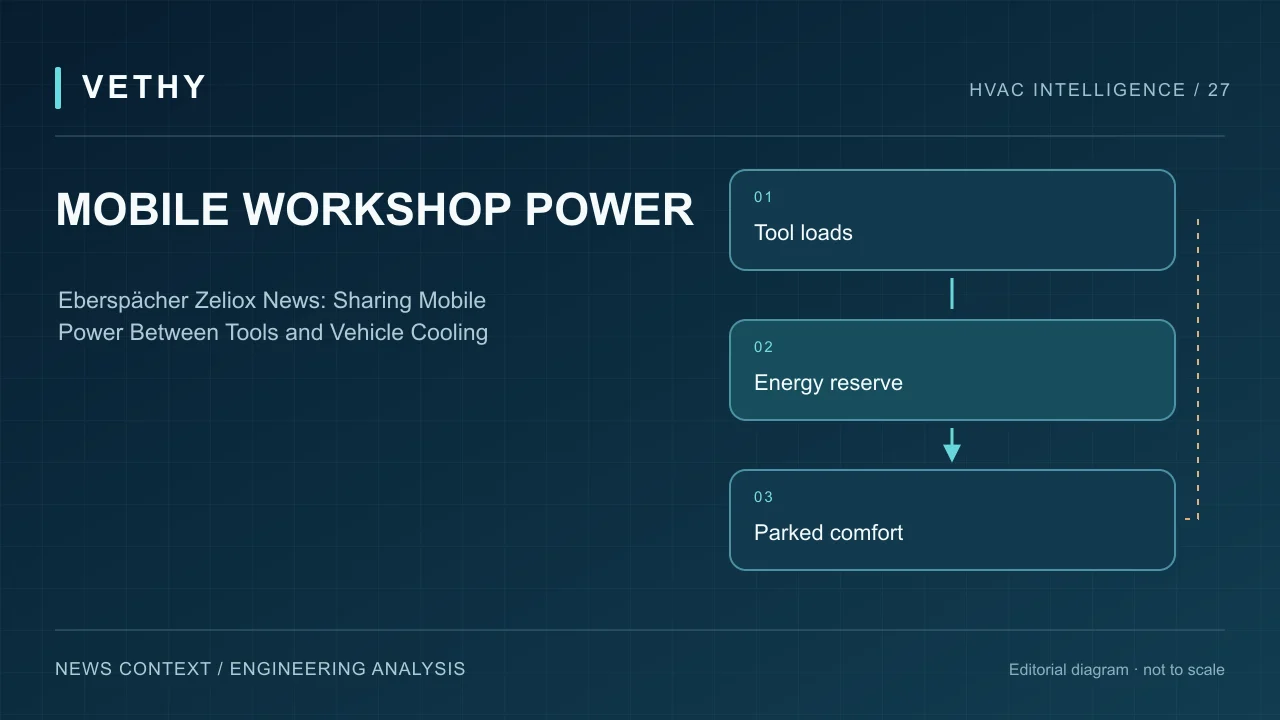
News facts: mobile power becomes a vehicle-system question
Eberspächer's February 26, 2026 newsroom article described its Zeliox mobile-energy portfolio for applications including service vehicles and mobile workshops. It outlined several sizes of equipment and options for charging while driving, from an external supply or through solar. The article presented combinations of storage, power conversion and control rather than a vehicle-specific HVAC package. Its product claims do not establish compatibility with every air conditioner, tool or chassis. Read the original Eberspächer update.
For a service fleet, the useful question is how one vehicle supports a working day. Cooling may be important, but it shares resources with tools, battery chargers, work lights and other equipment. The following framework examines those competing demands without turning a power-system announcement into an unsupported runtime promise.
Begin with the job sequence
A mobile technician might drive to a site, operate tools briefly, charge several tool batteries and spend time completing records inside the van. Another team might work continuously from a parked vehicle. The equipment list could look similar while the time pattern differs substantially.
Describe the shift as a sequence of activities. Include typical driving periods, parked work, breaks and return-to-depot time. Mark which activities can overlap. A cooling system that runs during a quiet administrative period presents a different demand from one expected to operate while energy-intensive tools are in use. The schedule gives the electrical designer a practical basis for evaluating the system instead of assuming that every listed device runs continuously or that no devices ever overlap.
Power is the ability to serve a moment
Electrical power describes the rate of energy use at a given time. The system must support the permitted combination of loads, including the relevant starting behavior and operating conditions. A headline inverter rating is only part of that assessment.
Ask the supplier to identify the supported continuous and short-duration conditions for the exact configuration. Those conditions need to be considered with the connected equipment and the vehicle environment. Do not assume that a short peak rating permits sustained operation at that value. Likewise, do not infer that a cooling system will start successfully because its typical running demand appears below an inverter's advertised maximum. The complete combination should be reviewed using the applicable documentation and, where necessary, tested by qualified personnel.
Energy is the ability to continue through the shift
Stored energy determines how long loads can be served within the system's usable operating window. A system with adequate power can still run short of energy before the workday ends. Conversely, a large store of energy does not resolve an unsupported instantaneous load.
Use watt-hours or kilowatt-hours for the shift calculation and keep them separate from watts or kilowatts. Record which values are nominal and which are actually available for the intended use. Include relevant conversion and auxiliary consumption at a clearly defined boundary. A buyer does not need to master every electrical detail, but the proposal should not require them to guess whether a quoted number describes battery storage, inverter output or the demand of the cooling equipment.
Classify loads by their working pattern
Tools often have intermittent use, while some chargers and comfort systems can operate for longer periods. The exact pattern varies, so classification should be based on observation rather than stereotypes about a device category.
| Load group | Typical planning question | Useful record |
|---|---|---|
| Intermittent work equipment | What can operate together and for how long? | Observed work sequence and equipment requirements |
| Battery charging stations | How many packs need replenishment during the shift? | Charging schedule and energy demand |
| Cabin or work-area cooling | When is the occupied area expected to be comfortable? | Cooling session and representative electrical consumption |
| Lighting and electronics | Which loads remain active between jobs? | Duration and measured or documented demand |
| Essential systems | Which functions must retain supply priority? | Approved reserve and priority policy |
The table does not assign priority automatically. The fleet and responsible designer must identify which functions are essential for the application and what restrictions apply to the others.
A worked shift separates energy from simultaneity
Consider a hypothetical four-hour parked work period. Assume cooling averages 0.5 kW for those four hours, tool charging averages 0.2 kW for three hours and lighting plus electronics average 0.1 kW for all four hours. The illustrative energy total is 2.0 + 0.6 + 0.4 = 3.0 kWh, before any additional losses outside the chosen measurement boundary.
Now assume a tool requires 1.5 kW while in use. Its effect on the power requirement depends on which other loads operate at the same moment. Its effect on total energy depends on how long it runs. These assumed numbers are not ratings for Zeliox or a VETHY air conditioner. They show why a fleet must evaluate both the work sequence and accumulated consumption rather than selecting a battery system from a single maximum-power figure.
Cooling for a work area is not always cooling for a sleeper
A parked truck sleeper often has a relatively defined occupied area and rest period. A mobile workshop may have open doors, changing occupancy and work-related heat sources. An air conditioner selected for one task should not be assumed suitable for the other.
Describe which part of the van needs conditioning. Is it the cab, a separated office area or the full rear compartment? Will doors remain open during work? What comfort target is reasonable for that arrangement? If the actual requirement is to protect specific equipment rather than occupants, identify it explicitly. Different objectives may call for different system architectures. A broad label such as “van AC” does not resolve the application boundary.
Define priority before the battery becomes low
A service team should know what happens when available energy approaches the agreed reserve. The response could include a warning, a supported reduction in a nonessential service or an operational decision to recharge. The correct approach depends on the system and the work being performed.
Avoid leaving technicians to discover the priority order during a job. A sudden loss of an important service can disrupt work even if the electrical system is operating within its intended limits. The fleet should define the policy, the designer should confirm that the equipment supports it and the user interface should explain it clearly. This is a coordination task, not permission to bypass protective functions or improvise control logic outside the approved installation.
Charging opportunities are part of the route plan
A system capable of charging while driving does not automatically receive enough energy during every route. The available charging power, duration and vehicle conditions all matter. A van that makes many short trips may have a different replenishment pattern from one that spends substantial time on the road.
Record the charging opportunities that actually occur. Include depot access and external supplies only when they are reliably available and approved for the vehicle. Solar, where fitted, should be treated as a variable contribution rather than a fixed amount available on every shift. The route plan and energy plan should agree. If they do not, a larger battery may delay the problem without correcting the underlying daily deficit.
Check whether the depot routine completes the cycle
A vehicle may return with depleted storage but fail to recharge because it is parked where no suitable connection is available, the connection is not made or the available time is shorter than planned. Those are operational constraints as much as equipment questions.
Assign responsibility for the depot routine and provide a clear way to confirm readiness for the next shift. The confirmation should reflect the relevant system state, not merely the presence of a cable. For fleets, a simple exception process can identify vehicles that are not ready before a technician leaves. The purpose is to make charging a dependable part of the workflow rather than an informal task that everyone assumes somebody else completed.
A shared power unit does not establish shared compatibility
An all-in-one enclosure can simplify packaging and reduce some integration work. It does not mean every connected load has been validated together. The supplier needs the actual equipment list and the permitted operating combinations.
Where the cooling system, mobile-power unit and vehicle come from different organizations, identify who owns the complete interface review. Each supplier may correctly describe its own product while the combination remains unconfirmed. Request written clarification for the exact configuration, including normal behavior and limits. Buyers should be cautious about a proposal that uses broad phrases such as “works with everything” but cannot identify the supporting documentation or the person responsible for system acceptance.
Installation space must include service and environment
Mobile workshops contain tools, stored materials and changing cargo. A power-system location needs to remain suitable when the vehicle is fully equipped and used normally. The same applies to cooling equipment and its air paths.
The qualified installer should follow the manufacturer's mounting, environmental and access requirements. From a planning perspective, ask whether equipment remains accessible after shelving is fitted and whether ordinary loading can obstruct required areas. A design drawing should represent the completed vehicle rather than an empty van. This prevents an installation from passing an initial inspection while becoming impractical once the business loads the equipment it actually carries.
Control access should reflect different users
A fleet manager, a technician and a service specialist may need different information or settings. The technician needs to operate ordinary functions and understand warnings. The fleet manager may need readiness and usage information. The service specialist may need diagnostic access.
Define these needs without assuming that every available app supports them. Confirm which functions the selected equipment actually provides and how users obtain access. If a phone-based function is important, consider what happens when the assigned phone is unavailable or the vehicle changes drivers. The vehicle should have a supported operating arrangement that fits the business, rather than depending on undocumented access held by one employee.
Use clear names for the values on the screen
A display might show battery state, instantaneous power, remaining time or charging activity. These values can be useful, but users must understand what each means and how any estimate is calculated. An estimated runtime may change when the active loads change.
During handover, demonstrate that change with ordinary supported operation. Explain that a positive charging indication does not necessarily mean stored energy is increasing if consumption is higher. Avoid presenting an estimate as a guaranteed completion time for a job. The strongest interface is one that helps a technician make the next practical decision: continue, reduce an optional load, recharge or contact support according to the approved operating guidance.
Test the workflow, not only the equipment
A bench demonstration can show that a power unit supplies a load. A fleet pilot should show that the complete vehicle supports representative work. Include the normal equipment, loading arrangement, driving schedule and charging routine.
Observe where the technician must make decisions. Are controls easy to reach? Is the warning understandable? Does the charging routine fit the depot? Does the cooling service match the time the work area is occupied? These questions connect technical capability with daily usability. A successful pilot should produce both a configuration record and a workable operating process. Without the second, a system that performs well during a supervised test may be used inconsistently in the field.
Do not confuse comfort savings with a measured business case
Mobile-power and cooling projects are often discussed in terms of productivity, reduced idling or lower operating cost. Those can be reasonable objectives, but a financial claim needs data from the relevant operation. It should not be inferred solely from the presence of a battery or electric air conditioner.
Before calculating a return, establish the baseline: how the vehicle currently supplies power, how long equipment runs and which costs change. Include installation and support requirements as well as equipment price. Where data are missing, present a scenario rather than a guaranteed saving. This allows the fleet to evaluate the project honestly and identify which measurements during the pilot will improve the decision.
Keep a configuration record for every vehicle type
A fleet may use several chassis, body layouts and tool packages. A successful arrangement in one configuration is useful evidence, but it should not silently become approval for every variation. Record the equipment, supported loads, settings and relevant installation documents for each approved type.
When a new tool or charger is added, review whether it changes the power and energy plan. When a route changes, review the charging opportunity. This does not mean reopening the whole project for every small change. It means identifying changes that affect the assumptions on which the system was selected. A short review can prevent a gradual accumulation of loads from turning a once-suitable system into an unexplained reliability problem.
Support should distinguish three different complaints
“The van is not cool,” “the battery is low” and “the tool will not run” may be related, but they are not the same diagnosis. The first could involve the cooling requirement or installation. The second concerns energy balance. The third could involve the load, supply or supported operating conditions.
A support record should capture the symptom, system state, active loads and recent sequence. It should avoid assuming a failed component before the evidence is reviewed. The responsible service team can then direct the investigation appropriately. Clear boundaries also help suppliers cooperate: the HVAC provider receives cooling observations, the power-system provider receives supply information and the fleet retains ownership of the overall service outcome.
Prepare a project brief that reflects the business
List the vehicle configuration, occupied spaces, tool package, route pattern and charging arrangements. Describe which services must be available together and which can be scheduled. State the required reserve and the consequences if a service is unavailable, using the business's actual priorities.
For a VETHY inquiry, use the parking AC technical guide to identify the cooling requirement and the engineering route to discuss its interfaces. The current product range provides model-specific starting points. This article does not claim that a particular VETHY product is approved for a named mobile-power unit; compatibility requires review of the exact configuration.
Build a load survey from representative jobs
A fleet does not need to guess the entire electrical profile from device labels. It can begin by observing a representative set of jobs and recording when equipment is used. Where suitable metering is available and safely installed by qualified personnel, measured consumption can improve the estimate. Keep the observation method consistent and note unusual work rather than treating every day as identical.
The survey should include quiet periods as well as active tool use. Cooling, charging stations and electronics may continue while the technician works elsewhere. Those loads can contribute significant energy over time even if none has the largest instantaneous rating. Conversely, a high-power tool used briefly may dominate the peak-power question without dominating the shift's energy total.
Use the findings to identify a normal day and a demanding but credible day. Avoid selecting only the easiest route to support an attractive runtime claim. Equally, do not assume every device operates at maximum demand for the entire shift unless that reflects the real work. The purpose is a realistic operating envelope that the fleet can explain and the system can be evaluated against.
Translate priority into understandable operating scenarios
A priority policy should describe recognizable situations. For example, the fleet might need a defined reserve for essential equipment at the end of a job, or it might permit an optional comfort load only when sufficient energy remains. The exact policy must be supported by the system and appropriate to the application; it should not be invented by an installer without the operator's agreement.
Write the scenario in plain language and ask a technician to explain what action they would take. If the instruction is unclear, revise it before rollout. A policy that exists only as an engineering setting may be technically correct while leaving users uncertain. The control behavior and the operating guidance should reinforce one another.
Record any functions that are advisory rather than automatic. A displayed recommendation is different from a control that actually limits a load. Confusing the two can lead managers to assume a reserve is protected when it still depends on user action. Clear documentation helps the fleet choose the level of supervision appropriate to its work.
Review the vehicle after new equipment is added
Service vans often evolve as businesses add tools and change tasks. A new charging station or longer cooling period may appear minor in isolation, but several changes can alter the original energy plan. Keep a simple list of approved equipment and review additions against the supported power and energy envelope.
This review is also useful when a vehicle moves to another team. The new users may follow a different route or leave different loads active. Passing on the original operating assumptions gives them a starting point and shows where a fresh assessment is needed. The result is a system managed as part of the working vehicle throughout its life, rather than an electrical accessory whose limits are remembered only by the original buyer.
Frequently asked questions
Is inverter wattage enough to choose a mobile-power system?
No. It addresses only part of the power question. The complete system must support the intended loads and their operating conditions, while usable stored energy and replenishment must cover the shift. Request a documented assessment of the whole configuration.
Can tools and air conditioning always operate together?
Only if the approved system supports that combination. Identify which loads may overlap and confirm the relevant requirements with the suppliers. A general claim about a powerful mobile-energy unit is not a substitute for checking the actual equipment list.
Will charging while driving restore everything used at a job site?
That depends on charging capability, driving time and consumption. Record the actual route and energy use. A charging feature provides an opportunity; it does not guarantee that every route supplies enough energy for the next shift.
Should the fleet buy a larger battery when runtime is short?
First determine why energy is running short. The cause could be higher loads, insufficient charging, changed use or a system issue requiring diagnosis. More storage may help a defined problem, but it does not automatically correct an ongoing daily energy deficit.
What is the main lesson from the mobile-energy announcement?
Treat cooling as part of the working vehicle's power plan. The most useful specification connects simultaneous loads, shift energy, charging opportunities and clear priorities. That allows the fleet to judge whether the complete vehicle can support its work, rather than relying on one impressive equipment rating.
Sources and editorial scope
- Power To Go: Mobile energy solutions for different application profiles — Eberspächer, 2026-02-26.
Analysis by VETHY, published November 7, 2026. Source news dates are shown separately. Manufacturer claims are attributed; examples and decision frameworks are editorial analysis, not VETHY test results. Mention of another brand does not imply a commercial affiliation or approved compatibility.