
VETHY / VEHICLE HVAC NEWS AND ANALYSIS
Eberspächer's 800 V Heating News: Separating Cabin Zones from Battery Conditioning
Cabin comfort and battery conditioning need separate targets, control responsibilities and acceptance evidence, even when they share a vehicle energy budget. Eberspächer’s 800 V heating announcement highlights that distinction. Buyers should specify the operating sequence, occupied zones and permitted electrical demand before comparing heater ratings or assuming a benefit for another vehicle.
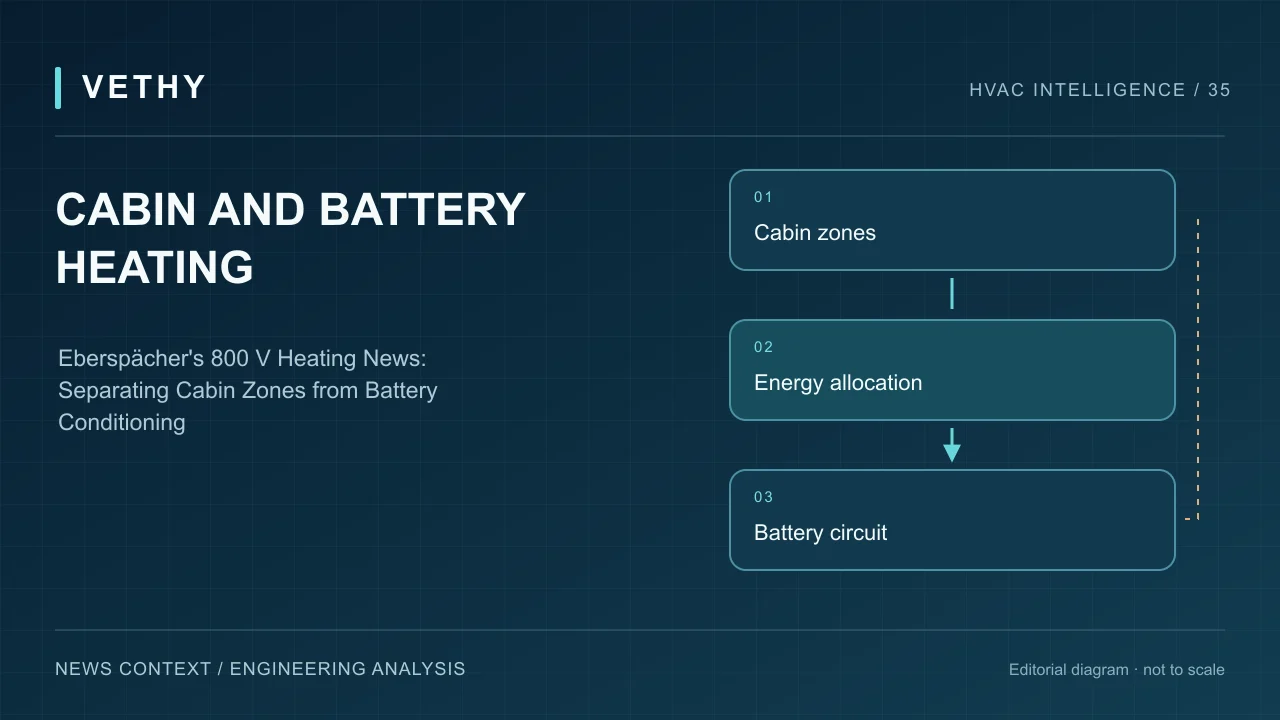
News facts: separate heat duties on an 800 V vehicle
On April 14, 2026, Eberspächer described two heating solutions for 800 V vehicle architectures: a coolant heater for battery conditioning and a cabin air heater. The company identifies thick-film technology for the coolant unit and PTC technology for the air unit, with separate cabin temperature control in up to four zones. These are manufacturer descriptions, not independent vehicle test results. The announcement does not establish the energy use, installation suitability or charging improvement of an unspecified commercial vehicle. Its relevance to an HVAC project is the separation of thermal duties that can otherwise become confused in a purchase specification. Read the Eberspächer interview.
The engineering discussion below is independent analysis. It explains how a buyer can turn that separation into useful requirements without copying a passenger-car architecture into a truck, bus or special vehicle.
Which temperature are you actually trying to control?
A request for an electric heater can conceal several different problems. A driver may need a warm footwell after entering a cold vehicle. A traction battery may need conditioning before a charging session. A windscreen may need a clear viewing area. A sleeper compartment may need stable comfort through a stationary rest period. These requests overlap in time, but they do not necessarily share the same target temperature, response time or acceptable interruption.
Start with the object being controlled rather than the component being purchased. For each duty, identify the temperature measurement that represents success. Cabin discharge temperature is useful for understanding an air heater, but it is not equivalent to the temperature near the driver. Coolant outlet temperature is useful for understanding a liquid heater, but it does not by itself prove that the whole battery has reached its required condition. A project needs both component measurements and the vehicle outcome they are intended to support.
This distinction also avoids an easy specification error: treating every kilowatt as interchangeable. Electrical input power, heat delivered to a liquid circuit, heat delivered to cabin air and the resulting temperature change are different quantities. A buyer should ask where a rating is measured and under what conditions, then compare equivalent quantities. The voltage label alone does not answer any of those questions.
Make one thermal request list before selecting hardware
A practical first document is a thermal request list tied to the vehicle's operating day. It should show who requests heat, when that request appears, how quickly the result is needed and which vehicle controller can authorize the associated electrical demand. This is more useful than collecting isolated heater brochures because it reveals simultaneous demands before the electrical architecture is fixed.
Consider an illustrative electric shuttle. Before departure, its battery controller requests conditioning, while its operator requests cabin preheating. At the first stop, doors open and cabin demand rises. Later, the vehicle approaches a scheduled charge, while passengers still expect comfort. These are hypothetical operating events, not reported behavior of a particular product. They show why a system can satisfy each duty separately on a bench yet disappoint when the duties compete on a vehicle.
The list should also describe the end of a request. Does preheating stop at a timer deadline, a temperature threshold or a driver command? What happens when a departure is cancelled? Who releases electrical capacity after a condition has been met? Without explicit exit conditions, a project can accidentally keep a load active after its useful work has finished, or stop a function before the vehicle-level objective is achieved.
| Heat duty | Outcome worth specifying | Context to record | Question for the integrator |
|---|---|---|---|
| Driver comfort | Occupied-zone temperature and acceptable warm-up time | Starting temperature, clothing assumptions and airflow setting | Where is comfort measured? |
| Battery conditioning | Battery controller's permitted thermal state | Pack state, charging plan and available energy | Which controller owns the request? |
| Visibility support | Agreed viewing-area condition | Ambient moisture and vehicle operating state | Which vehicle requirement has priority? |
| Parked accommodation | Stable occupied-space conditions | Rest duration, ventilation and reserve policy | What ends heating before energy reserve is compromised? |
Separate control authority from temperature preference
An occupant selecting a warmer cabin is expressing a preference. A battery controller restricting power is issuing an operating constraint. The HVAC controller must resolve these two kinds of input deliberately. Giving both the same priority can create unstable behavior: one subsystem asks for more heat while another repeatedly removes permission to provide it.
Define an authority chain. The vehicle energy manager might publish a permitted electrical budget, while the HVAC controller allocates that budget between its functions. Alternatively, a central controller may issue individual power requests to each heater. Either arrangement can be workable when its responsibilities are explicit. A procurement discussion should establish the owner of the budget, the owner of each temperature target and the owner of the response when those targets cannot all be met.
The driver interface belongs in that discussion. If available power is temporarily limited, a temperature setting that appears unchanged can make the system seem faulty. A concise, understandable status message can explain that conditioning is restricted or delayed. That message should reflect an actual controller state, rather than simply appear whenever the cabin has not yet warmed. Status accuracy is part of the customer experience, especially when a commercial vehicle changes drivers frequently.
Treat zoning as an airflow and occupancy problem
Independent temperature requests can be useful when different occupied areas have different needs. However, adding more selectable zones does not automatically create independent physical environments. Air moves between adjacent spaces, doors open, and a warm discharge jet can affect a nearby sensor before the rest of the area becomes comfortable. The value of zoning therefore depends on the vehicle layout and the way the air reaches occupants.
For a cab with one regular driver, ask whether the unused area can actually be heated less without compromising visibility or creating an uncomfortable draft. For a shuttle, distinguish the driver's work area from the passenger saloon. For a sleeper, consider the position of the occupant during rest rather than using daytime seated comfort as a substitute. These are separate design questions even when the same controller offers similar temperature buttons.
A useful development exercise is an occupancy map with representative sitting or sleeping positions. Mark supply outlets, returns, doors and sensor locations. Then explain what each zone is supposed to accomplish at those positions. This makes it possible to reject a superficially sophisticated control arrangement that does not correspond to the actual interior, while keeping a simpler arrangement that delivers predictable comfort.
Budget energy across time, not just peak power
Peak electrical demand matters because it affects the supply architecture. Energy over the complete operating period matters because it affects how the vehicle completes its work. A short period at high power and a long period at moderate power can have very different operational consequences even if the components share a similar maximum rating.
For illustration only, suppose a vehicle allocates an average 3 kW to one conditioning function for 20 minutes and an average 1.5 kW to cabin heating for two hours. The first allocation uses 1 kWh; the second uses 3 kWh. Those simple values do not predict any real heater, battery or route. They show why a buyer needs durations and duty profiles as well as component ratings. The longer, less dramatic demand can dominate the energy total.
Repeat the calculation for several operational cases rather than using one convenient day. Include an early departure, an extended stationary wait and an interrupted charging stop. State whether the energy is measured at the vehicle battery, at the heater input or somewhere else. Add other loads separately instead of silently assigning every auxiliary watt-hour to HVAC. A clear boundary makes later test data interpretable.
Preconditioning needs a dependable departure signal
Preconditioning is most useful when the vehicle knows what is about to happen. A fixed timetable, a driver command and a connected dispatch instruction are different sources of that information. Each has failure cases. A timetable can become outdated, a driver can forget to set a departure time, and a connected instruction can arrive after the vehicle has lost network access.
The project should specify which signal is authoritative and what happens when signals disagree. A delayed departure should not force the system to repeat the same full conditioning sequence unnecessarily. A cancelled trip should not leave the vehicle consuming energy indefinitely. A late request should produce an honest estimate or limited service rather than a misleading claim that the requested condition has already been reached.
Commercial operators also need a practical boundary between depot and vehicle responsibility. If external power is unavailable, will the same schedule still run using onboard energy? That decision belongs to the operator's agreed policy and the approved vehicle design. It should not be an accidental consequence of software defaults discovered after the first cold weekend in service.
Build graceful limits into the operating concept
A heater can encounter a condition in which full performance is unavailable without being permanently defective. The vehicle may have restricted electrical capacity, a required operating signal may be missing, or a temperature target may be outside the validated combination of conditions. The system should distinguish these cases from faults that require service.
An operating concept should explain what remains available under each limitation. For example, a project may prioritize essential vehicle functions and provide reduced comfort when the energy manager limits auxiliary demand. The exact priority must be decided by the vehicle manufacturer and applicable requirements, not inferred from a generic component article. What matters here is that the remaining behavior is deliberate, visible and testable.
Also specify recovery. If full power becomes available again, should heating resume immediately, ramp gradually or wait for another authorization? What should happen after the vehicle wakes from a low-power state? A design that handles the first restriction correctly but repeatedly overshoots or restarts during recovery can still create a poor user experience. Recovery sequences deserve their own acceptance cases.
Validate transitions as well as steady temperatures
A steady-state chamber result is valuable, but a vehicle spends much of its life changing state. Doors open, the driver changes a setting, a charger connects, a route begins and the available electrical budget moves. These transitions expose interactions that a single temperature reading cannot capture.
A development test plan can begin with a small, well-defined set of operating sequences. Record starting conditions, commanded targets, permitted power, measured electrical use and the relevant temperature responses. Use a shared time reference so that a change in comfort can be compared with a change in controller permission. Otherwise, separate logs may make an ordinary control response look like an unexplained component failure.
Repeat important sequences after the vehicle has been exposed to the environmental conditions in its agreed validation plan. The objective is not to invent an extreme test from a marketing article. It is to establish that the complete installed system still behaves as specified within its intended operating envelope. Qualified development personnel should determine the electrical and environmental procedures appropriate to that vehicle.
A useful acceptance plan has three levels
At component level, the buyer needs evidence that the supplied part matches the agreed specification and interfaces. At subsystem level, the project needs evidence that heaters, sensors, airflow or liquid paths and their controller work together. At vehicle level, the operator needs evidence that the arrangement supports the intended driving, charging and stationary duties. Passing one level does not eliminate the others.
The acceptance record should identify what is being accepted at each level. A controller responding to a command is not the same as a cabin becoming comfortable. A liquid circuit reaching a target is not the same as a charging session improving under the operator's conditions. This is particularly important when several suppliers contribute components but no single supplier has been assigned responsibility for the integrated result.
For an outsourced project, name the owner of each unresolved interface before the first prototype is built. That owner may be the vehicle manufacturer, bodybuilder, system integrator or component supplier. Avoid a contract in which everyone supplies a compliant part while nobody owns the combined outcome. The VETHY engineering page provides an appropriate starting point for discussing vehicle requirements and the evidence a project must produce.
What changes for a 12 V parking-air-conditioning buyer?
An 800 V heating announcement does not make a high-voltage component suitable for a conventional 12 V truck installation. The electrical architecture, intended duty and integration responsibilities differ. A buyer looking for engine-off summer cooling should continue to define that cooling requirement directly, including the truck's supply arrangement and required stationary operating period.
The transferable lesson is organizational: separate comfort demand from energy availability, specify priorities, and test the installed result. A parking air conditioner may have a much narrower function than a complete electric-vehicle thermal system, but it still needs a clear power boundary and an honest operating expectation. A nominal voltage printed in an enquiry is the beginning of that discussion, not the complete electrical specification.
Use the parking AC technical enquiry guide to structure a cooling project around vehicle type, operating conditions and power information. Keep a heating architecture review separate unless the project actually requires both. Combining unrelated functions in one request can make quotations harder to compare and encourage assumptions that neither side intended.
Three project situations that need different decisions
For a scheduled shuttle, prioritize predictable departures and repeated door-opening behavior. Its development question is whether cabin recovery and battery preparation remain coordinated across a route with frequent stops. The acceptance evidence should reflect a representative service sequence, not only a closed-door parked demonstration. The operator also needs a simple procedure for timetable changes.
For a special vehicle that waits for long periods, prioritize the stationary duty and the energy reserve policy. The important question may be how long an occupied area can be maintained under stated conditions while preserving the vehicle's required readiness. A short drive between long waits can make a driving-only energy assessment misleading. Required auxiliary functions must be accounted for alongside climate control.
For a long-haul cab, distinguish driving comfort from rest-period comfort. Occupant position, noise expectations, ventilation and the acceptable user interaction can change when the driver sleeps. A system that requires repeated manual intervention may satisfy a laboratory temperature target while failing the actual rest requirement. These scenarios are independent planning examples; they are not claims about the announced products or any VETHY installation.
Questions to settle before approving the interface drawing
Ask the supplier to identify the rated operating envelope, electrical connection requirements and control interface in the project documentation. Ask who owns sensor plausibility checks, who authorizes heating and how the vehicle learns that the requested performance is unavailable. These are functional questions; detailed high-voltage design and service procedures belong with qualified specialists and the approved manufacturer documentation.
Then ask for a clear distinction between a proposed function and a validated one. A feature may exist in a component but require vehicle software, calibration or additional hardware before it is available to the driver. Keep those dependencies visible in the development schedule. That prevents a capability shown in a presentation from becoming an assumed production commitment without an integration task behind it.
Finally, agree how changes will be controlled. A revised vehicle battery, interior layout or departure strategy can invalidate an earlier thermal assumption. Record the configuration associated with every result and identify which changes require review. Good traceability makes it possible to reuse valid evidence without treating an earlier prototype as proof for every later variant.
Compare quotations using the same boundary
Two quotations can appear to cover the same heating duty while assigning very different work to the customer. One may include the controller and vehicle communication work; another may supply only the heating hardware. One may include installed-system validation; another may provide component results and expect the bodybuilder to complete the vehicle tests. A lower component price does not resolve these scope differences.
Create a comparison sheet with separate rows for hardware, interface engineering, calibration, prototype support, vehicle validation and service documentation. Mark each row as included, excluded or awaiting clarification. Keep commercial quantities separate from technical acceptance conditions so that a larger order does not silently change the required performance evidence.
For a fleet purchasing finished vehicles, request the same clarity from the vehicle supplier rather than attempting to approve individual high-voltage parts. The fleet's decision concerns the supported operating result and the response when that result is unavailable. A complete, understandable responsibility map is often more useful at this stage than another page of isolated component ratings.
Frequently asked questions
Does an 800 V heater automatically use less energy?
No. Nominal system voltage does not establish the heat required by the vehicle or the energy used over a duty cycle. Compare complete operating conditions, delivered results and measured electrical energy. Any claimed benefit needs an appropriate baseline and the relevant vehicle configuration.
Can the battery heater also heat the cabin?
That depends on the designed thermal architecture. A shared liquid circuit may be part of a particular vehicle concept, but a component name or press release does not establish that arrangement. Obtain the approved circuit and control description before assuming one heat source serves multiple loads.
Is more zoning always better?
No. Zoning is useful when the occupied areas, airflow paths and control strategy support meaningful differences in demand. Extra settings can add complexity without improving comfort if the physical interior does not support the intended separation. Evaluate the occupied locations, not the number of buttons.
What should be requested first from an HVAC engineering partner?
Provide the vehicle operating day, environmental targets, interior layout, electrical architecture and acceptance priorities. Ask for an interface review that identifies missing information and assigns responsibilities. A project becomes easier to quote and validate when every thermal duty has a named outcome and owner.
Sources and editorial scope
- High-voltage performance — Eberspächer, 2026-04-14.
Analysis by VETHY, published November 7, 2026. Source news dates are shown separately. Manufacturer claims are attributed; examples and decision frameworks are editorial analysis, not VETHY test results. Mention of another brand does not imply a commercial affiliation or approved compatibility.