
VETHY / VEHICLE HVAC NEWS AND ANALYSIS
Dometic BlackSolarPro News: Can RV Solar Replace the Energy Used by Air Conditioning?
A solar panel's rated watts cannot establish how long an RV air conditioner will run. Compare daily solar energy reaching the battery or loads with the complete daily consumption, then check storage and power limits separately. Better panel performance can help, but it does not remove weather, shading or recharge constraints.
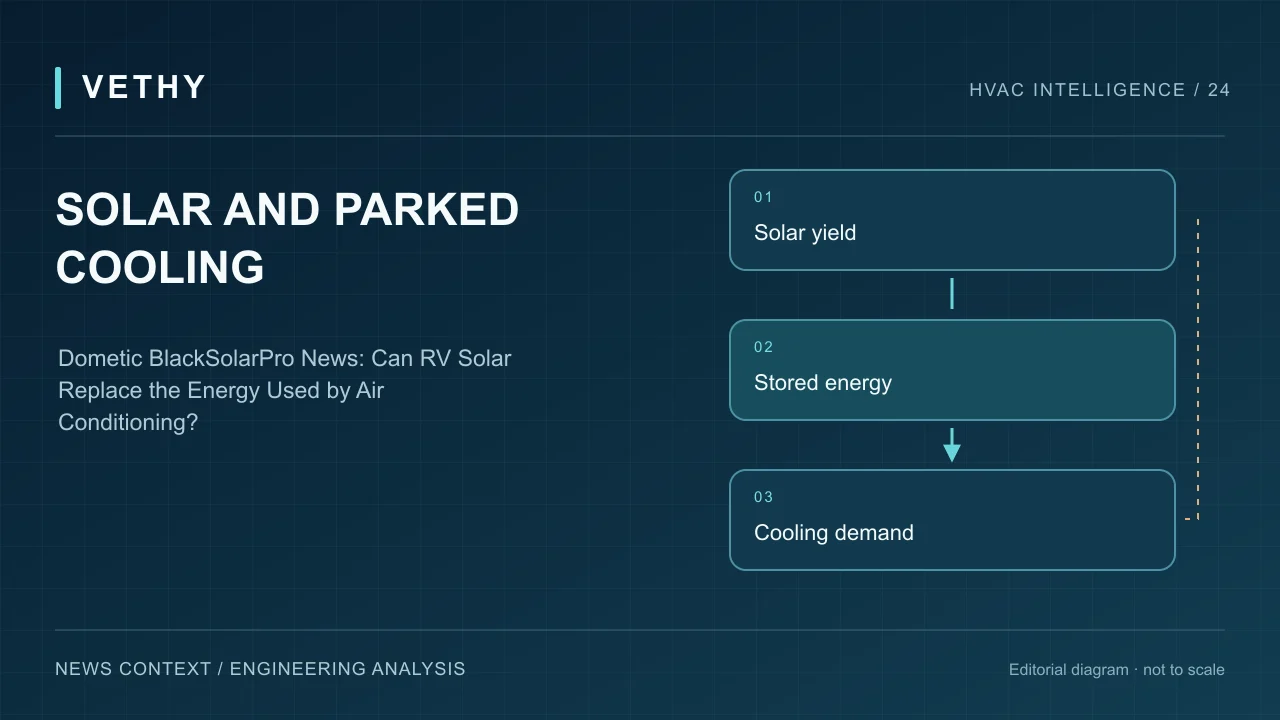
News facts: new RV solar hardware, not a cooling-runtime guarantee
Dometic announced BlackSolarPro on August 29, 2026, describing an RV solar-panel range using back-contact cell technology. The release discussed performance under partial shade and lower-light conditions, listed panel classes from 115 to 240 W and mentioned complete kits with a charge controller. Those statements concern the announced solar equipment. They do not establish how much energy a particular vehicle will collect on a particular day, or how long its air conditioner will run. Read Dometic's original announcement.
For parked-cooling buyers, the central question is energy replacement. If the vehicle uses several kilowatt-hours each day, the charging plan must explain where that energy comes from. Solar can contribute, but its contribution must be evaluated over time rather than inferred from a panel label.
Keep four quantities separate
Solar rated power, actual charging power, stored energy and air-conditioning demand describe different parts of the system. Rated panel watts identify a test-based power category. Actual charging power changes with the installation and conditions. Stored energy is an amount, commonly expressed in watt-hours or kilowatt-hours. Cooling equipment has both an electrical power demand and accumulated energy use over its operating period.
Confusing these quantities produces attractive but unreliable sales claims. A panel rating cannot be compared directly with cooling output, because one concerns electrical generation and the other heat removal. A battery's nominal capacity cannot be assumed to equal energy available to a load. Begin with a diagram showing the direction of energy flow and the units at each point. That often exposes a mistaken comparison before it reaches the quotation.
Ask how much energy arrives during the whole day
Daily solar yield is the accumulation of changing power over time. A strong reading around midday may be encouraging, but it does not represent every daylight hour. Cloud, shading, orientation and the vehicle's actual parking behavior can change the result.
For planning, obtain an estimate appropriate to the destination, season and installed arrangement, then identify its assumptions. If measured data are available from a representative vehicle, record the date and operating conditions. Do not present a single favorable day as a guaranteed daily result. A fleet operating through different regions may need several seasonal scenarios. The correct number for a summer demonstration could be a poor basis for travel in another climate or during a different part of the year.
Use an energy ledger rather than a runtime slogan
Create a daily record with charging on one side and consumption on the other. Include solar, driving-related charging and mains charging separately. On the consumption side, include air conditioning and the other loads that share the same storage system.
| Ledger item | What to record | What not to assume |
|---|---|---|
| Solar contribution | Energy measured or estimated at a defined system point | Every rated watt is available all day |
| Other charging | Source, duration and confirmed delivered energy | A short drive always restores a full battery |
| Air conditioning | Electrical energy for the intended comfort session | Cooling capacity equals electrical input |
| Other loads | Lighting, refrigeration, charging and auxiliary consumption | Small loads have no cumulative effect |
| Reserve | Energy the system must retain for agreed purposes | Nominal battery capacity is fully usable |
The ledger is useful even before exact numbers are known. An explicitly unconfirmed entry is better than a hidden assumption. It tells the buyer what must be measured or clarified before a performance commitment can be made.
A worked day shows why the measurement boundary matters
Assume a hypothetical solar installation delivers 2.2 kWh to a vehicle's usable electrical system over a day. During daylight, other equipment consumes 0.8 kWh and cooling consumes 0.6 kWh. That leaves 0.8 kWh available to increase stored energy, before any additional losses or limits not already included at the chosen measurement point.
If the planned night then requires 2.0 kWh for cooling and 0.3 kWh for other loads, that day's solar contribution alone has not replaced the night's demand. This is an illustrative example, not a prediction for the announced panels or any VETHY unit. It demonstrates why the location of a meter matters. Energy recorded at a panel, controller, battery or load may represent different boundaries. State which value is being used and avoid subtracting losses twice or ignoring them entirely.
Better shade behavior does not make shade irrelevant
A manufacturer may improve how a panel responds when part of it is shaded. That can be useful, but the buyer still needs to understand the actual shading pattern. A small fixed obstruction and a large tree moving with the wind do not produce the same condition. Neighboring vehicles can also change the pattern during a stop.
Ask what the manufacturer's comparison refers to and what test conditions support it. Then keep that claim separate from the vehicle-level energy estimate. Do not convert a relative improvement under one test into an equal percentage increase in every day's yield. For an installed system, a simple observation record of where and when shading occurs can be more useful than repeating an unqualified efficiency headline.
Parking for shade creates a real comfort tradeoff
An owner may seek shade to reduce heat entering the vehicle while also wanting solar panels in strong sunlight. Both goals are understandable, but they may conflict at a particular campsite. The correct decision depends on the resulting cooling demand and generation, not on solar output alone.
A useful evaluation compares complete scenarios. In one, the vehicle receives more sunlight and collects more electrical energy but may require more cooling. In another, it receives less sunlight and generates less energy but may also need less cooling. Measure or estimate both sides rather than declaring one parking strategy universally better. This is an example of a system decision that cannot be settled by selecting a panel with a higher rated wattage.
The charge controller is part of the energy path
Panel selection and charge-controller selection must be reviewed together. The controller has its own supported input, output and operating limits, and the battery system has charging requirements. A kit can simplify procurement, but the complete vehicle configuration still needs to be confirmed.
A qualified electrical designer should establish the compatible arrangement using the exact documentation. This article does not prescribe panel wiring, protection values or controller settings. For a buyer, the practical question is whether the proposal includes a documented charging design or merely a collection of components that appear to have suitable headline ratings. Ask who accepts responsibility for the combination and how its normal and limited states will be communicated to the owner.
Storage capacity and discharge power solve different problems
A battery may contain sufficient energy for a planned session while the associated electrical system cannot support the required instantaneous demand. Alternatively, the system may readily supply the power but contain too little usable energy for the intended duration. Both must be checked.
If the air conditioner uses an inverter, the inverter's requirements and losses enter the design. If the equipment uses DC directly, the exact voltage and supply conditions still matter. Neither architecture removes the need for an approved electrical design. Compare the complete configurations, including protective functions and the permitted operating window. Avoid universal claims that direct DC means negligible losses or that a larger inverter automatically creates more available runtime.
A larger battery can postpone a deficit without fixing it
Suppose an illustrative vehicle consumes 3.0 kWh each day and replenishes only 2.2 kWh. Its stored energy decreases by 0.8 kWh per day. A larger battery may allow more days before the chosen reserve is reached, but the daily imbalance remains.
This arithmetic explains why a system can appear satisfactory during a short demonstration and disappoint later in a trip. The issue may be energy replenishment rather than the air conditioner's ability to cool. A multi-day evaluation should begin and end with a defined state of charge or another suitable energy record. Otherwise, an apparently successful test might simply have consumed energy stored before the test started. Report that contribution honestly when discussing autonomy.
Give weather uncertainty a place in the plan
A practical off-grid plan includes what happens when solar generation is lower than expected. The response might involve another charging opportunity, a shorter cooling session or a revised travel schedule. The appropriate choice depends on the application and cannot be prescribed universally.
The important point is that the response should be planned, understandable and safe. Do not market essential comfort for vulnerable occupants as dependent on an optimistic weather assumption. Where cooling availability is critical, the responsible vehicle designer and operator need a suitable contingency. For ordinary leisure use, the owner should still understand how the system communicates reduced energy and what options remain. A clear limit is more useful than a promise that has no defined response when conditions change.
Specify the cooling session before selecting the solar package
“Run the AC off solar” is too broad to form an acceptance criterion. Does it mean operating during midday while parked, replacing part of the previous night's energy, or supporting an entire trip without another charging source? Those are different objectives.
Define the hours, occupied conditions and comfort target. State whether the vehicle begins the session already cooled and whether other loads remain active. Then ask the supplier to describe the proposed energy contribution under representative conditions. The resulting specification may support a meaningful partial benefit even when full autonomy is unrealistic. Partial contribution is not a failure if it is the agreed objective and is reported accurately.
Look at charging while the air conditioner is running
A controller display can show charging activity while the battery is still losing net energy because loads consume more than the charging source supplies. Owners may reasonably misunderstand this if the interface shows only a positive solar value.
An effective monitoring arrangement should help the user understand the overall balance. The relevant information may include generation, load and battery state, with clear units and time periods. Do not assume that every available app or display reports all of these values at the same system boundary. During handover, explain which numbers describe current power and which describe accumulated energy. That small distinction can prevent repeated complaints based on reading watts as watt-hours or interpreting charging activity as proof of a full recovery.
Use measurements that answer the buying question
A demonstration intended to prove daytime assistance should record the daylight generation and the simultaneous load. A demonstration intended to support overnight cooling should record the energy available at the start, consumption during the session and the reserve remaining at the end. A demonstration intended to support several days should include the recharge periods as well.
Keep the method proportionate to the claim. There is no need to turn every small project into a large laboratory exercise, but the evidence must cover the promised outcome. If only a short functional test has been completed, call it a short functional test. The strongest marketing statement is the one that remains true when the buyer asks how the result was obtained.
Document seasonal and user differences
A configuration that works for two occupants during a mild trip may not serve a larger group during hot weather in the same way. Door opening, cooking, electronics use and preferred temperature can change demand. These variations do not automatically indicate a product defect.
For rental or fleet use, create a small number of supported operating scenarios with clear instructions. Staff can then explain the intended use without promising identical performance for every customer. For private owners, record the use case that informed the purchase. If the travel pattern changes substantially, review the energy plan rather than assuming that a specification developed for the earlier pattern remains sufficient.
Prepare a useful supplier inquiry
Send the vehicle type, destination climate and season, intended cooling hours and existing electrical architecture. Include known usable storage information and other loads, but mark uncertain values clearly. Ask the supplier to distinguish confirmed product ratings from estimated vehicle performance.
For a VETHY parking-cooling inquiry, the technical information guide provides a starting point. Use the current product range to identify the exact model and voltage under discussion, then raise system-interface questions through the engineering route. Solar hardware news does not establish compatibility with a particular air conditioner; that relationship must be reviewed for the proposed system.
Use a simple sensitivity table before committing to autonomy
A single planning estimate can hide how strongly the outcome depends on the weather. A sensitivity table makes that dependence visible without pretending to predict every day. Start with a stated daily demand, then consider several possible charging outcomes using clearly labelled hypothetical values.
| Illustrative daily demand | Illustrative replenishment | Daily balance | What the scenario tells the planner |
|---|---|---|---|
| 2.5 kWh | 3.0 kWh | 0.5 kWh surplus before uncounted limits | Check whether the system can accept and use the surplus |
| 2.5 kWh | 2.5 kWh | Approximately balanced | There is little allowance for worse conditions or higher demand |
| 2.5 kWh | 1.5 kWh | 1.0 kWh deficit | Stored energy or another charging source must cover the difference |
These values are arbitrary examples, not estimates for a particular roof or panel. A real project should replace them with appropriate data and use a consistent measurement boundary. The point is that the same cooling requirement can lead to very different trip outcomes as replenishment changes.
This also helps explain reserve. A nominally balanced plan may still need room for ordinary variation, and a system cannot store an unlimited surplus once its usable storage is full. The designer should evaluate the intended trip rather than averaging away an inconvenient sequence of low-generation days.
A short monitoring plan can improve the next purchase
Owners who already have solar and air conditioning can collect useful observations before buying more hardware. Record the trip location and season, the broad weather conditions, major shading, cooling hours and the energy readings the installed system makes available. Keep the units and measurement point consistent.
The record does not need to include private travel detail or continuous tracking. Its purpose is to identify the limitation. Perhaps cooling demand is lower than expected but recharge is inconsistent. Perhaps the battery begins each evening well charged but other overnight equipment accounts for a substantial share of consumption. Perhaps the display does not provide enough information to distinguish these cases. Each finding points to a different next step.
Avoid drawing a sweeping conclusion from one anomalous reading. If a value seems implausible, confirm what the device measures and whether its time period has reset. A daily total and an instantaneous reading can look similar on a small screen. Better understanding of the existing data may be more valuable than immediately purchasing another component.
Evaluate portability and parked location as operating choices
Some owners consider separate portable generation equipment to obtain sunlight while the vehicle remains shaded. Whether that is practical depends on the supported system, campsite conditions, setup effort and the owner's routine. It should not be treated as a universal solution or connected through improvised arrangements.
The useful design question is whether the proposed charging method will actually be used consistently. Equipment that is inconvenient to deploy may contribute less over a trip than its theoretical potential suggests. A fleet or rental operator also needs to consider how users will understand the setup and keep it within approved conditions. Technical capability and ordinary operating behavior must be assessed together.
State the commercial claim at the right level
There are several honest ways to describe a solar contribution. A package might offset some daytime consumption, reduce the energy that must be replenished elsewhere, or support a specified cooling session under defined conditions. Those are different claims and should not be compressed into a general statement of unlimited off-grid comfort.
A distributor should keep the approved wording connected to the evidence. If the result comes from a planning calculation, say so. If it comes from a vehicle test, state the relevant conditions and configuration. If a new panel has not yet been evaluated on the intended vehicle, describe its verified product features without inventing a whole-vehicle outcome. This produces a clearer offer and gives the customer a fair basis for acceptance.
Ask which result the system can actually verify
Before accepting a monitoring-based claim, confirm that the installed equipment records the relevant value. Some systems expose a useful daily total; others show only current power or a battery estimate. A supplier should distinguish directly measured information from calculated estimates and unavailable data. That distinction makes later comparisons reproducible and prevents an attractive dashboard from being mistaken for evidence it does not contain.
Frequently asked questions
Can I compare panel watts with the air conditioner's cooling watts?
No. They describe different quantities. Panel watts concern electrical generation under stated conditions, while cooling watts describe heat removal. Use the air conditioner's electrical input for power planning and its accumulated electrical consumption for energy planning, with the relevant operating conditions identified.
Does improved partial-shade performance guarantee overnight cooling?
No. It may improve generation under some conditions, but overnight cooling also depends on daytime yield, other consumption, storage and the cooling session itself. A product-level improvement must be translated into a vehicle-level energy assessment before making a runtime commitment.
Is a bigger solar array always the first upgrade?
Not necessarily. First identify the limiting factor. The constraint could involve available roof area, charging limits, storage, high cooling demand or an unsuitable operating schedule. An upgrade is useful when it addresses the actual limitation and remains compatible with the complete installation.
Why can the battery fall while solar charging is visible?
Because connected loads may be drawing more power than the solar system is delivering at that moment. The charging indicator describes one contribution, not necessarily the net balance. Review generation, load and storage information together using consistent units and measurement boundaries.
What should a realistic solar-assisted cooling promise include?
It should state the vehicle configuration, operating period, relevant conditions, other loads and the energy reserve. It should identify whether the result is a measured demonstration or a planning estimate. That gives buyers a usable expectation and a clear basis for checking whether the installed system delivers the agreed benefit.
Sources and editorial scope
- Dometic New BlackSolarPro Delivers More Power Throughout the Day — Dometic Group, 2026-08-29.
Analysis by VETHY, published November 7, 2026. Source news dates are shown separately. Manufacturer claims are attributed; examples and decision frameworks are editorial analysis, not VETHY test results. Mention of another brand does not imply a commercial affiliation or approved compatibility.