
VETHY / VEHICLE HVAC NEWS AND ANALYSIS
DENSO's Moving-Vehicle Defrost Award: How to Evaluate Winter HVAC and Range Claims
Winter HVAC evaluation should distinguish cabin heating, windscreen clearing and external heat-exchanger defrost. DENSO’s invention award highlights the importance of thermal transitions, but a reported range improvement cannot be transferred to another vehicle without comparable evidence. Buyers should examine complete operating sequences, starting conditions, comfort continuity and a clearly defined energy baseline.
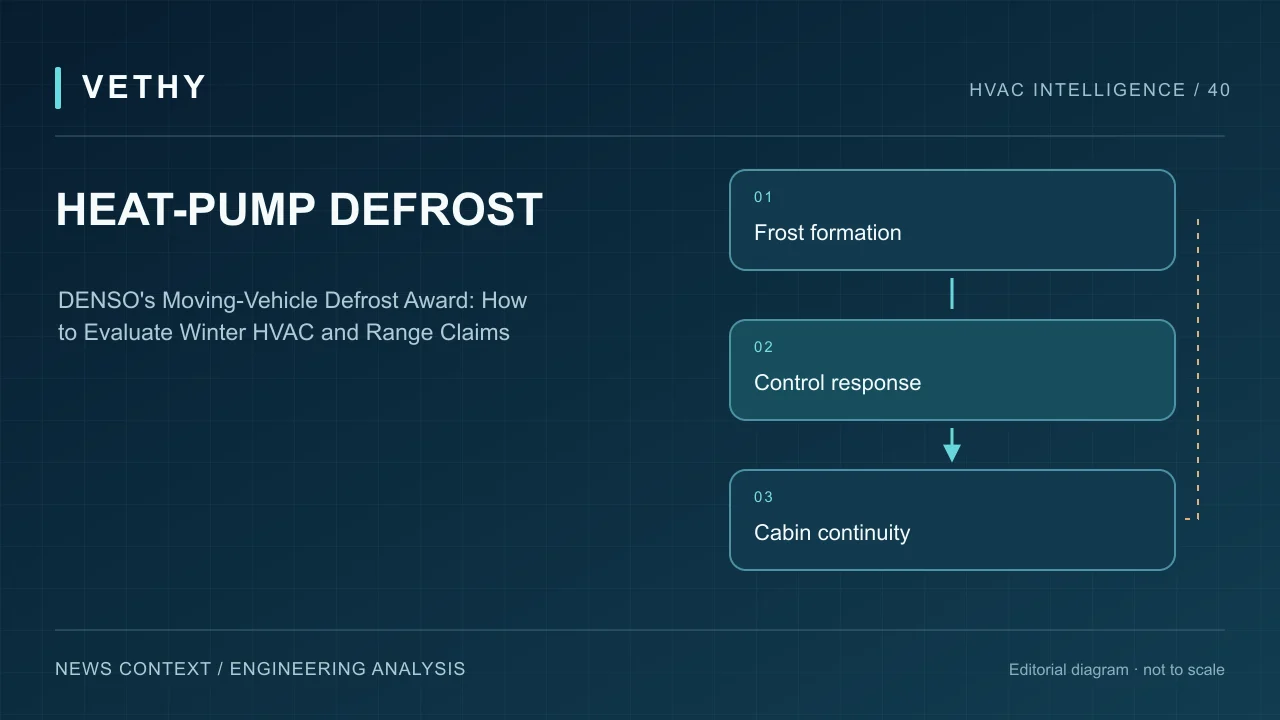
News facts: DENSO receives recognition for EV defrost technology
On June 16, 2026, DENSO announced a Japanese national invention award for a heat-pump thermal-management system that supports defrosting while an electric vehicle is moving. The release describes managing liquid temperatures during changes in flow to reduce thermal shock while using heat from the wider vehicle. DENSO reports an approximately 20% range improvement under frosting conditions; the announcement does not provide enough test detail to apply that percentage to another vehicle, climate or route. The award concerns a specific invention, not a universal winter-range guarantee. Read DENSO's official Japanese announcement.
The following independent analysis examines what that news means for winter HVAC requirements. Its focus is how to evaluate defrost behavior, comfort continuity and energy use without confusing a technical achievement with a ready-made performance claim for an unrelated vehicle.
First distinguish three different winter problems
Winter HVAC discussions often combine cabin heating, windscreen clearing and defrosting of an external heat exchanger. These are related to the vehicle's climate system, but they are not the same task. Each has a different location, measurement and operating objective. A specification that simply asks for “good defrost” can leave the supplier and customer discussing different functions.
Cabin heating concerns the thermal conditions experienced by occupants. Windscreen clearing concerns the required viewing area and the vehicle's applicable visibility requirements. External heat-exchanger defrost concerns the condition of equipment used by the thermal system. Success in one area does not automatically demonstrate success in the others. The project should name each required function explicitly.
This distinction is particularly useful for fleet enquiries. A driver reporting poor heat may be experiencing a temporary change in system operation, an airflow problem or another issue. The workshop needs the context before deciding what to investigate. A precise description helps the team connect the occupant's experience with the relevant vehicle state rather than assuming that every winter complaint has the same cause.
Ambient temperature alone is an incomplete test description
A winter test reported only as an outside temperature leaves out important context. Moisture conditions, the vehicle's starting state, air movement and the operating sequence can affect what the system encounters. The engineering team should determine the conditions relevant to the intended application and document them consistently.
For a heat-pump project, that means asking whether the test addresses the environmental conditions that can produce the behavior under investigation. A cold but dry test and a different cold, damp test are not automatically equivalent. The purpose is not to prescribe one universal chamber setting; it is to avoid treating the lowest temperature as the only meaningful winter challenge.
A useful report states the conditions actually used and the reason they were selected. It also distinguishes a controlled laboratory test from a road observation. Both can be valuable, but they answer different questions. The customer should be able to see whether the evidence represents a repeatable comparison, a realistic operating example or a limited observation requiring further work.
The whole sequence matters more than one successful moment
A system can demonstrate effective heating at one moment and still create an unsatisfactory operating cycle if its performance changes frequently or recovers slowly after interruptions. Winter assessment should therefore examine a complete sequence rather than selecting a favorable temperature reading from the middle of a test.
Define the beginning and end of the sequence. Include the starting cabin and vehicle conditions, the requested comfort setting, the relevant operating mode and the point at which the test is considered complete. If the system changes state during the run, record when that happens and how the occupied-space conditions respond. The resulting timeline is more useful than a single maximum output figure.
For a commercial vehicle, the sequence should reflect its work. A shuttle with frequent stops may need a different evaluation from a vehicle that spends a long period on an uninterrupted route. A special vehicle that waits stationary may present another pattern. These application differences should shape the test plan rather than being added as caveats after a generic result has been advertised.
Comfort continuity is a measurable project requirement
A driver may tolerate a short change in discharge air temperature differently from a prolonged loss of comfort. Passengers may experience another part of the cabin differently from the driver. The project should define what acceptable continuity means at the occupied positions, using criteria appropriate to the vehicle.
Avoid relying only on the temperature at a convenient outlet. That measurement can help explain system behavior, but it does not necessarily describe the whole occupied space. Identify representative locations and record the relevant response through the operating sequence. The aim is to understand what the occupant experiences while the thermal system manages its other duties.
The user interface also matters. If a temporary operating change is expected, the display should not imply a permanent fault. If performance is genuinely restricted, it should not promise that the selected condition has already been achieved. Clear status information can help drivers report meaningful symptoms and can reduce unnecessary adjustments that complicate diagnosis.
| Winter question | Useful observation | Common interpretation to avoid |
|---|---|---|
| Is cabin comfort maintained? | Occupied-position conditions over the complete sequence | One warm outlet reading proves whole-cabin comfort |
| Does the system recover predictably? | Time-aligned operating states and temperature response | Clearing a warning proves full recovery |
| What is the energy cost? | Electrical energy within a stated boundary | A short power reading represents the entire trip |
| Is the comparison fair? | Equivalent starting conditions and delivered service | Different weather or comfort targets are interchangeable |
| Is the result applicable? | Tested vehicle configuration and duty | A manufacturer percentage applies to all vehicles |
Read a range claim through its baseline
A percentage improvement needs a defined reference. It matters whether the comparison concerns another control strategy, a previous vehicle configuration or a specific test condition. It also matters which energy uses are included. Without that information, a percentage can sound more universal than the supporting evidence allows.
For a fleet decision, ask what the vehicle was required to do in both cases. Were the cabin conditions comparable? Was battery conditioning included? Did the route, speed, starting energy and environmental conditions match? The relevant questions depend on the claim, but the principle is consistent: compare equivalent service at a clear boundary.
Do not turn a manufacturer-reported result into a guaranteed range increase for an unrelated product. The appropriate use of the news is to identify a technical direction worth examining and to request application-specific evidence. That preserves the value of the innovation while avoiding a promise that neither the source nor the supplier has established.
Separate thermal energy from route energy
The HVAC system is one contributor to a vehicle's energy use. A route result also reflects driving conditions and other loads. If a buyer wants to understand the effect of a thermal change, the test needs enough information to distinguish that change from unrelated variation.
An illustrative calculation makes the boundary visible. Suppose a hypothetical route uses 40 kWh for all measured vehicle functions, of which 5 kWh is assigned to a defined thermal subsystem. Reducing that subsystem's use by 1 kWh would reduce the stated total from 40 to 39 kWh under otherwise identical assumptions. That is a 20% reduction for the subsystem but a 2.5% reduction for the total. These invented numbers are only an arithmetic example, not a model of any announced technology.
The lesson is to label the denominator. A component improvement, a thermal-system improvement and a vehicle-level improvement are different statements. A clear report identifies which statement its data supports. This helps procurement teams compare evidence without dismissing a useful subsystem improvement or exaggerating its effect on the whole vehicle.
Understand why transitions deserve their own review
A thermal circuit can change operating purpose as the vehicle's needs change. The engineering challenge is not limited to reaching a steady condition; it also includes moving between conditions in a controlled way. The particular design described in the news is one example of attention to that transition problem, but its detailed implementation should not be inferred beyond the published information.
For a new project, ask the system integrator to identify the important transitions and their permitted operating conditions. The review should cover entry, completion, interruption and recovery. If several controllers contribute to the sequence, their responsibilities must be explicit. Otherwise, an apparently simple mode change can depend on assumptions that differ between suppliers.
The buyer should request evidence at the right level. Component information may establish an individual operating limit. System testing may establish coordinated behavior. Vehicle testing may establish the actual comfort and energy outcome. Those layers complement each other; no single diagram or isolated component rating substitutes for the complete application review.
Plan for a delayed or incomplete thermal operation
Real operating sequences do not always proceed exactly as planned. A driver may change a setting, the vehicle may stop, a control request may be withdrawn or available electrical power may change. The system should have defined behavior for those events within its approved design.
The project needs to distinguish a temporary limitation from a condition requiring service. It should also define what information the driver and workshop receive. A generic warning that hides the distinction can make an ordinary operating limitation look like a failed component, while an overly reassuring message can conceal a real problem.
Recovery should be part of acceptance. After the limiting condition ends, does the system resume the requested function as expected? Is another driver action required? Does the vehicle retain useful diagnostic information? The correct answers depend on the design, but the questions should be settled before the fleet encounters the behavior during a working shift.
Use field complaints to improve the laboratory question
A fleet complaint can reveal an operating condition that was not represented well in development. The maintenance team should preserve enough context to help the engineering team reproduce or explain it. Record the approximate environmental conditions, operating duration, vehicle state, selected settings and any displayed messages.
Do not ask the driver to diagnose the refrigerant circuit. Ask for observations the driver can reliably provide. A statement such as “heat reduced after the third stop and returned later” is more useful than an unsupported conclusion that a particular valve has failed. Technical diagnosis belongs with qualified personnel using the equipment's approved information.
When the engineering team investigates, connect the field observation to a specific test question. The result may identify a design issue, an installation difference, an operating misunderstanding or insufficient information. Preserve that distinction in the closeout record. A truthful unresolved status is more useful than assigning a cause simply to close the service ticket.
Choose representative vehicles for a winter pilot
A pilot should represent the configurations and duties that matter to the intended rollout. Choosing only the easiest route or newest vehicle can create a positive demonstration without addressing the actual fleet uncertainty. At the same time, an unusual extreme case should not be presented as representative of every vehicle.
Define the selection logic. Include the vehicle configurations, routes and operating patterns that are expected to influence the thermal result. Record any differences between pilot units and planned production units. This makes it possible to understand which conclusions can be carried forward and which need further review.
Set decision criteria before the pilot begins. The fleet should know which outcomes support expansion, which require a change and which require additional evidence. Otherwise, the pilot can end with a collection of impressions rather than a usable engineering and commercial decision. A small, well-defined trial is more informative than a larger trial with no common acceptance question.
Keep software and calibration in the equipment record
Modern thermal behavior can depend on software and calibration as well as hardware. A replacement component or control update may change the relevant configuration even when the vehicle looks unchanged. The evidence record should identify the versions associated with each test and field observation.
This helps the service team avoid comparing unlike cases. Two vehicles with similar hardware may not have the same control release or settings. If one behaves differently, that difference should be checked before drawing a conclusion about component quality. The purpose is not to blame software by default, but to keep the investigation tied to the actual configuration.
For procurement, ask how approved updates are communicated and applied through the support arrangement. A supplier's development capability becomes commercially useful when the fleet can identify which units need attention and what evidence supports the change. An informal instruction passed through a sales conversation is not a dependable substitute for controlled service information.
What does this mean for electric buses and special vehicles?
The news is relevant as an example of whole-vehicle thermal coordination, but it does not establish that a particular passenger-car invention is directly available for a bus or special vehicle. Those applications have different interiors, operating duties and integration requirements. Their HVAC specification should begin with the actual vehicle and its intended use.
For an electric bus, the engineering discussion may need to consider passenger-space behavior across stops and the relationship with the vehicle's energy-management policy. For a special vehicle, a long stationary duty or unusual occupied area may dominate. These are application questions, not claims that the announced technology has been tested in either scenario.
Use the VETHY applications page to frame a bus requirement and the engineering page to discuss system responsibilities. Provide the operating sequence, environmental targets and available interface information. That is a stronger starting point than asking for a headline range benefit without an agreed vehicle-level baseline.
What does it mean for parking air conditioning?
A summer cooling unit for a conventional truck should not be described as having winter heat-pump functions unless its exact specification supports them. The same caution applies to claims about defrosting, battery conditioning or vehicle range. A news article about an integrated EV system does not add those functions to an unrelated parking air conditioner.
The transferable lesson is to test a complete operating period and define the service delivered. A parking-cooling buyer also needs to know the starting conditions, electrical boundary and occupied-space outcome behind a runtime statement. That discipline improves the quality of a quotation even when the product has no heating mode at all.
For such an enquiry, the parking AC technical information page helps collect the relevant vehicle and power details. Keep cooling requirements separate from a broader electric-vehicle thermal project unless the customer explicitly needs both. Clear scope prevents an attractive industry development from becoming an unsupported product promise.
Build a winter evidence pack that a buyer can review
A useful pack starts with the intended vehicle duty and the questions being evaluated. It then identifies the configuration, test conditions, measured results and limits of the conclusion. Include a clear explanation of any manufacturer-reported claims that have not been independently reproduced for the proposed vehicle.
Make the evidence readable. A procurement team needs enough information to understand whether the required outcome is supported, while the engineering team needs the detail required to assess the method. A concise result summary can point to the underlying report without replacing it. The two levels should agree on configuration and scope.
Finish with the remaining decision, not a generic claim that the technology is advanced. The next step might be an interface review, a targeted test, a pilot installation or acceptance of a validated configuration. A named next step makes the news useful to a real project and keeps uncertainty from being hidden behind technical terminology.
Compare a cold start with a return trip
Two journeys on the same route can begin from very different thermal states. A vehicle that has stood overnight may not represent a vehicle that has just completed another trip. If both are recorded only as the same route at the same outside temperature, the comparison can hide a material difference in the starting conditions.
For an illustrative fleet review, separate the first departure of the day from subsequent departures. Record whether the vehicle was preconditioned, whether external power was available and how long it had been stationary. Do not assume that a favorable return-trip result proves the first-morning requirement. Equally, do not apply the first-morning energy demand to every later journey without evidence.
This distinction can change the operational response. If the main difficulty occurs before the first departure, the useful next step may be to examine the preparation schedule and starting conditions. If it appears after repeated stops, the investigation may need a different operating sequence. The point is to select the next test from the observed pattern rather than repeat the same general winter demonstration.
The final report should state which departures the evidence covers. A fleet planner can then use it to assess the relevant part of the working day and identify where additional margin or investigation is required. This makes the result more useful than one averaged figure that combines unlike journeys and conceals the condition that actually drives the complaint.
Frequently asked questions
Is external heat-exchanger defrost the same as windscreen defrost?
No. They concern different parts of the vehicle and require different acceptance criteria. A project should identify both functions explicitly when they are required. Evidence that one function works does not automatically establish the other, even when they are managed within the same overall HVAC system.
Can the reported range improvement be used in my product brochure?
It should not be presented as a result for an unrelated product. Attribute the source and preserve its stated conditions when discussing the news. A claim about your vehicle or equipment requires evidence for that configuration and a clear definition of the comparison baseline.
Is the coldest test always the most informative winter test?
No single temperature describes every winter operating challenge. The appropriate plan considers the relevant environmental conditions and operating sequence. The engineering team should explain why the selected cases represent the intended application rather than assuming that one extreme temperature answers every question.
What should be reviewed before selecting a winter HVAC architecture?
Review the occupied-space duty, relevant vehicle thermal functions, available energy, control responsibilities and validation plan. Identify the transitions and limitations that matter in service. This provides a practical basis for assessing a technology announcement without assuming that recognition or a headline percentage proves suitability for the finished vehicle.
Sources and editorial scope
- DENSO receives an Invention Award at the 2026 National Commendation for Invention — DENSO, 2026-06-16.
Analysis by VETHY, published November 7, 2026. Source news dates are shown separately. Manufacturer claims are attributed; examples and decision frameworks are editorial analysis, not VETHY test results. Mention of another brand does not imply a commercial affiliation or approved compatibility.