
VETHY / VEHICLE HVAC NEWS AND ANALYSIS
Carrier's Vector HE 17 A2L News: Why a Refrigerant Transition Requires a System Review
A new unit designed for an A2L refrigerant does not authorize conversion of an existing system. Carrier’s Vector HE 17 announcement illustrates why refrigerant choice, engineered responses, installation requirements and service readiness must be reviewed together. Cargo refrigeration and occupied-space HVAC also require separate application evidence rather than assumed interchangeability.
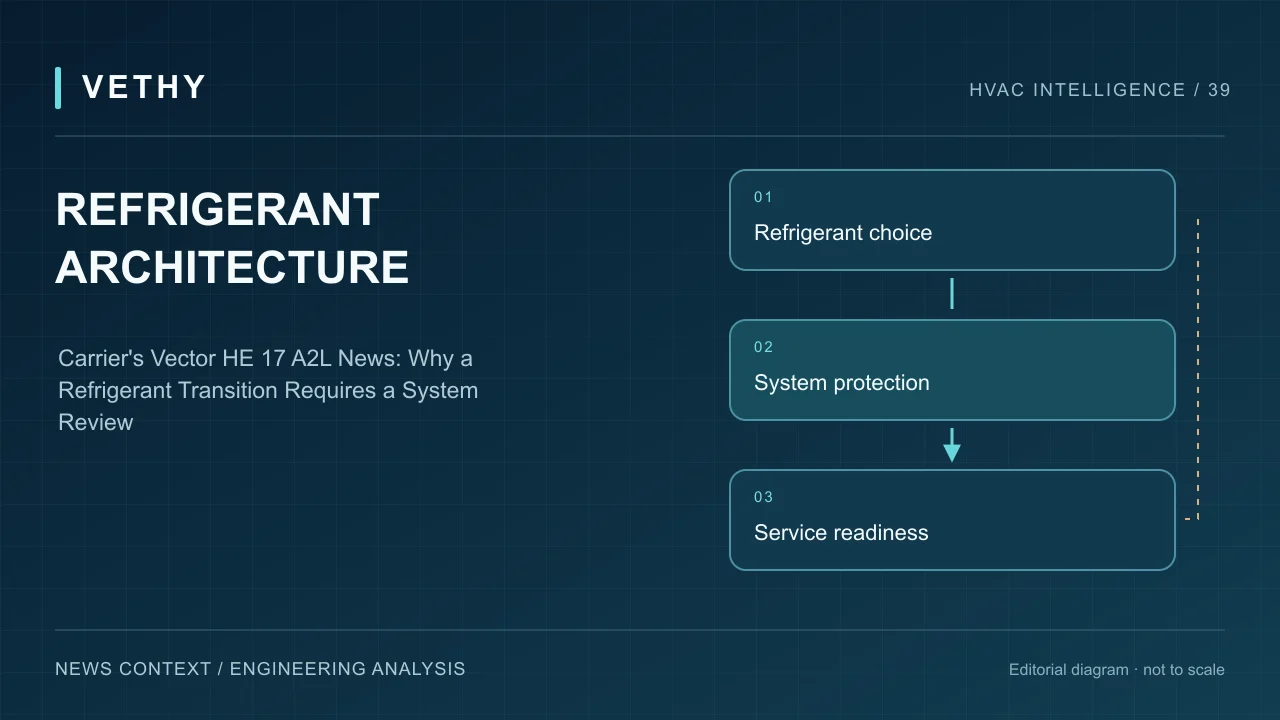
News facts: Carrier extends its A2L approach to another trailer unit
On September 14, 2026, Carrier Transicold announced that its Vector HE 17 would use the company's A2L safety-by-design approach. Carrier identifies R454A as the refrigerant and describes a response that begins with an alarm and forced-air circulation, with refrigerant isolation and movement away from the cargo area available when needed. These are the manufacturer's descriptions of a purpose-engineered refrigerated-transport unit. They are not approval to convert an existing system or to use the same refrigerant in passenger HVAC. Read Carrier's official announcement.
The broader procurement lesson is that a refrigerant transition is a system decision. The independent analysis below explains what a fleet, importer or vehicle integrator should establish before treating a lower-impact refrigerant as an acceptable replacement for its existing equipment.
Start with the equipment boundary
The announcement concerns refrigerated cargo transport. A trailer refrigeration unit, a bus passenger air conditioner and a truck parking air conditioner serve different spaces and operate within different vehicle arrangements. Sharing the general task of moving heat does not make their refrigerants, components or safety concepts interchangeable.
Before discussing a new refrigerant, identify the exact equipment and intended application. Record whether the proposal concerns a newly designed unit, an approved replacement unit or a modification to installed equipment. Those are different projects with different evidence requirements. A supplier's new-product announcement cannot, by itself, establish the acceptability of a conversion to an older system.
The customer should also define who owns the complete system. A component supplier may be able to provide a compressor or valve without being responsible for the final vehicle installation. A refrigeration-unit manufacturer may define an approved installation envelope that the bodybuilder must respect. Understanding those responsibilities prevents a buyer from assuming that each separate purchase adds up to a supported finished system.
A lower environmental metric does not answer every question
A refrigerant's environmental characteristics are important, but they are one part of equipment selection. The customer still needs an appropriate operating envelope, a supported installation, a suitable service arrangement and the evidence required for the intended market. Improving one metric does not automatically establish those other conditions.
Treat the decision as several connected questions. What environmental objective is the operator trying to meet? What performance does the vehicle need to deliver? What design changes are part of the proposed solution? What support will be available throughout its service life? Answering these questions separately makes it easier to understand the tradeoffs without reducing the decision to one headline number.
This also improves communication with customers. A distributor should state the specific equipment and declared characteristics rather than advertising a refrigerant name as a general guarantee of efficiency, safety or compliance. Those broader claims need their own evidence and scope. Clear language helps a technically meaningful improvement remain credible.
Purpose-built equipment and a retrofit are different propositions
A newly designed system can be developed around a chosen refrigerant and its intended operating conditions. A retrofit begins with an existing design whose assumptions may differ. The fact that a refrigerant appears in a new product does not establish that the old product can accept it without further engineering and approval.
For installed equipment, obtain explicit manufacturer guidance before considering a change. The review may need to address components, controls, materials, service processes and the installation environment. This article does not prescribe those changes or provide a conversion procedure. The qualified manufacturer and responsible engineering team must determine what, if anything, is supported for the specific equipment.
From a commercial perspective, a proposal should state clearly whether it is a new-equipment supply or a supported modification. Avoid ambiguous wording such as “upgrade refrigerant” when the actual scope is not defined. The customer needs to know what will be changed, what evidence supports the change and who remains responsible for the resulting system.
Ask how the safety concept becomes a vehicle requirement
A safety concept should connect identified conditions with intended system responses and the evidence used to validate them. A buyer does not need to design the internal control strategy, but does need to understand the responsibilities at the installation boundary. Otherwise, a unit may be installed in a way that conflicts with assumptions behind its design.
Ask the equipment manufacturer which installation conditions are essential to its approved use. These may concern the arrangement of the unit, required interfaces, access or other application-specific factors. Do not infer the requirements from a promotional diagram. Obtain the current installation and service documentation for the exact model and market.
The bodybuilder or integrator should then show how those conditions are satisfied on the vehicle. If an installation departs from the supplied requirements, the departure needs a formal engineering resolution. Treating a deviation as a minor workshop convenience can leave a gap between the product evidence and the finished vehicle configuration.
| Procurement question | Appropriate evidence | What would remain unproven |
|---|---|---|
| Is this the intended refrigerant for the unit? | Exact model documentation and identification | Suitability for a different model |
| Is the installation supported? | Approved installation requirements and vehicle review | A layout inferred from a photograph |
| Are operating responses defined? | Manufacturer's functional and service information | A generic claim that the system is safe |
| Can the fleet support the equipment? | Training, tools, service coverage and parts plan | Availability implied by a launch announcement |
| Is the market requirement addressed? | Applicable evidence reviewed by the responsible specialist | A global compliance claim without scope |
Treat alarms as operating information, not decoration
An alarm is useful only if the people receiving it understand what to do within the approved operating procedure. A vehicle may have a driver, a depot supervisor and a service provider, each seeing different information. The operator should establish who receives the relevant status and how responsibility passes between those people.
The interface should distinguish ordinary operating information from a condition requiring intervention. The wording, priority and persistence of messages should be reviewed with the equipment supplier. Avoid inventing a local workaround that bypasses the intended response simply because an alarm is inconvenient during service. The operator's procedures should follow the approved equipment instructions.
For fleet procurement, request a demonstration of the user and service interfaces under the manufacturer's permitted demonstration conditions. The purpose is to assess clarity, not to create a hazardous event. A short review can reveal whether a warning is understandable to drivers and whether the service team can retrieve the information it needs for a proper investigation.
Service readiness belongs in the purchase decision
A new technology can be technically suitable while the intended operating region lacks a practical support arrangement. Before ordering a fleet quantity, establish who will install, inspect and service the equipment, and what training and resources that work requires. The answer should be specific to the equipment and market rather than based on general refrigeration experience.
Ask the supplier to identify the approved service route and the documentation available to the local provider. Confirm the supply arrangement for the relevant parts and service materials. If support depends on a distant specialist, include the resulting lead time in the operating plan. A purchase decision that ignores service access can underestimate vehicle downtime even when the equipment performs as intended.
The importer also needs an escalation process for uncertain cases. A local technician should know how to obtain authoritative guidance when the observed condition does not match the available documentation. Keeping that route clear is more reliable than encouraging informal modifications based on experience with a different refrigerant or product generation.
Avoid mixed identification across a fleet
During a technology transition, a fleet may operate several equipment generations at once. Similar exterior appearance can make accurate identification especially important. The operator should be able to determine the installed model, approved refrigerant and relevant service documentation without relying on memory or a driver's informal description.
Keep the equipment record tied to the vehicle or trailer identifier. Record replacements and approved changes so that the maintenance system remains aligned with the physical unit. A spare part taken from an earlier stock list should not be assumed suitable because it looks familiar. The current application information must govern the decision.
Clear identification also supports purchasing. If the fleet cannot distinguish its installed generations, it may combine incompatible requirements into a single tender line. Separate the configurations that need different service or supply arrangements. That makes the transition manageable and prevents the new technology from becoming an inventory problem caused by incomplete records.
Compare environmental and operational results separately
An operator may want to reduce environmental impact while preserving temperature performance and availability. Those objectives should be measured separately and then considered together. A claim about refrigerant characteristics is not a direct measurement of total vehicle energy use or lifetime environmental performance.
For an equipment comparison, define the operating task and conditions. Record electrical or fuel consumption at a clear boundary, the delivered temperature outcome and the relevant service conditions. If the products differ in capacity or duty, explain that difference rather than presenting the results as equivalent. A fair comparison needs a common question.
A broader environmental assessment may require additional information beyond a product release. State the scope of any such assessment and the data that remain unavailable. Avoid publishing a precise overall reduction when only one input has been verified. A well-bounded claim is easier for customers to understand and easier to support when they ask for the underlying evidence.
A fleet transition should have defined decision points
Moving to a new equipment generation does not have to mean replacing every unit immediately. An operator can define a sequence that starts with documentation review, moves to a representative installation and then evaluates operational experience against agreed criteria. The size and timing of that sequence should reflect the fleet's actual needs.
Before the first installation, decide what would justify expanding the rollout. Relevant criteria might include meeting the required temperature duty, a workable service arrangement and satisfactory integration with the vehicle. Define how issues will be recorded and who can approve changes. This prevents a trial from becoming a vague demonstration with no clear decision at the end.
Also decide what would pause the rollout. An unresolved installation question or unavailable service support may be a reason to stop expansion while the issue is addressed, even if the unit itself appears to operate well. The purpose of a pilot is to reduce uncertainty about the complete operating arrangement, not merely to collect a positive first impression.
Use a tender to expose responsibilities, not only specifications
A tender can ask suppliers to describe the supported equipment, installation conditions, validation evidence and service plan in a consistent format. This allows the buyer to compare complete offers. A list of capacity, dimensions and price is useful, but it leaves important responsibilities undefined when the technology or service model is changing.
Require bidders to identify exclusions and assumptions. If a supplier expects the customer to provide training facilities, installation work or local service coverage, that should be visible in the offer. If evidence applies only to a particular market or configuration, the scope should be stated. A missing item should remain an open point rather than being silently interpreted as included.
The buyer should then assess those responses with the appropriate technical and commercial specialists. This article does not determine legal approval for a market or vehicle. Its recommendation is procedural: obtain the actual applicable evidence and assign its review to the responsible people before treating a launch announcement as sufficient support for a fleet purchase.
Keep cargo refrigeration and occupied-space HVAC distinct
Cargo temperature control and passenger comfort can share engineering concepts, but their acceptance criteria differ. A refrigerated trailer is evaluated around its cargo duty and associated operating requirements. A passenger compartment adds occupant comfort, airflow distribution and interaction with the vehicle's other functions. A parking air conditioner has its own installed supply and stationary-use requirements.
When a customer asks whether a refrigerant development can be used in another application, begin with that application's specification. Do not transfer a system concept solely because both products are described as refrigeration. The correct question is whether the complete proposed design has been developed and supported for the intended use.
For vehicle cabin projects, the VETHY applications page helps frame the operating context. For a custom assembly, the HVAC modules page provides a route to discuss integration requirements. The Carrier equipment in this article is an independent industry news subject; no supply, approval or technical relationship with VETHY is implied.
Record what the source does and does not establish
A useful news review should preserve the boundary between a manufacturer's announcement and a buyer's application decision. The announcement can establish that a product or approach has been introduced and describe the manufacturer's stated features. It cannot establish the result of an installation that has not been assessed.
For internal procurement use, create a short evidence register. Link each material claim to the relevant manufacturer document, identify the configuration it covers and note any unanswered question. Keep independent observations separate from supplier statements. That makes it possible to use news efficiently without allowing a promotional summary to become the only engineering record.
Update the register as the project develops. A catalogue entry may later be supplemented by installation documentation, an application review or a test result. Each addition should close a particular question. This is a practical way to move from awareness of a technology to a supported purchase while retaining an honest view of what remains uncertain.
Prepare the handover before the first delivery
The delivery package should identify the unit, supplied documentation, installation responsibilities and service contacts appropriate to the customer's support arrangement. Check that the actual delivered configuration matches the ordered one. A good handover avoids relying on a sales presentation that may describe several variants together.
For a mixed fleet, include a clear way to distinguish the new generation in the maintenance system. Review how a driver reports a warning and how the workshop identifies the corresponding service information. These ordinary administrative steps become important when the equipment introduces a different operating or service context.
Finally, agree how updates will reach the operator. Revised service information or an approved configuration change must be connected to the units affected. A fleet does not need every marketing update, but it does need the information that changes how its installed equipment should be operated or supported. Make that communication responsibility part of the purchase arrangement.
Three buying situations need different evidence
A fleet purchasing complete new trailers should focus on the finished operating package. Its supplier should explain the installed equipment, the supported duty, the service route and the records delivered with each unit. The fleet should not have to reconstruct the integration responsibility from unrelated component brochures. Its acceptance process should address the trailer configuration that will actually enter service.
A bodybuilder integrating a refrigeration unit needs more detail at the installation boundary. It must understand which conditions the equipment manufacturer requires and which vehicle-level tasks remain with the bodybuilder. If the intended layout changes during development, the affected assumptions should be reviewed before production. An earlier installation approval should not be treated as automatically covering a materially different arrangement.
An importer supplying replacement equipment needs a precise application and support definition. The commercial offer should identify the supported models and the work required to install the replacement. It should not suggest that a newer refrigerant creates universal compatibility. The importer also needs a way to resolve uncertain identification before dispatching a unit, especially when photographs and informal descriptions are the customer's first source of information.
These situations may involve the same broad technology, but they create different obligations. Separating them prevents a complete-equipment reference from being used as evidence for an unsupported component substitution.
Review transport, storage and documentation as part of supply
The supply plan should include the manufacturer's requirements for the actual delivered equipment, from dispatch through installation. Ask the responsible logistics and technical teams to determine the applicable handling and documentation needs. Do not infer them from the refrigerant name alone or reuse paperwork from a different product without review.
At receipt, verify identification and condition against the order and delivery documents. Preserve the records needed to resolve a discrepancy before installation. A missing document or unclear model label is easier to address while the unit remains traceable to its shipment than after it has been fitted and the packaging discarded.
For an international project, agree who supplies the necessary local-language operating and service information. Translation should preserve technical meaning and the exact model scope. A fluent marketing summary is not a replacement for the approved instructions used by installers and service personnel. Treat documentation readiness as a delivery requirement, alongside the physical equipment, so that the customer receives a usable and supportable package.
Frequently asked questions
Can R454A be added to an existing parking air conditioner?
This announcement provides no basis for doing so. Use only the refrigerant and service procedure explicitly approved for the exact equipment. Any proposed change requires the responsible manufacturer's guidance and qualified engineering review. A new trailer product is not a retrofit authorization for another system.
Does A2L mean that every product uses the same safeguards?
No. A refrigerant classification does not describe a complete product design. Obtain the equipment manufacturer's actual installation, operating and service information. The supported safeguards and application conditions belong to the specific system, not to a generic label applied across unrelated products.
Should a fleet wait until every service provider supports the new technology?
The decision depends on its operating region and support needs. Before deployment, it should have a workable approved service arrangement for the units it buys. A controlled introduction may be appropriate when support is available for a defined route or depot, but that scope must be explicit.
What is the most useful question to ask after reading this news?
Ask which parts of the complete application are already supported and which still need review. Confirm the equipment, installation, operating duty, service route and applicable market evidence. That question turns a refrigerant headline into a concrete engineering and procurement discussion without assuming that different vehicle systems are interchangeable.
Sources and editorial scope
- Carrier Transicold Expands Patented A2L Safety-by-Design Approach to Vector HE 17 — Carrier Transicold, 2026-09-14.
Analysis by VETHY, published November 7, 2026. Source news dates are shown separately. Manufacturer claims are attributed; examples and decision frameworks are editorial analysis, not VETHY test results. Mention of another brand does not imply a commercial affiliation or approved compatibility.